










































Access to HPV Vaccination in Japan: Increasing Social Trust to Regain Vaccine Confidence
Harvard T.H. Chan School of Public Health (Kunitoki, Funato, Mitsunami, Kinoshita, Reich); Harvard Medical School (Kunitoki, Mitsunami)
"Vaccine hesitancy is a growing concern in global public health, and illustrates serious problems arising from loss of social trust."
Japan has among the world's lowest levels of confidence in the human papillomavirus (HPV) vaccine. The hesitancy stems from reports in Japanese mass media that emerged as HPV vaccination started in 2013. Though no one (including the media) had provided reliable scientific evidence of a causal relationship between unconfirmed adverse events and the vaccination, in June 2013, the Vaccine Adverse Reactions Review Committee (VARRC) of the Ministry of Health, Labour and Welfare (MHLW) withdrew its recommendation for the vaccine. This paper considers the Japanese HPV case as an example of how social trust in a public health intervention can be lost and offers recommendations for rebuilding trust in the HPV vaccine in this context and in similar instances.
The researchers use an analytical framework that focuses on four elements that influence access to a health technology, such as vaccines:
- Architecture, which refers to the network of coordinating organisations that enable access to health technologies - Since the VARRC suspended its initial recommendation in 2013, the MHLW has failed to promote the HPV vaccine.
- Availability, which includes specific activities to assure regular supplies to providers and end-users - Problems in the availability of information (leaflets) for adolescent girls occurred after municipalities were required to stop notifying their residents about HPV vaccination in 2013.
- Affordability, which concerns whether technologies can be purchased at a reasonable price - Despite suspending its proactive recommendation of the HPV vaccine in 2013, the government has continued to make the vaccine available in the national routine immunisation programme, so affordability should not be a barrier.
- Adoption, which addresses the acceptance of and demand for a health technology by global agencies, national governments, health providers, and the intended end-users - National adoption, especially by government and politicians, represents a major source of Japan's hesitancy. The lack of a proactive recommendation yet inclusion of the HPV vaccine in the national routine immunisation programme contributes to confusion and hesitancy on the part of healthcare providers and the public. Analysis provided here suggests that reversing the suspension of the recommendation could be the final hurdle to get physicians to provide the HPV vaccine to eligible users. With regard to end-users, repeated reports on adverse vaccine events, rarely accompanied by information about the cancer-preventive effects of the HPV vaccine, put a spotlight on the negative aspects of vaccination. Furthermore, inadequate sex education contributes to insufficient knowledge about cervical cancer, and discussion about these topics is taboo in Japan. Teenagers are the least likely age group to consult doctors in Japan, making it difficult for them to develop trusting relationships and to obtain accurate knowledge and confidential advice.
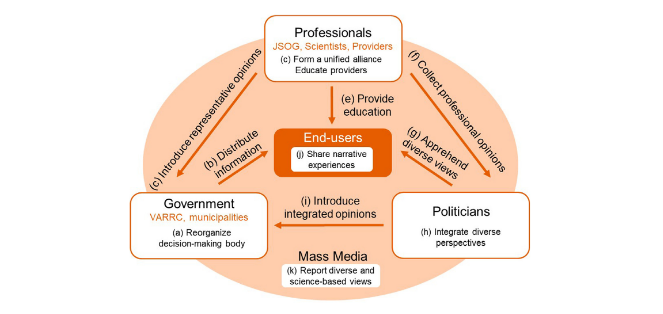
Actions suggested for stakeholders to increase social trust for the HPV vaccine in Japan include, in brief:
- The national government can reorganise the structure of decision-making bodies to incorporate diverse perspectives and expand public deliberation.
- Municipalities can distribute information on the safety and efficacy of the HPV vaccine to eligible end-users. For instance, Okayama prefecture developed its own leaflets and advocacy videos, actively spreading information about HPV vaccination in cooperation with the local professional association of obstetricians and gynaecologists.
- Professionals can form a united alliance to enhance their visibility and power and educate individual healthcare providers about the HPV vaccine. In addition to one-on-one communication, healthcare providers can offer public lectures, school programmes, and information transmission through social media. Medical and public health experts can also engage with mass media outlets to provide the latest HPV vaccine studies and help interpret scientific data.
- Politicians can integrate the various opinions of diverse citizens with evidence provided by scientists to introduce and communicate about evidence-based policy.
- Civil society, such as patient groups and individuals, can share the narrative experiences of cervical cancer survivors and vaccinated girls to bridge a gap between end-users and professionals. Social media can be an integral tool in soliciting and distributing these experiences.
- Mass media can write reports using diverse and science-based information sources to facilitate informed public discussions.
The researchers suggest: "These stakeholders can influence each other, change public perceptions about the vaccine, reinstate the official proactive recommendation, and help resolve Japan's case of HPV vaccine hesitancy. Cooperation among stakeholders will be important to develop better understanding and increase social trust about the HPV vaccine, thereby improving public health for women and for all of Japan."
Vaccine, Volume 39, Issue 41, Pages 6104-10. https://doi.org/10.1016/j.vaccine.2021.08.085
- Log in to post comments