










































Addressing Provider Bias in Contraceptive Service Delivery for Youth and Adolescents: An Evaluation of the Beyond Bias Project
RAND Corporation (Wagner); University of California, Los Angeles (Moucheraud, Wollum, Shah, Dow); University of Houston (Friedman)
"We had the myths that we shouldn't give family planning services to newly married couples and young-age people... But now we give family planning services to 17 years and under age people. Those who are young need family planning services too." - Provider from intervention facility, Pakistan
About half of pregnancies among adolescent women living in the world's developing regions are unintended, and more than half of these end in abortion, often under unsafe conditions. One reason why women around the world who want to avoid pregnancy do not have their contraception needs satisfied is provider bias, such as a belief that young, unmarried people should not be sexually active or that young, married women should prove fertility. The Beyond Bias project (detailed at Related Summaries, below) conducted a randomised controlled trial (RCT) to evaluate its intervention designed to reduce family planning (FP) provider bias toward young and adolescent women aged 15-24 in 233 clinics in Tanzania, Burkina Faso, and Pakistan. This report provides an in-depth look at the study design and methodology, analysis, findings, discussion, and recommendations.
Led by Pathfinder International, in collaboration with Camber Collective, YLabs, and RAND with funding from the Bill & Melinda Gates Foundation, Beyond Bias used human-centred design (HCD), market segmentation, behavioural economics, and social and behaviour change (SBC) principles in creating and testing scalable solutions to address negative attitudes or beliefs that manifest in judgmental, non-empathetic, and/or low-quality provider behaviours. Through this process, the project discovered that, while providers in the 3 countries shared the same drivers of bias, bias manifests differently across settings. The roots of provider bias in Burkina Faso were found to be largely situational and practical, whereas biases in Pakistan stemmed more from social norms and values. In contrast, in Tanzania, provider biases were found to be influenced more by biographical, situational, and cultural factors.
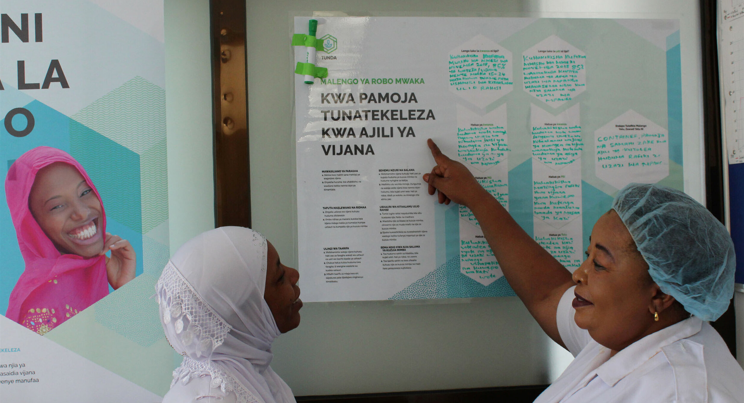
Because tailoring an approach to a particular audience is more likely to lead to behaviour change impact, the intervention varied by country by generally included: (i) "Summit": a one-day, story-driven, in-person event designed to facilitate dialogue and self-reflection on provider bias and providers' own behaviours and create an action plan for shifting these biases; (ii) "Connect": an ongoing interactive peer-support forum for knowledge sharing and learning among providers and programme implementers to apply unbiased practices in their daily work; and (iii) Rewards: a non-financial performance-based incentive for clinics assessed through client feedback and conducted through quarterly awards ceremonies.
The following principles provide a framework for providers seeking to deliver unbiased care to their clients: (i) providing a safe, welcoming space; (ii) engaging in sensitive communication; (iii) seeking understanding and agreement; (iv) saying yes to a safe method; (v) offering simple, comprehensive counseling; and (vi) ensuring security of client information. Each principle corresponds to specific, measurable provider behaviours. Within the Beyond Bias approach, providers are introduced to the Six Principles during the Summit stage. They then work to apply the Six Principles during the Connect phase. Finally, providers' achievements toward adopting the Six Principles are recognised during the Rewards stage.
The intervention took place at 75 public clinics in Tanzania (Dar es Salaam), 80 public clinics in Pakistan (Karachi), and 78 public clinics in Burkina Faso (Ouagadoogu, Banfora, and Bobo). As part of the RCT to evaluate the impact of the intervention:
- Half of clinics in each country were assigned to the intervention arm, and half were assigned to the control arm.
- The researchers collected data from providers and clients to assess the impact on 4 main quantitative outcome domains: (i) providers' biased attitudes and beliefs; (ii) patient-centred FP care; (iii) FP methods dispensed; and (iv) client perceptions of how they were treated by the provider. Methods included client exit surveys, mystery client visits, a provider survey, administrative service delivery data, and cost data.
- A strong qualitative component helped contextualise the quantitative outcomes and included client and provider interviews among a subset of all enrolled facilities (in Burkina Faso and Tanzania, 11 treatment and 4 control facilities; in Pakistan 22 treatment and 8 control providers).
After 12 months, results from provider surveys suggest that providers at intervention clinics had less-biased attitudes and beliefs in all three countries compared to control clinics. For example, providers were significantly less likely to report imposing method restrictions because a client was "too young" (23 percentage point reduction), unmarried (7 percentage point reduction), or did not have children (15 percentage point reduction). Client exit surveys and mystery client visits show that intervention providers in Tanzania and Pakistan also offered more comprehensive counseling, and their youth clients perceived better treatment from providers compared to the control group; effects on these outcomes are mostly small and insignificant in Burkina Faso, but the pooled effects across the three countries are statistically significant.
Despite improvements in counseling and perceived treatment, the RCT found limited evidence of changes in FP method uptake, the types of FP methods received by clients, or the likelihood that clients receive their method of choice; only in Tanzania were improvements in uptake and receiving method of choice found, and effect sizes were small. This lack of change in uptake and method of choice is partly explained by very high rates of these outcomes in the control group, leaving little room for improvement.
The intervention mostly did not change the effect of age, marital status, and parity on FP outcomes: Improvements in counseling and perceived treatment were similar across age and marital status; there was suggestive evidence of differential improvements and reduced disparities in counseling for nulliparous clients, but this finding inconsistent across data sources. The researchers suggest that the lack of reduction in disparities is partly because the effects of age, marital status, and parity were not as large as expected or absent in the control group for most outcomes.
In-depth interviews with providers, clients, and policy and programme stakeholders indicate that there is broad enthusiasm and support for the Beyond Bias intervention and its activities, although there were specific implementation challenges in different countries. For example, in Pakistan, many providers struggled with effectively using Connect, and in Burkina Faso there were structural/systemic barriers to full intervention engagement. Providers in all countries felt that participation in Beyond Bias had changed their knowledge and attitudes toward FP service provision. Many cited examples of their changed behaviour, including more supportive counseling and fewer service refusals, and in some countries, especially Burkina Faso, there were operational modifications to make services more youth-friendly.
Evaluation results in Tanzania were most promising. This is the only country where the RCT saw significant improvements in every outcome domain, and effects were mostly consistent across data sources. Engagement with the intervention was very strong, and it seemed to be well-received per qualitative results: Very few providers interviewed expressed challenges with engaging in the intervention, and it was common for interviewees to share anecdotes that contrasted their prior attitudes and behaviour to their current approach, particularly toward young people.
In all three countries, policy and programme stakeholders were largely enthusiastic about the intervention and encouraging about the prospect of scaling up or introducing it in new countries. The most common concerns were about social/community norms in scale-up areas, and stakeholders suggested needs analyses and community-based sensitisation activities alongside scale-up. In addition, it was common for stakeholders in all countries to reflect on how the government should be involved; integration with ongoing services was seen as essential for scale-up and sustainability, but stakeholders wondered if there was sufficient priority and political will to achieve this. Stakeholders were also optimistic about the impact Beyond Bias has had, but several said they were waiting on these evaluation results before making strong recommendations about continuation or scale-up.
The qualitative analysis also highlighted potential ways for improving the effectiveness of the intervention. Some providers suggested they did not fully understand the Rewards scoring system. Making the scoring system more transparent and linked to specific behaviours could help guide providers' behaviour change strategies to increase their score. Finding ways of keeping providers engaged and carving out time in busy schedules is another area where effectiveness could be enhanced.
In conclusion: "The Beyond Bias intervention was effective at changing provider attitudes and beliefs to be less biased. In Tanzania and Pakistan, this led to improved patient centered care and better client experiences, but not in Burkina Faso. Despite improvements in care, there is limited evidence that this intervention impacted the types of FP methods received among young women who visited the clinic. Future work should test whether coupling this intervention with community outreach efforts can increase modern contraception use for young women who would not otherwise come into the clinic."
Editor's notes:
- Evaluation briefs, in English and French, present a condensed report of the analysis and findings from the Beyond Bias evaluation. Click here in order to download them.
- To launch the report, Pathfinder held a series of webinars called "Tackling Provider Bias in Contraceptive Service Delivery" in 2022. In Part 1 (March 30 2022), speakers focused on the results, findings, and impact of the project. Click on the video below to watch it in English; click here to view the French version.
- Click here for the PowerPoint slides from Part 1 of the webinar series in English (94 pages, PDF).
- Click on the second item under Related Summaries, below, to watch the recording of Part 2 of the series (May 11 2022) in English and/or in French. This webinar provides an overview of the Beyond Bias project approach and intervention, launches the Beyond Bias how-to guide, and shares experiences from the experts who implemented Beyond Bias and helped write the guide.
Posting from Ilayda Oranköy to the IPBnetwork on March 25 2022; and Pathfinder website, June 9 2022. Image credit: YLabs
- Log in to post comments