










































Applying C4D to Curb Maternal Mortality in Cambodia
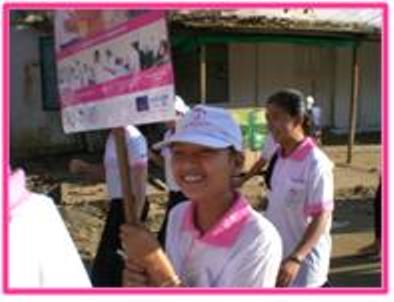
UNICEF Cambodia (Try Tan), UNICEF Pacific (Tomas Jensen)
According to this article from the United Nations Children's Fund (UNICEF) Cambodia: "Between 2005 and 2010 Antenatal Care (ANC) and delivery by skilled birth attendants has increased significantly," demonstrating families' health seeking behaviours and a national focus on curtailing the nation's maternal mortality. UNICEF and The European Commission worked to strengthen the national health promotion capacity using behaviour change communication as one among a set of key strategies to improve the health of women and children in the country by jointly establishing "The Health Behaviour Change Communication (BCC) Project" from 2005 - 2009.
"The implementing partner was Cambodia’s National Center for Health Promotion (NCHP) with 60 staff based in the capital Phnom Penh, supported by Provincial Health Promotion Units (PHPU) in each of the 24 provinces. While nation-wide in scope, the BCC Project was in particular focused on demonstrating good BCC practices in seven of the least developed provinces. Activities were implemented in close collaboration with Provincial Maternal and Child Health Managers and Supervisors." The project focused its first three years on capacity building. Then "to demonstrate its renewed capacity, the Nation Health Congress made an evidence-based decision to priorities promotion of ANC."
NCHP, with technical support from UNICEF, developed a communication strategy using the C4D/COMBI (Communication for Behavioural Impact) planning model. "UNICEF and NCHP hired a professional advertising agency and jointly oversaw the development of...audio-visual and printed campaign materials" focused on mothers, fathers, and other family members. Content was developed through consultations and pre-testing among the communities, families, and health staff. "Simultaneously, NCHP and PHPUs oversaw the training of around 300 health workers from health centres and 4,400 village health volunteers in the seven demonstration provinces, to provide and promote quality ANC services. Many of these where volunteers and mother support groups that UNICEF had also...worked with in the past to promote exclusive breastfeeding."
The campaign was launched in 2009 with radio and TV spots, mobile phone ring tones, posters, banners, and leaflets promoting early ANC visits for pregnant women. "The 12 month communication objective was to increase the percentage of women seeking ANC within the first 8 weeks of pregnancy from 5 per cent to 25 per cent in the seven demonstration provinces. In turn this would enable them to receive a set of ANC services including confirmation of the pregnancy and related medical check-ups, vaccination against tetanus, iron-folate tablets, and education on birth planning and proper health and nutrition during pregnancy. An external evaluation of the BCC project and the ANC campaign in 2011 documented that the communication objective was met well beyond expectations: Already within the first 12 month of the ANC campaign, 36 percent of potentially pregnant women came in for their first ANC visit within the first 8 weeks of pregnancy...Key to the success of the campaign was the use of both mass media and interpersonal communicators which added credibility to the campaign and enabled genuine community engagement on the importance of ANC. Other key enabling factors were provision of financial incentives for midwifes for delivering a live birth as well as improved road infrastructure."
"The Cambodia Demographic and Health Survey (CDHS) in 2010 registered and documented the related and overall improved maternal health indicators. Since 2005, ANC coverage increased from 69 to 89 per cent, delivery by skilled birth attendants increased from 44 to 71 per cent and delivery in health facilities increased from 22 to 53 per cent. Furthermore, the proportion of women delivering with the support of traditional birth attendants at home decreased from 55 per cent in 2005 to 28 per cent in 2010. The ANC campaign has now been expanded to intensively provide and promote ANC in 16 out of the 24 provinces in Cambodia."
To access this document, see the contact details below.
Email from Try Tan to The Communication Initiative on October 8 2012. Image reprinted and article summarised with the permission of UNICEF: Applying C4D to Curb Maternal Mortality in Cambodia, Try Tan, C4D Specialist, UNICEF Cambodia, and Tomas Jensen, Communication Specialist, UNICEF Pacific (Health Education Specialist, UNICEF Cambodia from 2005-2009) - in collaboration with Denise Shepherd-Johnson, Chief of Communication, UNICEF Cambodia; Penelope Campbell, Chief, Health & Nutrition, UNICEF Cambodia; Malalay Ahmadzai, MCH Specialist, UNICEF Cambodia; Vanny Ung, Health Education Officer, UNICEF Cambodia; Viorica Berdaga, Chief, Health & Nutrition, UNICEF Lao PDR (Chief of Health & Nutrition, UNICEF Cambodia from 2008-2012); and Everold Hosein, Founder of COMBI.
- Log in to post comments