










































Art in Global Health
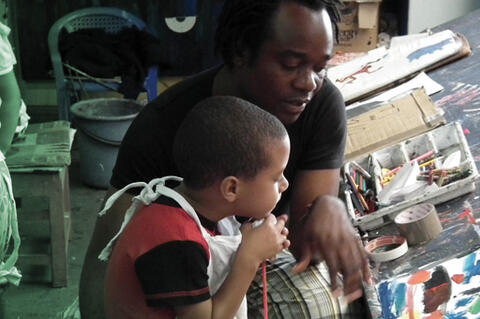
"'Global health' is a phrase we hear more and more frequently. As it attracts more attention it attracts more investment and more research. But what does it mean? Can health really be 'global'? To the extent that some diseases are tied to geography, no. But the challenges facing researchers, doctors, families, politicians and individuals who deal with disease often have a great deal in common, wherever they are in the world."
With these questions in mind, this initiative has set up 6 artist residencies in 6 Wellcome Trust-funded research centres on 3 continents as a way of teasing out some of the personal, philosophical, cultural, and political dimensions of health research and communicating them to the public through exhibitions and the internet.
Participating artists are asked to: find out about the research being undertaken, interact with (and question) scientists and team members from other disciplines (anthropologists, ethicists, economists, educators, and so on), and produce work in response to the processes of research and discovery they have observed. Outcomes of the residencies - exhibitions, performances and supporting events - will begin in the last quarter of 2012 and continue into early 2013. Each investigative journey and its outcomes are being documented online in an effort to help illuminate the scientific processes and the web of relationships upon which those processes depend.
The locations and their corresponding artists include:
- Kenya: the KEMRI-Wellcome Trust Research Programme, which works to tackle malaria and other infectious diseases, particularly bacterial and viral childhood infections. Artist information: Miriam Syowia Kyambi and James Muriuki are collaborating on investigating how health researchers and the involved community depend on and perceive one another. The outcomes of their residency will include an exhibition, curated by Sam Hopkins. Click here to learn more about Miriam Syowia Kyambi and James Muriuki's residency in Kenya.
- Malawi: the Malawi-Liverpool-Wellcome Trust Clinical Research Programme carries out health research on diseases such as pneumonia, tuberculosis (TB), HIV/AIDS, and malaria, and trains clinical and laboratory scientists from Malawi and abroad. Artist information: Elson Kambalu is "increasingly drawn to conceptual and participatory work". While in residence, Elson is exploring the gaps between traditional and modern medicine that influence health research. The outcomes of his residency will include exhibitions and performances in Blantyre, Lilongwe, and one rural location. His residency blog may be accessed here.
- South Africa: the Africa Centre for Health and Population Studies at the University of KwaZulu-Natal carries out research on population and health issues affecting a rural population with one of the highest burdens of HIV in the world. Artist information: Photographer Zwelethu Mthethwa is exploring the part that communities play in contributing to health research. The outcomes of his residency may include an exhibition in the Umkhanyakude district of KwaZulu-Natal.
- Thailand and Laos: the Wellcome Trust-Mahidol University-Oxford Tropical Medicine Research Programme addresses Asia's healthcare challenges ranging from endemic diseases such as malaria and melioidosis to the dangers of counterfeit drugs and the threat of pandemic flu. Artist information: B-Floor Theatre is a Thai physical theatre company that creates "highly visual theatre combining movement and multimedia elements" in an effort to stimulate social and political awareness. Their plays often involve little or no script, focusing instead on exploring and incorporating the expressive abilities of the human body and other elements of theatre creation - objects, lights, sound, puppets, and film - to create the play's narrative. While in residence, B-Floor will be exploring research into malaria and lesser-known tropical diseases. The outcomes of their residency will include a series of performances at the Pridi Banomyong Institute in Bangkok in collaboration with Wandering Moon Theatre. Click here to view images and read first impressions of the residency in Bangkok.
- United Kingdom (UK): the Wellcome Trust Sanger Institute focuses on understanding the role of genetics in health and disease. Artist information: Katie Paterson's "conceptual projects...stage intimate, poetic and philosophical engagements between people and their natural environment. While in residence, she will be exploring genomics research. The outcomes of her residency will include an exhibition at Kettle's Yard in Cambridge."
- Vietnam: the Vietnam Research Programme, which is home to the Oxford University Clinical Research Unit, researches infectious diseases such as dengue, influenza, typhoid, and TB. Artist information: While in residence, Lena Bui will be collecting stories, portraying them through mixed media, as she explores zoonosis research and the relationship between animals and people. The outcomes of her residency will include an exhibition at Ho Chi Minh City Fine Arts Museum in partnership with Sàn Art.
Health.
According to Wellcome Trust: "Whether the challenge is investigating genetic susceptibility to malaria, designing diagnostics for dengue fever or sequencing the human genome, all research teams have trained personnel working with agreed protocols and standard equipment to generate data that will be analysed using recognised statistical methods. However, who gets recruited to studies, why they agree to take part, what some politicians do with the results and how a drug gets marketed are all things that can vary enormously from place to place and that can lead to the enthusiastic adoption of dubious solutions or bury lab successes under a mountain of bureaucratic indifference. The social relevance of scientific research is shaped by its cultural context."
Emails from Tamara Chipasula and Danielle Olsen to The Communication Initiative on September 6 2012 and October 25, respectively; and Wellcome Collection website, September 25 2012.
- Log in to post comments