










































Assessment of Family Planning Use in Bauchi and Sokoto States, Nigeria
Health Communication Capacity Collaborative (HC3)
"The focus of this report is to understand the family planning [FP] context in Northern Nigeria through a literature review. It will also assess changes in modern contraceptive use in Bauchi and Sokoto States between 2009 and 2014 using household survey and facility-level data, and contextualize the quantitative findings with a qualitative study."
This study follows a period in which a Nigeria-based effort, begun in 2009, through the United States Agency of International Development Focus States Strategy, invested in governance, basic education, and health of women and children. The purpose of the research, a literature review and assessment, is to understand the family planning context in Northern Nigeria and "assess changes in modern contraceptive use in Bauchi and Sokoto States between 2009 and 2014 using household survey and facility-level data, and contextualize the quantitative findings with a qualitative study."
The research found low contraceptive use, a high value placed upon large family size, both high levels of knowledge and high levels of misconception of contraceptive use, gender dynamics and fears around contraceptive use, and difficulty in obtaining accurate survey information.
Major findings from the literature review included:
- "Community-based distribution of injectable contraceptives was feasible.
- Family planning providers with more training had more accurate knowledge and positive attitudes about modern contraception than those with less training.
- Limited hours of operation as well as limited stock of contraceptives prevented Northern Nigerians from accessing contraceptives."
Quantitative comparisons - facility-level data, household survey data, and projected population increase data - raised questions on the quality of available data. Similarly, in qualitative data collection, "daily activities were well-recorded by facility staff, however these daily activities were not often reconciled with the commodity records." However, providers and clients of FP all reported increases in acceptance and use of FP. "[T]he number of service delivery facilities, trainings, renovations and communication with potential clients" increased, changes identified as occurring after the arrival of the Targeted States High Impact Project (TSHIP). "Despite the increasing use of family planning, use was still low and seen as a private matter. Whether or not a woman would respond to an interviewer asking questions about her family planning use depended on a variety of factors - types of questions, location of the interview, gender of the interviewer and awareness of the woman’s use by others."
The conclusions section of the report emphasises the need for demand-driven contraception. Factors to be considered in approaching increasing demand include:
- Fear as a critical barrier - "some based on actual side effects and others on misconceptions about contraceptive side effects."
- FP providers with training noted that they could provide more accurate knowledge about more methods.
- Routine supervision of providers increased the quality of service provision.
- Shifting to community-based distribution of longer-acting methods and provision of services by female providers were preferences, though finding women with sufficient educational attainment to receive provider training was a challenge.
- Service challenges include limited hours of operation, frequent transfers of personnel, and stock-outs.
- Training of local survey assistants who speak the local dialect and their introduction by a community leader made a difference to data quality. Women were shy about responding to study questions: "Their response would depend on a number of factors: the gender of the interviewer, the location of the interview, the nature of the questions and the awareness of their contraceptive, use among others." Researchers found that there was clandestine use that women were hesitant to report.
- The inclusion of FP with broader maternal and child health efforts is more welcomed in the communities. "Through this more-welcome focus, they were able to attract positive attention to modern contraceptive use. In particular, the project was able to successfully focus on child spacing, as opposed to child limiting, which was more welcome in this context."
- "The demand side activities could build upon the provider training and the current networking already occurring among current users with their friends. Areas in need of more creative approaches will be incorporating men, and other family members typically resistant, into the family planning dialogue."
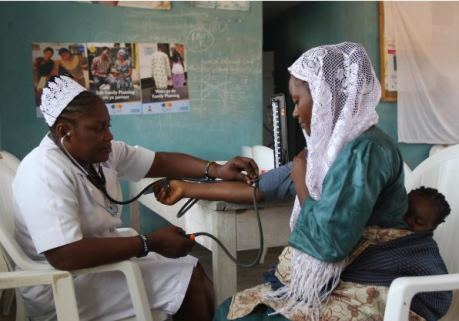
The HC3 website, September 2 2015. Image credit: © 2012 Akintunde Akinleye/NURHI, Courtesy of Photoshare
- Log in to post comments