










































Ato Haileleul Seyoum, Government of Ethiopia, and Dr. Annabel Erulkar, Population Council Ethiopia - DFID Girl Summit 2014
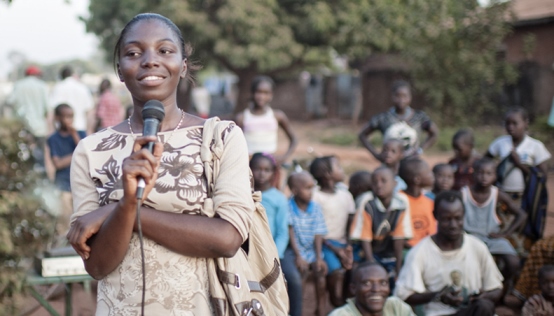
Panel Discussion: Spotlight on Progress - "Reaching Millions, Not Hundreds: Experiences in Scaling Up Community Social Change"
Context: This presentation is from one of the 14 "Spotlights on Progress" video-recorded sessions from the Girl Summit 2014, London, United Kingdom (UK). The sessions were organised to share best practice between practitioners, grassroots activists, and government ministers across the issues of female genital mutilation (FGM) (also FGM/C - female genital mutilation/cutting) and child, early, and forced marriage (CEFM). Girl Summit is a project of the Department for International Development (DFID), UK.
Profile of speakers: The featured panelists of this Spotlight session were Ato Haileleul Seyoum, Director of Women and Youth Mobilization and Participation Enhancement, Ministry of Women, Children and Youth Affairs, Government of Ethiopia, and Dr. Annabel Erulkar Director, Population Council Ethiopia, whose presentation was entitled "Berhane Hewan & Finote Hiwot - pathway to life comprehensive approach for bringing and sustaining social norms change ". (See related summaries below for more on Berhane Hewan.)
Ato Hailelul Siyoum holds Bachelors' degree in Sociology and Social Administration, as well as an LLB from Addis Ababa University (Ethiopia). "Ato Haileul has accumulated professional experience in serving the Ethiopian government at different levels, with an outstanding partnership skills working with donors, civil society and UN agencies in issues of child welfare, youth development, women’s empowerment and family integration. He has also led the development of women and youth capacity building oriented Programs and projects as well as design of a various national strategies and manuals including the National Strategy on the Prevention and Elimination of Harmful Traditional Practices."
Dr. Annabel Erulkar is a social scientist with expertise in developing and managing research and programmes related to adolescents, HIV and AIDS, reproductive health, and gender in sub-Saharan Africa. "She oversees the Council’s office in Ethiopia and its projects, including those related to married adolescents, domestic workers, and male involvement. She was the principal investigator for the Berhane Hewan program, named best UNFPA “good practice” for adolescents and youth."
Strategy overview: Dr. Erulkar presented work resulting from the Berhane Hewan programme and its follow-up, Finote Hiwot. She explained that, 15 years ago, Berhane Hewan (Light for Eve) was started in the Amhara region, with the dual objectives of delaying the age of marriage of those at risk of CEFM and supporting those girls already married. It was a partnership of: the Ministry of Women, Children and Youth Affairs, both the national ministry and the regional bureau; the UNFPA (United National Population Fund); and the Population Council. The programme was based upon formative research and consultations with the government and community leaders. The four components designed to address the drivers of CEFM include: community conversations to address social norms; school materials provided to address the economic barriers to schooling and take advantage of the protective effect of schooling; cash transfers in the form of a goat to families who kept their daughters in school for the 2-year duration of the agreement; and mentoring groups, mainly for married girls.
The programme had a quasi-experimental research design: population-based surveys were done before and after 2 years of implementation. Results showed that girls, aged 10-14, were one-tenth as likely to be married and three times more likely to be in school, compared to girls in the control site. Among married girls, they were three times more likely to be using family planning.
The research showed that a programme of a short duration could be effective in delaying the age of marriage, but it was not possible to find which elements were most effective, leading to concerns about complexity, scalability, and cost. The second phase tested the programme’s components separately in areas where CEFM was prevalent: the Amhara region of Ethiopia, Tanzania, and Burkina Faso. The second phase also uses testing at the population level using population-base surveys. Additionally, the second phase is tracking costs of the intervention.
Ato Hailelul Siyoum spoke about the Ministry's pilot programme on CEFM started in 2010, a five-year programme designed to delay marriages of girls in the Amhara region of Ethiopia. It is a development partnership and community-owned programme. It is focused on sustainability, capacity building, and community empowerment, utilising existing structures: ministry, community, station workers, and women development arms - 406,000, consisting of 10 million women, a third of women in the Amhara region. Components are: a community-level and school-based component; a strategic engagement and communication component; a capacity building for government institutions component; and an evidence-based and knowledge sharing component, all with the objective of the well-being of girls and the empowerment of girls, using synergised and harmonised multi-level social transformation. Coordination mechanisms are non-governmental organisations (NGOs) and government organisations working through the National Alliance to end child marriage and the FGM/C Network, now officially merged and named National Alliance to end child marriage and FGM/C, as well as local-level councils. The programme has contributed the national-level legal framework. Progress has been made on making ending CEFM and FGM part of local community agendas rather than a top-down government mandate, through government-community partnership, reducing child marriage below the age of 15 from 33% to 8%. Religious institutions have been instrumental in encouraging the abandonment of CEFM; and school-based interventions have increased longer school attendance. Providing school materials has contributed a social component that increases attendance. The greatest problems have been encountered in delivering all the components at scale.
Overview of this Summit session: From the Girl Summit summary document: "We know community-led social change is an effective, long-term strategy to promote abandonment of FGM and child, early and forced marriage. Reaching millions of people will be a key element of success in the global movement to end the practices and change the futures of as many girls. Yet the intensity, cost and technique of community-led social change present important challenges. Experiences in taking what worked with hundreds in one setting and scaling it up to entire districts and nations will be presented in this interactive spotlight...."
The speakers, in order of appearance, are:
Sonali Khan, Vice President, Breakthrough.
Adama Ndiaye, Secretary-General of the Ministry of the Family, Women and Children, Government of Senegal.
Dr. Ben Cislaghi, Director of Monitoring, Evaluation, Research and Learning, Tostan.
Ato Haileleul Seyoum, Director of Women and Youth Mobilization and Participation Enhancement, Ministry of Women, Children and Youth Affairs, Government of Ethiopia, and Dr Annabel Erulkar, Director, Population Council Ethiopia.
Hekate Papadaki, Grants and Development Manager, Rosa Fund.
The session is moderated by Rajesh Mirchandani World Affairs Correspondent/Anchor at BBC News."
Strategy points from the session outline include:
- "Scale Matters. - given how widespread these practices are and the numbers involved.
- Girls should be at the heart of any approach. Girls can’t and don’t register complaints after the act. Action must come first to enable girls to have a view - to be able to able to say no and for example resist early marriage for example. Girls clubs and other mechanisms can support this process.
- How girls are valued matter (especially for child marriage) - dowry issues and how girls are seen matters. Push is to get families to invest in education of girls.
- Discourse matters. - Issue is to shift the discourse on these issues and how they are talked about. Communities’ deliberations and discussions are crucial. These deliberations change communities’ views.
- Approaches can transform.- Rights based approaches on these issues can challenge the vision that communities have of gender issues and rights more widely.
- How communities function matters. - However, when community spaces and debate is restricted and excluded it needs to be opened up before change takes place. Women must join the public space to become actors.
- National leadership and political will matters. - governments changing laws and clear messaging has an impact without it things are harder.
- Service providers play a role. - health providers (esp. Reproductive health) child workers, education systems etc. all have a role and should be included in any approach. These actors need a shared vision and ambition.
- Religious leaders are important. - In the past child marriage was given support by the church. This must change.
- Linkages matter. - Strong link between domestic violence, wider gender relations and CEFM.
- Communications are important - A clear communications strategy using media and other channels are important for scale. National schemes under which communities make public pledges have a role. They can tie in large groups of people.
- Many interventions are driven by limited evidence. - Research and randomized trials are on-going and will give us more information on what works and how. However, these sort of programmes that involve community engagement need to be flexible and learn from the process of implementation using trial and error."
Footage of this (available below) and other "Spotlights" are available on DFID’s YouTube channel.
The Girl Summit is a project of DFID. Click here and scroll down to see the full list of individuals and organisations committed to working on girls' issues, as well as a list of Girl Summit Charter signatories.
DFID Girls Summit Outcomes website and the Population Council website, both accessed on August 13 2015. Image credit: Population Council
- Log in to post comments