










































Bargaining and Gendered Authority: A Framework to Understand Household Decision-making about Childhood Vaccines in the Philippines
Heidelberg University Hospital (Wachinger, Reñosa, McMahon); Department of Health, Muntinlupa City, Philippines (Reñosa, Endoma, Aligato, Landicho-Guevarra, Landicho, Bravo); Johns Hopkins University Bloomberg School of Public Health (McMahon)
"Targeted vaccination promotion efforts aimed at building vaccine confidence require an in-depth understanding of how and by whom decisions about vaccinating children are made."
Evidence suggests that within households, different roles, rooted in religious, cultural and gendered norms, influence who has a say in deciding whether a child is vaccinated. Intra-household bargaining involves several actors who have varying capabilities and vulnerabilities across several interrelated dimensions of bargaining power - within and beyond gender. This qualitative study of the power dynamics underpinning intra-household bargaining for childhood vaccination is part of a larger project to co-develop vaccine promotive messaging and interventions in the Philippines. A highly publicised vaccine scare in 2017 and its fallout, coupled with vocal debates of the topic, provides context for this study into how conflicting interests, experiences, and convictions inform vaccination decision-making within households.
Between August 2020 and March 2021, the researchers conducted 44 in-depth interviews with caregivers of children under five in the Philippines who had delayed or refused vaccination.
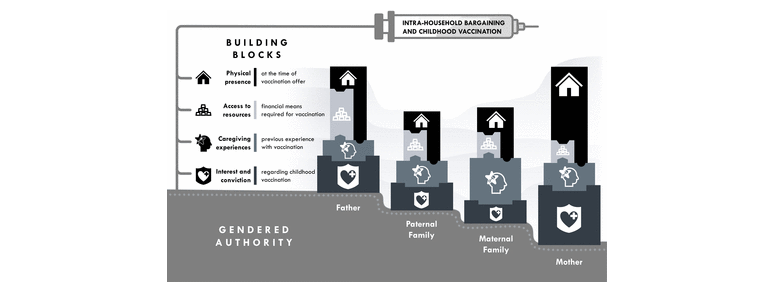
The interviews revealed that gendered authority and power formed an unequal basis on which bargaining around childhood vaccination took place among household members such as fathers and mothers, but also maternal and paternal extended families (with grandparents being the most influential actors in the bargaining process besides the child's parents). Fathers were, almost universally, the clear figure of authority in households, and paternal grandparents often had considerably more influence on the father than maternal grandparents. Mothers reported they were afraid to be held accountable for any negative consequences if they decided to go against their partner's vaccination decision.
Although bargaining among parents, as well as paternal and maternal families, was based on engrained, gender-based power imbalances, disadvantaged stakeholders could draw on a range of interrelated sources of bargaining power to nevertheless shape decision-making. Sources of bargaining power included, in descending order of their relevance for vaccination: (i) physical presence at the household (at the time of vaccination decision-making), (ii) interest in the topic of vaccination and conviction of one's own position, (iii) previous vaccination and caregiving experience, and (iv) access to household resources (including finances). The degree to which each household member could draw on these sources of bargaining power varied considerably over time and across households. (See figure above.) The degree to which household members who lacked high levels of gendered authority, especially mothers, could draw on combinations of sources of power to mold the decision-making process could vary considerably over the course of their life. Case study 1 in the paper highlights how changing circumstances within a mother's life influenced the power she exerted in intrahousehold vaccination decision-making.
In discussing the findings, which largely cohere with previous scholarship, the researchers note that one additional factor that has been highlighted as potentially influencing gendered power dynamics is (formal) education. While not emerging as a core determinant of gendered power from the present study, in the context of the framework presented here, education specifically about the relevance of vaccines could influence the degree to which individuals care about the topic (although invoking such care might not automatically suffice to convince other household members).
Furthermore, the emergence of potential sources of bargaining power that interact with (and are co-dependent on) each other links to ongoing intersectionality discourses. Intersectionality highlights how inequalities associated with individual social stratifiers (e.g., gender, class, age) interact dynamically. While the findings "shed light on how emerging sources of bargaining power were not merely additive but influenced each other, further research specifically focused on exploring intersectional facets of childhood vaccination bargaining would facilitate further framework refinement." The researchers also suggest further investigation into how particular facets of the Filipino setting, including household characteristics and the role of recent public vaccination discourses (e.g., sparked by the 2017 Dengvaxia controversy), influence vaccination bargaining as compared to other contexts.
Given the gendered dynamics of decision-making, the researchers encourage the following:
- Reach out to not only mothers in vaccination campaigns but also other household members who have more gendered power in the respective setting.
- Leverage the high relevance of physical presence in bargaining by timing accessible vaccination offers accordingly, especially in cases where authoritative household members oppose vaccination.
- Inspire confidence in the caregiving experience among household members favouring vaccination, and invoke interest and conviction about the topic - for example, via nudging interventions - among household members with considerable bargaining power.
- Ensure that financial costs of accessing vaccination (including fees, transportation, loss of income, etc.) remain low, considering the study's finding that mothers' relative bargaining power decreases as costs for vaccination uptake increase.
In conclusion, considering the risks for public health associated with vaccine hesitancy globally, the researchers "advocate for acknowledging intra-household dynamics in research and practice, such as by purposefully targeting household members with decision-making capacity in vaccination promotion efforts, aligning promotion efforts with available bargaining capacity or further empowering those convinced of vaccination."
BMJ Global Health 2022;7:e009781. doi:10.1136/bmjgh-2022-009781.