










































C4D Ebola Surge Mission: Community Level Learnings from Sierra Leone
United Nations Children's Fund (UNICEF)
This presentation summarises the experience of a communication for development (C4D) specialist who traveled to Sierra Leone (SL) on an Ebola virus disease (EVD) surge mission to support social and behaviour change communication (SBCC) for the Ebola emergency response. (SL was the last to contain the spread of EVD in West Africa). This mission was launched in the context of 12,795 cases affecting all 12 districts between May 23 2014 and May 29 2015, which led to 3,911 deaths. The highly contagious disease led to a panic, with social, cultural, and economic activities stopped for several months, according to Nasir Ateeq.
With support from the British and the Sierra Leonean Army, the Level 3 EVD emergency response in SL was operationalised through 7 pillars: media and communication; social mobilisation (SM); logistics; surveillance; case management and infection prevention and control (IPC); burials; and child protection (CP) and psychosocial matters. Communication challenges include panic, confusion, and lack and trust and confidence in the operations due in part to the inappropriate positioning of slogans like "Ebola kills." There was an overemphasis on messages and at the same time inadequate attention to messengers and media/channels. This led to top-down messages undermining social-cultural realities, which was reflective of "extremely weak involvement of [the] primary audience (e.g., women were the most affected, but least involved in mobilization)". Ateeq also points to lack of coordination among pillars and partners and references issues with the implementation of the national communication strategy.
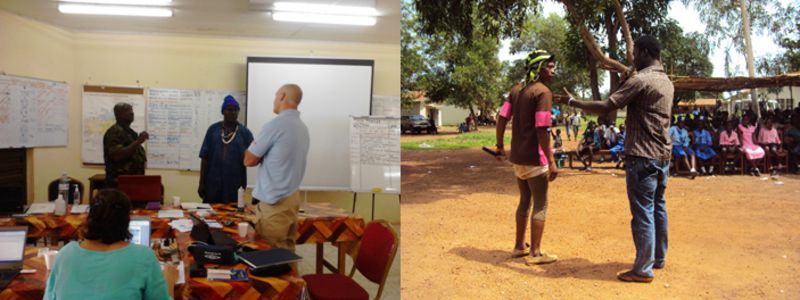
These communication challenges led to a lack of cooperation on the part of the communities for the response, as evidenced for instance by families hiding diseases and secret burials - the greatest challenges for virus interruption. Noting that social norms are not so easy to change and identifying weaknesses in the SM interventions, the C4D Ebola surge mission demonstrated existing gaps between the scientific gaps related to EVD and the social/cultural realities. They worked to convince authorities, such as those affiliated with the National Ebola Response Center (NERC) and District Ebola Response Centers (DERCs), to address and ensure community participation (bottom-up communication). Examples of activities on the part of the mission team included: developing SM plans for districts and high-priority chiefdoms, sensitising paramount chiefs for community mobilisation, and developing terms of reference (TOR) for the districts' SM pillar and its key functionaries. The team also developed strategies to change misconceptions about EVD survivors and involved them in SM as important change agents. Looking beyond the emergency, the team engaged in post-Ebola recovery planning, taking a broad-based perspective on social and cultural rehabilitation.
Ateeq calls SBCC "an art of making sense out of nonsense by listening to [the] key audience, opening up dialogues, building trust and involvement". Slide 13 of the presentation shows the operationalisation structure of SM in Ebola-affected districts. It includes details about participatory mobilisation planning, which should be guided by the community's needs and facilitated by paramount chiefs, public health units (PHUs), non-governmental organisations (NGOs), Ebola survivors, etc. One piece of advice: Let families/ communities speak out in hotspot areas, as per the community-led Ebola approach (CLEA).
The presentation concludes with some key lessons learned, such as: communicate that "Ebola does not necessarily kill if..."; share daily field notes to generate useful discussion; work closely with armies, NGOs, United Nations (UN) agencies, and others to stress the importance of "soft skills" like evidence-based community mobilisation; and involve communities in fast-tracking proposal development to implement innovations based on their ideas (which can help build resilience).
Emails from Nasir Ateeq to The Communication Initiative on April 23 2016 and April 27 2016.
Comments

EVD
Mr Nasir Ateeq worked hard to handle the situation which was spread by the people having negative throughts of EVD
- Log in to post comments