










































Co-designing a Theory-informed, Multicomponent Intervention to Increase Vaccine Uptake with Congolese Migrants: A Qualitative, Community‐based Participatory Research Study (LISOLO MALAMU)
St George's University of London (Crawshaw, Deal, Carter, Knights, Hargreaves); Hackney Congolese Women Support Group (Kitoko, Nkembi, Lutumba); Hackney Refugee and Migrant Forum and Hackney CVS (Hickey); London School of Hygiene and Tropical Medicine (Deal); Kingston University London (Vandrevala); Our Future Health (Forster)
"This study effectively demonstrates how behavioural theory can be adapted to a participatory approach to co-design a vaccination intervention."
Globally, COVID-19 exacerbated inequalities experienced by some migrants and ethnically minoritised groups and highlighted issues of mistrust, insufficient access, and low vaccine confidence. Tailored vaccination interventions that address these complex barriers in partnership with communities are needed. This study used a theory-informed, community-based participatory research (CPBR) approach to co-design a culturally tailored behaviour change intervention aimed at increasing COVID-19 vaccine uptake among Congolese migrants in London, United Kingdom (UK). By describing the intervention, this paper highlights how a participatory research paradigm can directly consider power asymmetries and histories of oppression, give value to the subjectivity of lived experience, and actively involve individuals affected by the issue being studied as equal partners in the research process.
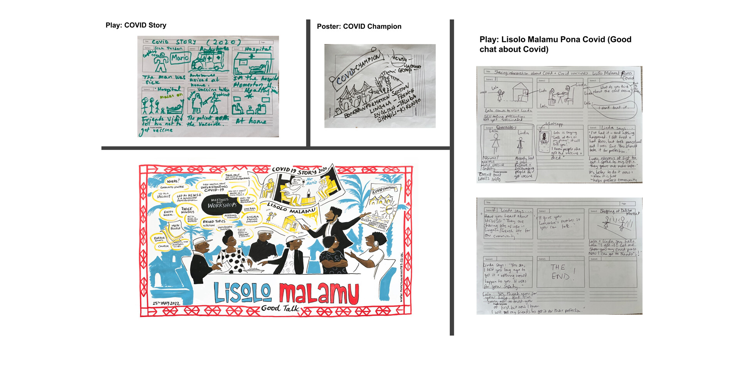
Developed in response to unmet needs in the Congolese community as the COVID-19 pandemic started, this CBPR study was conducted by a community-academic coalition (including Congolese migrants, community, and academic stakeholders) from November 2021 to November 2022 in Hackney, UK, a diverse London borough. Community days (involving peer-led qualitative in-depth interviews and interactive poster walls) and co-design workshops were conducted with Congolese migrants, and the CBPR approach was evaluated through participant feedback. Barriers and facilitators to COVID-19 vaccination, information and communication preferences, and intervention suggestions were explored through qualitative in-depth interviews with Congolese migrants, thematically analysed, and mapped to the theoretical domains framework (TDF) and the capability, opportunity, motivation, behaviour (COM-B) model to identify target behaviours and strategies to include in interventions. Three intervention components were agreed upon to take forward to co-design workshops, which were felt to blend community desires with effective and contextually feasible approaches to change behaviour. These components were iterated on and refined by Congolese migrants during two, 2-hour co-design workshops, resulting in a final, culturally tailored and co-designed intervention. A local artist attended the workshops and recorded visual minutes.
Specifically, 32 Congolese adult migrants (75% women) took part in in-depth interviews and 16 (same sample) took part in co-design workshops. Congolese migrants were found to experience similar barriers to COVID-19 vaccination as identified in other migrant and ethnic minority groups. Fourteen barrier concepts, organised under 5 topic headings (vaccine safety concerns, vaccine effectiveness concerns, vaccine necessity and norms, issues relating to information and communications, and government distrust), were identified. For example, many participants highlighted how language and literacy barriers and/or exposure to misinformation and rumours in their social networks had directly influenced their vaccination decisions. Most barrier data related to 4 TDF domains (beliefs about consequences; emotion; social influences; and environmental context and resources). Also identified were 10 facilitator concepts, organised under 8 topic headings (accessibility of the vaccine, opportunity to discuss with a general practitioner (GP) or other trusted source, higher risk perception and saliency of the disease, social influences, respect for authority, trust in government, belief in medical research process, desire to protect self and others). Participants indicated a preference for oral and visual communications and receiving vaccination information via a trusted intermediary.
The behavioural diagnosis concluded interventions should target improving psychological capability, reflective and automatic motivations, and social opportunities. Strategies included culturally tailored behaviour change techniques based on education, persuasion, modelling, enablement, and environmental restructuring, which resulted in a co-designed intervention comprising: community-led workshops featuring two-way communication; short plays using storyboards that positively framed messages through relatable characters, local settings, cultural references, customs, and humour to encourage vaccine uptake; and posters with rich, eye-catching colours, culturally relevant imagery (e.g., Congolese scenery, ways of life), photos of local people to convey credibility, and Lingala language. Findings and interventions were disseminated through a community celebration event.
Reflecting on the findings, the researchers note, in part, that: A key aspect of fostering vaccine acceptance lies in enhancing institutional and interpersonal trust and trust in vaccines,...which may be achieved by actively listening to the concerns of various groups and prioritising transparent and clear communication, especially during emergencies. Surprisingly, access to vaccines was not a major barrier in our study, suggesting that government efforts to widen access to vaccination for marginalised groups during the pandemic were largely successful. Nevertheless, the limited impact of these efforts on increasing uptake in this population due to other prevailing barriers emphasises the need for contextually-tailored initiatives, rather than a one-size-fits-all approach....The critical role of community connectors in facilitating vaccination opportunities must also be recognised and integrated into intervention strategies."
Per the researchers, future studies seeking to use behavioural theory in the development of interventions with migrant populations could explore developing migrant-specific models of health with communities as a means of ensuring culturally specific beliefs, values, and worldviews are more robustly translated into behaviour change techniques while equally valuing Western and migrant worldviews. Looking ahead to potential future interventions, they caution that, "While the increased attention on collaborative approaches is positive, funders, authorities and researchers must be cognisant of how inherent biases and systemic racism may serve to widen inequalities despite their good intentions and proactively address this."
Next steps for this particular research endeavour will involve refining, implementing, and testing the intervention and potentially adapting and expanding the content to routine vaccinations and wider health needs, as requested by study participants and to address gaps exacerbated by the pandemic.
In conclusion, this study "demonstrates how behavioural theory can be applied to co-designing tailored interventions with underserved migrant communities through a participatory research paradigm to address a range of health issues and inequalities. Future research should build on this empowering approach, with the goal of developing more sensitive vaccination services and interventions which respond to migrant communities' unique cultural needs and realities."
Health Expectations 2023; 1-16. DOI: 10.1111/hex.13884
- Log in to post comments