










































Combating Vaccine Hesitancy and Other 21st Century Social Determinants in the Global Fight Against Measles
Baylor College of Medicine; Hagler Institute for Advanced Study at Texas A&M University; Texas A&M University; Baylor University; and Rice University (Hotez); Texas A&M School of Public Health (Nuzhath, Colwell)
"Vaccine hesitancy will continue to be a major barrier to expansion of the use of the MMR and other vaccines."
Since 2017, the number of measles cases has begun to rise due in part to sharp declines in measles-mumps-rubella (MMR) vaccination coverage. Vaccine hesitancy is one of the reasons for the re-emergence of measles to the United States (US), almost 20 years after it was eliminated from that country. This article explores the key determinants driving down immunisation rates and bringing back measles in the US and around the world.
The authors point to:
- War and political conflict: In 2019, the World Health Organization (WHO) and the United Nations Children's Fund (UNICEF) reported that approximately 20 million children lack access to life-saving vaccines, including MMR. These unvaccinated children live disproportionately in 16 countries characterised as fragile states, where ongoing conflicts and hostilities compromise both health systems and vaccine delivery infrastructures.
- Socioeconomic collapse: Physical determinants associated with climate change, agricultural failures, food insecurity, and urbanisation can destabilise nations and contribute to the decline in vaccine coverage by weakening the public health infrastructure.
- Vaccine access: In some parts of the world, Indigenous or aboriginal people disproportionately lack access to vaccines and vaccination programmesl; historically, measles has deeply impacted these populations.
- Vaccine hesitancy: Delay in acceptance or refusal of vaccines despite availability of vaccine services has now emerged as a major force driving down vaccine coverage in the Philippines, for example, where lack of public confidence in the national vaccination programmes has produced a large measles epidemic with hundreds of deaths. Moreover, an ongoing measles epidemic that began in 2019 in Samoa was due to sharp declines in vaccine coverage after an MMR vaccine mishap caused the deaths of two infants. The resultant widespread mistrust of the vaccine, fuelled in part by the social media activities of prominent antivaccine activists, caused a measles epidemic in 2019 that killed at least 80 people. Vaccine hesitancy has also emerged as a dominant force in many nations in Europe, though it is not the only factor. The London, United Kingdom (UK)-based Vaccine Confidence Project is working to understand the specific and underlying factors affecting the public support of the MMR and other vaccines in these nations.
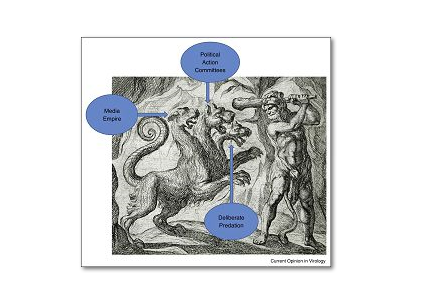
A closer look at vaccine hesitancy in the US leads to an analysis of the American antivaccine movement, which the authors envision as a triple-headed monster or 3-headed Cerberus, as depited in the figure above, consisting of:
- A media empire that by some estimates is comprised of hundreds of misinformation websites and amplified on social media and e-commerce platforms. "The consequence of this misinformation glut is that parents in the United States have trouble finding and downloading meaningful or accurate healthcare information on vaccines. With regard to the MMR vaccine, the message from the antivaccine movement is that it causes autism or neurodevelopmental disorders, or even sudden, unexplained death in infants. However, copious amounts of scientific evidence...show[s] that MMR vaccine does not cause autism..."
- A political arm whereby political action committees (PACS) in several Western states lobby state legislatures to enact legislation promoting vaccine exemptions or requiring extra layers of "informed consent" to administer vaccines.
- Deliberate predatory behaviour that antivaccine groups use to target insular or tight-knit ethnic groups. This practice has been used to promote fears that vaccines cause developmental disorders or death.
A significant concern, according to the authors, "is whether the American-style antivaccine movement will globalize and make inroads into some of the large low-income or middle-income nations such as Brazil, India, China, and Nigeria..." They note, however, that while vaccine hesitancy has become pervasive in the US and elsewhere, "there is evidence that attitudes can be reversed. For example, college students at a notoriously vaccine-hesitant university changed their minds after interviewing individuals who had suffered the sequelae of vaccine-preventable diseases....Others have reported that clinicians taking time to address parental concerns about vaccines, while urging vaccine schedule adherence, can also be effective..."
The authors are working to create metrics for vaccine-preventable disease (VPD) risk "that embrace the lead social determinants reported here, or even generate a heat map to identify the global hotspots where vaccine coverage may be at risk of decline." They also explore the promise of "vaccine diplomacy", which they indicate will entail dialogue between virologists, vaccinologists, and experts in key areas of social science, including economics, political science, sociology, public health and psychology, as well as with experts in climate change and food security. "Otherwise, we risk further erosions and measles epidemics of the past."
Current Opinion in Virology 2020,41:1-7. https://doi.org/10.1016/j.coviro.2020.01.001