










































Communicating for Advocacy (CFA) Project
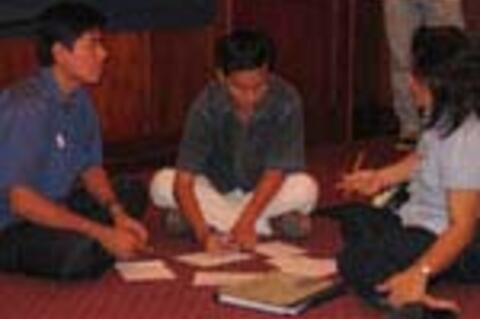
The core of the CFA project was its people-centred and rights-based approach to advocacy. This strategy reflected an attempt to empower marginalised people to speak for themselves, asserting their rights to decent and humane lives. Thus, participatory approaches shaped the CFA partners' activities, which revolved around issues such as education, the environment, children's rights, disability, sexual and reproductive health, gay rights, and community health. All of the partners carried out their own campaigns, guided by the notion that advocacy must lead to both policy change and practice change. Organisers stress that this is a continuous process and there is a need to build relationships, and to foster dialogues, between those at the "grassroots" and the decision-makers.
Here are a few concrete examples of CFA partners' work:
- As part of the Reproductive Health Network organised by CHEMS, members of the community took part in intensive trainings on sexual and reproductive health (SRH) issues and advocacy skills. The sessions were designed to instil participants with the confidence to promote SRH in their communities, especially among youth, as well as to encourage those who they suspect might have sexually transmitted infections (STIs) to seek medical assistance in health centres. They used their voices at local authority and health centre meetings, and at various conferences. One young participant in this programme wrote and performed a song, which was aired on the "Especially for You, Young People" radio programme. "I try to help peers and elders on reproductive health care and sexual reproductive rights by gathering real stories and communicating it through broadcasts," she said.
- Aside from providing gay men with various services, members of Iwag Dabaw, a gay rights organisation in the Philippines, used the experience they gained through CFA training to project a positive image of gay people. Their activities included radio and TV guestings, and networking with the government and other non-governmental organisations (NGOs).
- Participants of the CFA advocacy workshop conducted by the Council for Health and Development used the medium of comics to encourage people to seek help when they have medical problems, as well as to take advantage of health education services provided by community health workers (CHWs). Organisers indicated that simple pen-and-ink illustration would suffice, with the narration in boxes and the dialogues in balloons.
- The Indra Devi Association (IDA), a Cambodian organisation working on HIV/AIDS issues, has been staging community theatre; they find this approach effective because it is a part of traditional Khmer entertainment. Since many Cambodians still have no access to TV or radio, and illiteracy is a major concern, it is also one of the few available means to educate the people on various health issues. Initially, IDA hired professional actors because they drew a huge crowd; later on, CHEMS was asked to train community members in writing scripts that incorporate SRH messages, such as non-discrimination against people living with HIV/AIDS. Art teachers were also tapped to train peer educators in drama and traditional theatre. Performances are usually held in areas populated by brothels, drug dens, and other high-risk areas (IDA coordinates with the local police and district chiefs to prevent gang wars).
- Kaugmaon, a Davao City (Philippines)-based organisation which focuses mainly on children's rights and welfare, used to be wary of dealing with government officials. However, after becoming involved with CFA, Kaugmaon became aware of the necessity of involving diverse groups, including the government, in its advocacy work. When it launched a programme to address increasing adolescent SRH-related issues in the community, Kaugmaon approached the local government and highlighted its concerns and suggested strategies. The government agreed to work with Kaugmaon to resolve the problem together. "By working with the government, the program achieved a wider impact in the region."
- Another CFA partner, the Save the Abra River Movement (STARM) used research and local participation as strategies to advocate for the closure of Lepanto Mining Corporation, which allegedly destroys the Abra River. STARM presented scientific studies to local government officials of Abra and Ilocos Sur and invited representatives of the two provinces to join the environmental investigatory missions (EIM) it conducted. In preparation for this work, STARM offered scientific training to local citizens, using simple terms; the people were thus educated to monitor the river's conditions themselves. When the provincial government of Ilocos Sur allowed them to have a dialogue with the provincial board, it was the local people who talked to the officials. Through such dialogues, the provincial boards passed resolutions opposing the expansion of Lepanto's operation in the provinces.
In an effort to create a sense of ownership of capacity-building activities, the partners adapted and translated capacity-building materials to local contexts and needs. The CFA guide has been translated into local languages, as well as Braille. Click here for access to this guide.
Rights.
CFA is based on a philosophy expressed in these words from David Curtis, Head of Programs - Asia Healthlink Worldwide: "Advocacy is not an add-on - a last minute addition to a program to give it currency; rather, it is a campaign - a series of inputs with a common objective. It takes time and need[s] strategic planning. The work is often frustrating, tiring, and thankless; and because it is associated with change, it can take all sorts of unexpected detours. However, the benefits are immense as gains are made, new coalitions are formed, and networks develop. United with others pursuing the same goals, advocacy work can bring positive social change."
Organisers explain that, for some of the CFA partners, advocacy was a new concept. In Cambodia, for example, there is no Khmer word that would closely approximate advocacy. The commonly used word is "tasumateh", meaning to struggle for idea. For others, it was the first time that advocacy has been incorporated in their work. In pursuing their CFA work, the Cambodian and Laotian partners had to adapt to the local situation. For instance, when implementing visible forms of advocacy, such as campaigns and demonstrations, they had to assure the government that such activities pose no threat to the status quo.
Healthlink Worldwide, Health Action Information Network, Cambodia Health Education Media Services, and Social Assistance and Rehabilitation for the Physically Vulnerable. Funded by The Department for International Development (DFID) and local organisations.
"What's New in Source", November-December 2006, from the Source International Information Support Centre; "Communicating for Advocacy: An Agent for Social Change", Health Alert Asia-Pacific Edition, 2006; and the CFA Project page on the Healthlink Worldwide website.
- Log in to post comments