










































Communicating and Monitoring Surveillance and Response Activities for Malaria Elimination: China's "1-3-7" Strategy
Jiangsu Institute of Parasitic Diseases (Cao, Zhou (H.), Liu, Gao); Key Laboratory of Parasitic Disease Control and Prevention, Ministry of Health (Cao, Zhou (H)., Gao); Jiangsu Provincial Key Laboratory of Parasite Molecular Biology (Cao, Liu, Gao); Global Health Group, University of California (Sturrock, Cotter, Gosling, Feachem); National Institute of Parasitic Diseases, Chinese Center for Disease Control and Prevention (Zhou (S.), Tang)
"Central to the value and effectiveness of the approach is the ability to communicate information between administrative levels to encourage rapid and complete reporting as well as improved adherence to surveillance and response procedures by health personnel."
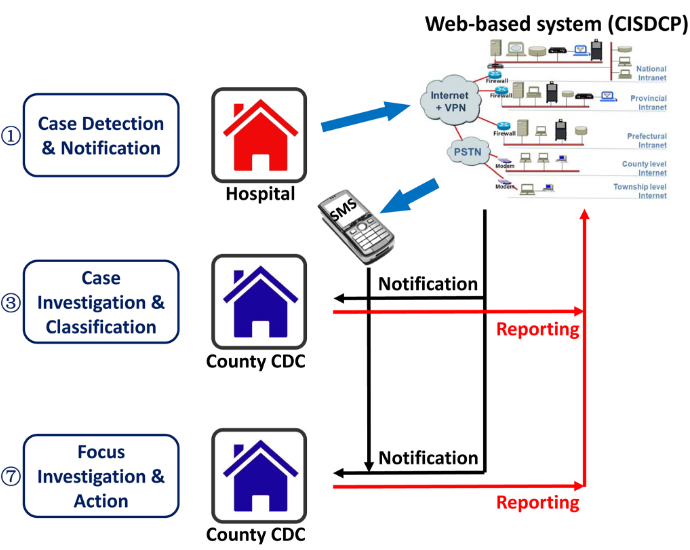
This paper outlines China's "1-3-7" communication strategy for taking a malaria control programme from the control phases through to elimination of the disease. China launched its malaria elimination programme in July 2010 with a plan to achieve elimination by 2020. The strategy defines targets used to guide and monitor case reporting, investigation, and response, respectively:
- Reporting of malaria cases within 1 day: "local health-care providers are encouraged to report both confirmed and suspected malaria cases within 24 hours using the web-based China Information System for Disease Control and Prevention (CISDCP). A cellphone-based short message service alert system immediately informs local Chinese Center for Disease Control and Prevention (China CDC) staff of a case, ensuring timely follow-up."
- Confirmation and investigation of cases within 3 days: "Cases are classified as being locally acquired or imported by a careful epidemiological investigation according to China's technical scheme of malaria elimination."
- The appropriate public health response to prevent further transmission within 7 days: "Irrespective of whether the case is classified as local or imported, the local area around a case (the focus) is investigated to evaluate the risk of local transmission. Different actions are triggered according to the results of the investigation and should be completed within seven days."
"Monthly 1-3-7 implementation analysis reports are generated by the Ministry of Health and circulated to all Provincial Health Departments and at a national level to the National Institute of Parasitic Diseases for monitoring and evaluation purposes. Once the case investigation or response activity for a case is complete, there is a reporting channel that feeds into the larger information system to provide critical feedback on the results of the response and action for each index case....After the initiation of monthly reports by the Ministry of Health in July 2012, the timeliness of implementation of malaria surveillance and response significantly improved, most notably for case investigation."
Challenges affecting the 1-3-7 approach are outlined. For example, Polymerase Chain Reaction (PCR) confirmation of all cases within the 3-day target and screening of household members, neighbours, and networks of cases within the 7-day target are continuing challenges.
The concluding section notes that "[c]ommunicating and monitoring disease-specific algorithms is essential in elimination campaigns and is particularly challenging when the disease is increasingly rare. The 1-3-7 strategy to encourage timely reporting of malaria cases, their investigation, and appropriate public health responses has a simplicity that is easy to understand, clearly defines roles and time frames, and is measurable....If widely adopted, such an indicator system would provide a robust and epidemiologically relevant standard against which to make comparisons and chart the progress of elimination across regions."
- Log in to post comments