










































Community Health Workers: Bringing Family Planning Services to Where People Live and Work
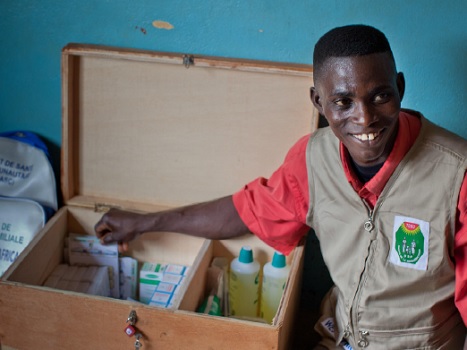
"When appropriately designed and implemented, community health worker (CHW) programs can increase use of contraception, particularly where unmet need is high, access is low, and geographic or social barriers to use of services exist."
This brief discusses how integrating community health worker programmes into the health system can help increase access to family planning by bringing information, services, and supplies to women and men in the communities where they live and work, rather than requiring them to visit health facilities. The brief was published as part of a series that focuses on high-impact practices in family planning (HIPs), identified by a technical advisory group of international experts.
The brief explains how CHWs provide services such as: health education, referral and follow up, case management, and basic preventive health care and home visiting services to communities. Their work helps address geographic access barriers and may reduce financial barriers for clients who would otherwise have to pay consultation fees or expensive transport for health facilities. CHWs also help address social barriers that inhibit family planning use, particularly among younger and unmarried women, those with spouses or families that do not support family planning, and women living within social norms that restrict their movement or ability to make independent decisions.
The brief outlines the impact that CHWs have on family planning, noting that CHW programmes can increase contraceptive use, especially in places that lack universal access and use of clinic-based services. For example, "a review of community-based programs in sub-Saharan Africa found six of seven experimental studies demonstrated a significant increase in contraceptive use or reduction in fertility rates" and in one study in Madagascar "individuals who had direct communication with CHWs were 10 times more likely to use modern contraceptives than individuals who did not have contact with CHWs." The brief goes on to provide case study examples of how programmes reduce unmet needs in countries with large rural populations, can reduce fertility rates, and be cost-effective.
A number of recommendations are provided, based on implementation experience. These are very briefly outlined below, and explained in more detail in the brief.
Integrate CHWs into the Health System
- Link CHWs to the health system with well-defined referral and supervision structures.
- Consider using mobile technology programme to link CHWs with the health system - in Malawi SMS communication has been used to improve information sharing between CHWs and their district teams, particularly around commodity stock-outs, "which ultimately resulted in stock-out reductions."
- Integrate management information systems - such as in Ethiopia where CHWs began keeping a "family folder" for every family in the catchment area of a health post. "Health cards were organised in wooden boxes according to the month in which follow-up services were needed for family members. If a health card was left in the previous month's box, it alerted the health worker that a service had not been provided, prompting the health worker to reach out to the family to provide care."
Train CHWs
- Implement a comprehensive training programme that includes incremental, practical, competency-based training and mechanisms to reinforce skills.
- Expand the variety of methods provided by CHWs.
- Train and engage CHWs in behaviour change communication efforts - for example, in India, "women living in communities where CHWs supported a behavior change communication campaign focused on healthy timing and spacing of pregnancy, were 3.5 times more likely to be using modern contraception at 9 months postpartum than women living in communities where CHWs were not involved in this communication campaign."
Equip CHWs
- Invest attention and funding to improve supply chains all the way to CHWs.
- Make appropriate and timely community logistics data visible at both the health centre and the district level. For example, "implementing an SMS and web-based mHealth system, where data are transformed into relevant, usable reports, can significantly improve timely and accurate availability and usability of community health logistics data at all levels of the supply chain." In the Malawi example above, mobile phones were used to "decrease stock-outs of essential medicines, lower communication costs, expand service coverage, and implement a more efficient referral system."
- Implement multilevel quality improvement teams that connect CHWs, health centre staff, and health programme staff.
Support CHWs
- Employing incentives can help retain CHWs, such as in Ethiopia and Mozambique, where recruiting and retaining CHWs was related to greater compensation and a sense of worthiness.
- Certify CHWs to visibly recognise their contributions.
- Engage communities in planning, monitoring, and supporting CHWs.
- Recruit CHWs from the beneficiary communities.
- Consider recruiting men as CHWs.
A table is provided which offers guidance around planning, implementing, and scale-up of CHW programmes, including key consideration and factors contributing to success and failure. This includes training and engaging CHWs in social and behaviour change communication activities as a success factors in addressing quality and social barriers.
Click here to download the full brief in PDF format in French.
Click here to download the full brief in PDF format in Portuguese.
Click here to download the full brief in PDF format in Spanish.
High Impact Practices website on April 27 2016.
- Log in to post comments