











































COVID-19: Community Radio Broadcasting Coronavirus Prevention Education in Bangladesh
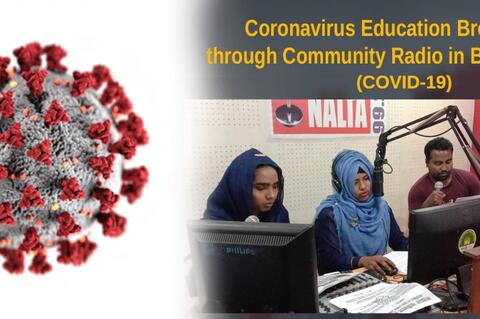
"Community Radio stations are producing content which speaks directly to localized issues and concerns, and features trusted local people in a way that nationally or regionally produced content cannot."
In March 2020, the 18 community radio stations that are part of the advocacy group Bangladesh NGOs Network for Radio and Communication (BNNRC) launched an educational broadcasting programme on COVID-19. By sharing information and enabling two-way communication on the outbreak in local languages or dialects, the stations hoped to reach rural people with information about the virus and the precautionary measures needed to avoid infection.
BNNRC has been mobilising stakeholders for social disaster preparedness and disaster risk reduction (DRR) since its inception. (See Related Summaries, below, for more on BNNRC). This initiative is based on the contention that community radio can play a vital role in building the awareness of the people. BNNRC suggests that community radio stations have already been established as a well-trusted source of information for Bangladesh's rural population. Community radio can also reinforce COVID-19-related behaviour change communication (BCC) being undertaken by civil society organisations (CSOs), Government, health officials, and locally elected bodies (LEB). This multi-stakeholder focus is reflected in the initiative's approach, which is to:
- Animate CSOs, Government, health service providers, and communities for reinforcing collective action to prevent spread of the coronavirus;
- Mobilise further cooperation among government, CSOs, local markets, and communities; and, ultimately, to
- Keep community people's daily life as normal as possible and their livelihoods functional - all while preventing illness.
BNNRC's 5-member monitoring team has been keeping tabs on the situation 24 hours per day and coordinating community radio programmes centrally, providing support as and when required. They assigned a broadcaster in each BNNRC member radio station to serve as the focal person to coordinate the special education programme.
Guided by the World Health Organization (WHO)'s COVID-19: Strategic Preparedness and Response Plan: Operational Planning Guidelines to Support Country Preparedness and Response [PDF] and in line with updated information provided by the Institute of Epidemiology Disease Control and Research (IEDCR), Ministry of Health and Family Welfare, Government of Bangladesh, the stations are broadcasting 20 hours of programming daily on coronavirus contamination, precautionary steps for preventing contamination, symptoms of the patients, service providing agencies and service delivery points, experts' opinions, and the role of rural people. The different formats include news, public service announcements (PSAs) and radio spots, talk shows, radio magazine programmes, dramas, jingles, interviews, and expert opinions. In many cases, listeners can communicate their questions or perspectives by contacting the station(s) via SMS (text message) or telephone.
BNNRC also released on its website and through its social media platforms a list (in English and Bangla) of precautions for community radio broadcasters themselves to take in order to help prevent the spread of COVID-19; click here to access it.
Health, Risk Management, Emergency
On March 18 2020, BNNRC reported that COVID-19 had disrupted lives and livelihoods of the communities in 158 countries globally, including Bangladesh. In this densely populated developing country, 1,961 people live in each square kilometer, and they have limited knowledge and healthcare services.
In response to the outbreak, the Government shut down all educational institutions until March 31 2020, and the Health Minister asked expatriate Bangladeshis who have returned home recently and their relatives not to visit mosques for prayers to help curb the spread of coronavirus. He urged people to avoid mass gatherings, asked them to practice "social distancing", and shuttered sporting, cultural, and religious events.
Because some people do not follow these instructions, posing a serious threat to the community, it is essential to build community awareness, BNNRC stresses. The group contends that individual initiatives are not sufficient to manage this situation. Thus, coordinated, combined action with multi-stakeholder cooperation - at scale and with speed - is the only approach with potential to mitigate the risks and impact of the crisis.
This awareness campaign will be continued until normalcy is restored.
COVID-19: Community Radio Broadcasting Coronavirus prevention education in Bangladesh, BNNRC website, March 18 2020, and COVID-19: Bangladeshi Community Radio Broadcasters Started Coronavirus Education Program, BNNRC website, March 9 2020 - both accessed on March 20 2020.
- Log in to post comments