










































Creating Safe Spaces to Prevent Unintentional Childhood Injuries among the Bedouins in Southern Israel: A Hybrid Model Comprising Positive Deviance, Community-Based Participatory Research, and Entertainment-Education
University of Haifa (Gesser-Edelsburg, Alamour, Cohen, Shahbari, Hijazi); Beterem Safe Kids Israel (Orr, Vered-Chen); The University of Texas at El Paso (Singhal); Inland University of Applied Sciences (Singhal)
"The findings and outcomes of the present project are a powerful reminder that the wisdom for preventing unintentional childhood injuries resides with the community itself."
In the Southern District of Israel, children and adolescents who are Bedouin - members of various Arab nomadic tribes - die at disproportionately high rates due to unintentional injuries. This paper outlines a strategy for addressing this problem using a hybrid model that brings together three health communication approaches: community-based participatory research (CBPR), positive deviance (PD), and entertainment-education (EE). The research questions are: (i) How does increasing the involvement and participation of Bedouin community members influence the issue of unintentional injuries among children? (ii) How does reframing the technical issue of safety into security influence community involvement and cooperation? The objectives are: (i) to identify effective and efficacious PD through CBPR with adults, children, and professionals in the Bedouin community; and (ii) to create wider and deeper connections and cohesion between and among diverse Bedouin communities by seeding and sparking opportunities for social networking and cross-learning.
Having defined each of the three social change approaches used in the study, the researchers explain why they chose them. They opted for CBPR because it is tailored to minority populations, it is especially suitable for culturally sensitive issues, and it emerges from the community. In contrast, existing intervention programmes on child safety are generic to the Israeli population and are top down: trainings, tutorials, and lectures implemented in schools and kindergartens. The PD approach is akin to CBPR in its bottom-up orientation while purposely identifying "outliers" who have found solutions within their environment without additional resources. Finally, EE's employment of experiential art-based strategies can animate social issues in an engaging and non-didactic way and can tackle complex issues through a multiplicity of characters and perspectives. Those watching a drama about a sensitive subject such as child accidents, for example, may lower their defenses and may be transported to a narrative space where they can be influenced to change their perceptions, attitudes, and behaviours.
The study was carried out from June 2019 through February 2020 with 404 participants from Bedouin localities in the Negev: 101 (25.0%) children aged 3 years to 10 years, 280 (69.3%) women, and 23 (5.7%) men. Among these participants, the researchers (i) conducted 23 personal interviews with welfare workers, community workers, teachers and educators, and religious leaders working in the Bedouin community; (ii) conducted 17 art-based focus group discussions (FGDs) with Bedouin mothers and grandmothers; (iii) conducted 5 art-based FGDs with teachers; and (iv) carried out 4 art-based FGDs with preschoolers and elementary school pupils.
Specifically, the central research tool entailed the use of an EE-based platform consisting of theatre and dialogue games to enable the participants - even the Bedouin mothers, who have very low health literacy and may be normatively constrained to take independent decisions and actions - to express themselves fully in art-based FGDs. In brief, the FGD session was crafted in line with the theatrical practices of Augusto Boal, who coined the term "spect-actor" to refer to spectators from within the community who become active agents in the dramatic space, i.e., actors. As part of the process, the facilitator told some stories - in a deeply compassionate tone - about unintentional child accidents based on actual events within the community. The participants were then invited to act out the story told by the facilitator. Later, they were charged with proposing specific ideas for preventing the child from being injured, acting out the story while modeling their suggestions in detail. In the final phase of the session, the participants watched a videoclip called "Lynn's Story", in which a young Bedouin girl asks the community to think of ways to keep children safe and to make suggestions for creating safe and feasible play environments. FGD participants then discussed ideas and practices that could be implemented locally to improve child safety. At the end of the art-based focus group, participants were provided with a magnet with two sentences that served as affirmations and action cues: (i) A verse from the Qur'an expressing the importance of children in Bedouin society and (ii) a PD-inspired sentence focusing on action: "What did you do today to provide a safe and secure play environment for me?"
The art-based focus groups with the Bedouin mothers often brought children into the conversational space. Hence, the researchers brought toys and arts-and-craft materials and asked the children to create scenarios and draw pictures depicting what they considered to be a safe and secure play environment in their localities. ("According to the PD approach, deviant ideas are found everywhere - among ordinary people and unusual suspects, not necessarily among professionals.")
The research resulted in the emergence of several PD ideas and practices for preventing and avoiding children's injuries. The practices proposed by the participants for promoting childhood safety included getting community members socially involved, suggesting reminders to parents using checklists and cell phones, establishing visual boundaries for play, and providing tips to prevent children from being run over and being forgotten in cars. None of these ideas and practices were found in official instructions or guidelines issued by hospitals.
In fact, the key idea for action came from the children themselves. When the children were asked to draw a safe and secure play environment, several drew playrooms in the mosque. Mosques in Israel usually do not have playrooms for children; the mosque is customarily used only for men's prayers or for special events. The children's idea instigated a community-led process to set up a safe and secure playroom for children in the mosque, which included a videoclip of children directly broaching the idea with imams. The opening ceremony of the playroom featured volunteers, imams, and people from the community voicing the importance of a safe and secure playroom for the children.
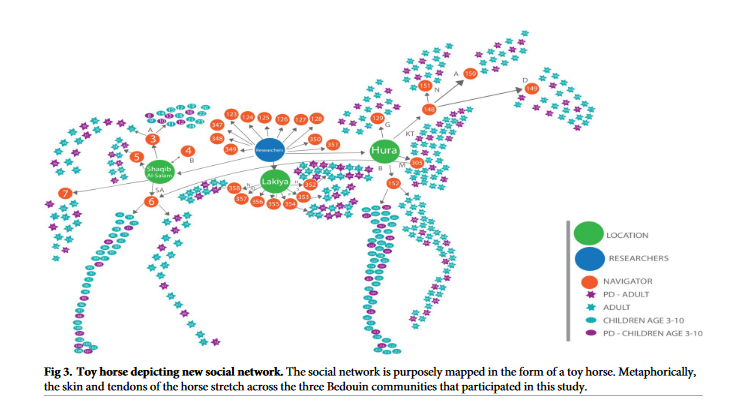
The experience also led to the creation of cascading and cross-learning social networks between and among members of the Bedouin community. The researchers represent the social network in the shape of a toy horse (see above) to depict: how new ideas emerged from the field through community residents (both adults and children); that people who provided new ideas and key people opened doors (navigators) so everyone in the community could be reached and invited to contribute, akin to the Trojan horse in Homer's Odyssey; and how ideas travel within each community as well as across communities.
In the paper's discussion section, the researchers examine the possible reasons this project was effective both in proposing new ideas and practices for preventing childhood injuries and, more importantly, in implementing them. For example: "The use of theater/drama enabled the participants to be drawn into the process at a deeply personal level. They were able to let down their defenses....Processing the issue of children's accidents by means of entertainment-education likely enabled the participants to undergo a process of catharsis....They underwent a process of engaged learning in which new interpretations, positions and possibilities emerged..."
To cite one other example, in this study, the issue of injury was reframed in a new way. In English, the word "safety" incorporates both the official aspect of being physically safe and the emotional aspect of feeling secure. The art-based FGDs in this study were conducted in Arabic. Arabic uses one word (أمن) to express the notion of conforming to professional safety regulations and another word to express the emotional aspect of feeling secure (مكان آمن). The researchers intentionally used the latter - the Arabic word for security - to encompass a component that arouses emotions and identification and thus to motivate the participants "to think about the topic of injury from their own personal perspective, allowing them to delve into their inner worlds."
In conclusion: "This study helped in reframing the technical issue of accidents and safety into the notion of sacredness and security, enhanced the association between emotions and cognition by means of experiential and EE methods, and stimulated creative thinking and the emergence of new culturally and contextually relevant ideas and practices through the PD process. It demonstrated the synergistic power of using a hybrid model that combined the rigor and vigor of different health communication approaches to address a significant disparity in the burden of child accidents faced by the Bedouins....[The] study generated solutions that emerged from, and directly benefitted, Bedouin children - those, who face overwhelming risk of injury and death from preventable accidents."
PLoS ONE 16(9): e0257696. https://doi.org/10.1371/journal.pone.0257696
- Log in to post comments