










































Dance4Life
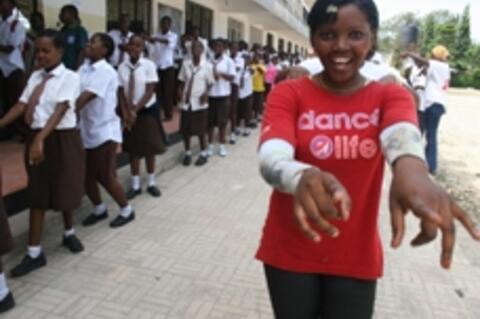
This programme centres around the use of dance to help youth see their collective power as a force for change. While in each participating country the activities vary, in general, the interactive, edutainment, and life-skills oriented Dance4Life consists of 4 interconnected activities:
- The Dance4Life Tour Team travels to schools in several regions per country, to inspire youth through the participation of musicians, dancers, peer educators, and young people living with HIV. Video is also used as a teaching tool. Workshop series are also often held; a key focus here is on making the sessions exhilarating and energetic by combining HIV/AIDS education with music, dance, and real life stories of people living with HIV.
- After this visit, which is meant to be empowering and "funky" at the same time, young people start their own actions - like fundraising for HIV prevention projects and advocacy efforts directed toward their governments.
- Active, in-depth involvement in a Life Skills programme is a core component of this portion of the strategy. Young people learn negotiation skills (e.g., "no" means "no"), entrepreneurial skills, details on sexuality and prevention, human rights, the relationship between drug abuse and HIV, and so on.
- The thematic Dance4Life event, considered a reward for involvement, is held every 2 years on the Saturday before World AIDS Day (December 1). To cite one example, on November 25 2006, the World Population Foundation (WPF), in partnership with the United States Embassy in Hanoi, Vietnam, hosted an event in which 500 local students joined with peers from Africa, Europe, and Russia to dance alongside well-known artists. In addition to performing, the artists communicated positive messages about the role and responsibility of young people in pushing back HIV and AIDS. No matter the location of the event, a common action is the performance of the Dance4Life Drill, which involves students performing a rap about HIV and AIDS, accompanied by a drill-like dance. This "drill" (click here to learn more) is performed simultaneously by youth who are dressed in white, at all Dance4Life events around the world. All the events are linked live via satellite so that the youth can see that they are dancing together, all over the world, for life. Information and communication technology (ICT) is also used here as a strategy for attracting attention about the cause from politicians, members of the media, and many others.
In 2008, a Dance4Life album was released around the world, with profits going to the Dance4Life Schools Projects in 19 countries. As part of this process, 19 disc jockeys (DJs) and artists came together, donated tracks free of charge, and created an album to support these young people.
In Vietnam, Dance4Life project started in 2006 with the cooperation of World Population Foundation Vietnam as its main partner. The project was implemented in city high schools using four components: kick off "heart connection" tours, life-skills training, "action for life", and "dance for life". In 2010, Dance4Life reached 6,000 Vietnamese youths through tours; another 6,000 received life skills lessons in which 2,490 became 'agents4change'. Also in 2010, Dance4Life held a photography contest titled "Living together, eliminating stigma against people with HIV". In December 2010, a live broadcast television show invited youth to join a group dance with 24 participating countries connecting young people internationally on the issue of HIV/AIDS.
Act4Life is a related component of Dance4Life, and centres around an international mass media campaign that aims to encourage as many young people as possible to participate in Dance4Life by providing a clear slogan and few requirements for joining. Various strategies for this process of engaging others are detailed on the Dance4Life website, which also features information about HIV and AIDS, as well as all 8 of the Millennium Development Goals (MDGs).
Youth, HIV/AIDS.
In 2006, 100,000 young people were involved in the Schools Project in 11 countries worldwide. In 2008, 150,000 youth were involved and became active with Dance4Life Schools Projects; the number of participating countries almost doubled (for a total of 19). The aim is to unite over 1 million young people from 24 countries within their countries and internationally via satellite to dance together on World AIDS Day 2014.
Dance4Life was developed by 2 businessmen who decided that making difficult social issues more appealing - to break the silence and stigma surrounding HIV/AIDS, for instance - through cultural expression (dance) was more important in their lives than pursuing commercial work.
Click here to obtain information about all Dance4Life partners.
"Dance4Life Dance-Music Event to Mark World AIDS Day", Press Release from the Embassy of the United States in Hanoi Vietnam, November 24 2006; Foundation for Community Dance website; Dance4Life website; Dance4life - Newsletter No. 27, November 14 2008; and email from Huyen Tran Dieu to The Communication Initiative on March 1 2012.
- Log in to post comments