










































Defining Drivers of Under-immunization and Vaccine Hesitancy in Refugee and Migrant Populations
University of London (Deal, Crawshaw, Carter, Knights, Iwami, Hargreaves); London School of Hygiene and Tropical Medicine (Deal); World Health Organization (Darwish, Hossain, Immordino, Kaojaroen, Severoni)
"Working to better understand how drivers of under-immunization and vaccine hesitancy in refugees and migrants impacts on vaccine uptake, as well as working more closely with affected communities, will ensure effective solutions are developed and delivered."
Refugees and migrants may face a range of personal, social, and physical barriers to accessing health and vaccination services. For example, some refugee and migrant populations will face specific barriers to public health messaging that will impact on vaccine motivation. This global rapid review explores drivers of under-immunisation and vaccine hesitancy in an effort to define strategies to strengthen both COVID-19 and routine vaccination uptake.
Having searched MEDLINE, Embase, Global Health PsycINFO, and grey literature for articles published between January 1 2010 and April 5 2022, the researchers included 63 papers reporting data on diverse population groups, including refugees, asylum seekers, labour migrants, and undocumented migrants in 22 countries. Papers covered a wide range of specific vaccines, with other papers focusing on vaccination in general and/or childhood vaccines. Qualitative data were analysed thematically to identify drivers of under-immunisation and vaccine hesitancy and then categorised using the Increasing Vaccination Model, which measures 3 domains that influence vaccine uptake: what people think and feel about vaccines; social processes that drive or inhibit vaccination; and practical factors involved in seeking and receiving vaccination.
The review revealed found a range of factors driving under-immunisation and hesitancy in refugee and migrant groups, including awareness and access factors to be considered in policy and service delivery. For instance:
- Personal factors: what people think and feel about vaccines - Personal confidence in vaccines such as concerns about safety and side effects are often cited as key drivers of vaccine hesitancy among refugees and migrants. Trust is a major factor in opinions on vaccination (both trust in vaccination itself, and the wider governance and healthcare system of the host country). Research suggests that low trust among some refugee and migrant populations towards vaccination itself or vaccination systems could be addressed by engagement with community/religious leaders, relevant non-governmental organisations (NGOs), and community groups. Data also suggest that an individual's awareness and access to information, which are often dependent on their health and digital literacy, are important factors in vaccine hesitancy. Multiple languages should be used to disseminate vaccination information, both in written and other formats (e.g., interpreters present either virtually or in person to answer questions). Six included papers suggest that education programmes should be created for refugee and migrant communities in collaboration with trusted, relevant actors to ensure cultural acceptability and reach.
- Social processes: drivers or inhibitors of individual motivation to seek vaccination - Included research strongly suggests that the perceived acceptability of vaccines among refugee and migrant groups is highly dependent on context and social processes, including historical, economic, religious, or political factors in different countries or regions. For example, religious norms or expectations may influence migrants' motivation to vaccinate and have been previously shown affect perceived acceptability of vaccines. Thus, collaboration with religious and cultural leaders is advisable, and education, outreach activities, and tailored information campaigns should draw on specific religious values where appropriate. Furthermore, misinformation on vaccines can spread rapidly through social media or word of mouth and may have a strong influence on individual and community vaccine confidence, particularly in communities, such as many refugee and migrant communities, where distrust already exists and/or who have more limited access to robust public health information. To address low/inaccurate knowledge, education programmes for healthcare workers (HCWs) on working with refugee and migrant populations and on refugee and migrant entitlement to healthcare and vaccination were widely recommended in the literature.
- Physical considerations: the ability of individuals to be reached by, reach, or afford recommended vaccines - Included papers described the accessibility of vaccination as potential driver of vaccine hesitancy among refugee and migrant populations, with migrant entitlement to health and vaccination systems in the host country a critical factor. Convenience of access points is often a key factor in vaccination decision-making among refugees and migrants, particularly those for whom losing a day of work to visit a distant vaccination centre may entail significant financial loss. Among the suggestions: Interventions that "take vaccination to migrants" rather than expect migrants to present themselves for vaccines have historically had success.
Figure 2 in the paper summarises key behavioural and social drivers of vaccination, as well as solutions and strategies to tackling it in the context of COVID-19 roll-out, compiled from the included literature in this review. Communication-related lessons learned to date suggest a focus on fostering meaningful community engagement, improving patient/provider interactions and building trust, providing strong risk communication, and designing and delivering tailored information that is context- and audience-specific. Multiple communication strategies will be needed to address the different motivations and social and cultural practices behind vaccine acceptance and preferred communication channels.
Here is a summary of policy actions that can support strategies for COVID-19 vaccine roll out for refugees and migrants:
- Advocate for countries that are getting vaccines from COVAX and other sources to explicitly include marginalised populations. Include refugees and migrants in all national, provincial, and local contingency, prevention, and response plans and interventions.
- Advocate for information systems to capture vaccination coverage data for refugees and migrants while ensuring data protection.
- Advocate for inclusion and non-discriminatory access of refugees and migrants to public health services.
- Put in place firewalls to shield migrants in irregular situations from the possible transfer of their personal data to immigration authorities and the risk of facing immigration enforcement measures when they attempt to access healthcare services, including COVID-19 immunisation.
- Research and plan appropriate communication on access to vaccinations in collaboration with communities themselves or local actors. Diversify communication tools and format, and simplify messages - being sure to test messages with the intended group.
- Strengthen the capacity of healthcare providers to identify opportunities to promote vaccination among refugees and migrants. Advocate for mobile vaccination points, expanded hours for vaccination services, and increased mobilisation of volunteer steward/vaccinator support services.
- Consider advocating for primary health centres to be used as accredited vaccination centres, provided access would not lead to deportation.
- Provide refugees and migrants with precise information on vaccine side effects, due to their limited access to health providers for follow-up questions and services.
- Educate healthcare and frontline workers on how refugees and migrants can be stigmatised, and encourage community action to prevent or mitigate stigma, particularly within vaccination points and health centres.
- Improve training and awareness of healthcare workers and other frontline workers on the needs and cultural, religious, and social perspectives of refugees and migrants. Involve the host community to defuse any potential conflict (vaccine nationalism discourse).
- Mobilise refugees and migrant-led organisations and networks to have a meaningful role in COVID-19 response and vaccination rollout plans from their inception.
- Partner with these groups to identify barriers, enablers, and behavioural factors, preferred and trusted communication channels, preferred languages, misinformation, and questions about vaccination uptake.
- Practise bottom-up approaches in developing community engagement strategies to emphasise the participation of the local community in developing initiatives and to ensure community ownership, commitment, and accountability. Engage existing volunteer groups to use their creativity to raise awareness.
- Ensure that national vaccination policies adopt specific measures for hard-to-reach populations living in conflict or in secured areas and where centralised vaccination policies and implementation strategies may face additional barriers to building trust.
- Partner with humanitarian actors who are already active in missed or under-vaccinated communities and have experience implementing vaccination campaigns.
- Synchronise demand for vaccines for refugees and migrants with supply availability to ensure that doses are not wasted and/or to avoid eroding public trust.
Recommendations for further research into vaccine confidence and uptake among migrant groups include:
- Generate evidence to more fully understand drivers of under-immunisation and vaccine hesitancy in diverse migrant populations in low- and middle-income countries and in humanitarian contexts globally (including closed settings such as migrant camps and detention centres).
- Explore and assess the influence of social-media-based communication as a new and major source of vaccine misinformation in marginalised populations with less access to robust public health messaging, including the extent to which certain nationalities and marginalised groups are being specifically targeted.
- Better understand the role of diaspora media and a migrant's links to their country of origin, and how these factors may specifically influence their views around a specific vaccine or vaccine-preventable disease - integrating findings into the development of specific strategies to improve vaccine uptake.
- Measure the impact of refugees' and migrants' attitudes and knowledge around vaccination and various social process and physical barriers on subsequent uptake of vaccines and the extent to which initiatives are effective in increasing uptake of a specific vaccination.
- Better define the role of healthcare workers and employers, as well as appropriate communication strategies that could be adopted, to drive vaccine uptake for COVID-19.
- Renew efforts to collect, analyse, and source refugee- and migrant-disaggregated, gender-disaggregated, and local-level data pertaining to vaccine hesitancy and its impact on vaccination uptake/coverage in refugee and migrant populations.
In conclusion, this review has highlighted that drivers of under-immunisation and vaccine hesitancy in refugee and migrant populations are complex, multi-factorial, and highly context dependent. It is important to do robust research prior to any vaccination campaigns to identify key behavioural and social drivers of vaccination to vaccination and to design appropriate strategies.
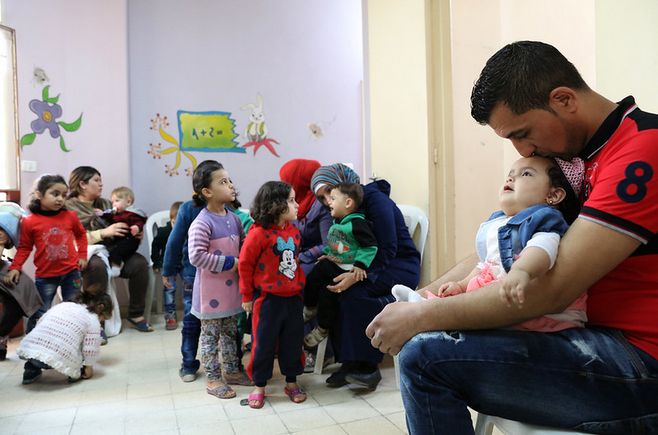
Journal of Travel Medicine, taad084, https://doi.org/10.1093/jtm/taad084. Image caption/credit: Syrian family refugees wait to vaccinate their children © Dominic Chavez/World Bank via Flickr (CC BY-NC-ND 2.0)
- Log in to post comments