










































Desh Pardesh [At Home and Abroad]
In light of the fact that a major cause of spread of HIV in Nepal is internal and cross-border migration to big cities in India, Desh Pardesh weaves messaging about HIV/AIDS prevention, care, and treatment into its episodes. In addition to being broadcast locally through 6 local FM stations in mid- and far-western districts and Radio Nepal, it is also broadcast via satellite in an effort to reach migrants in India and their families in Nepal.
The programme seeks to bring separated husbands and wives closer by affording the ability to send audio letters through the programme - often communicating messages about safe sex and HIV/AIDS. Every week the women's audio letters are recorded by community reporters in the remote western region. They are then compiled and broadcast from Kathmandu. Sunkesha Wod sent this pragmatic message to her husband working in Mumbai: "The children and the cattle are doing fine," she says during a broadcast. "The rice harvest was 150 kg. I have heard about HIV, be careful about it to save our lives." Satellite technology enables such messages to reach the Nepali communities in Mumbai directly at the same time the programme is reaching their families and spouses back home. The men abroad are also able to record their voices and send messages home to their wives in Nepal through the radio programme. Nirmal Rijal, Country Director of Equal Access Nepal, comments on the strategy: "There is nothing more powerful than hearing from a loved one when you away from home. You hear the voice of your near and dear one with certain messages I think that is very powerful and it goes a long way in preventing risk behaviors among Nepali migrants in Mumbai."
Desh Pardesh also teaches a song that is sung by Nepali women working alone in their fields with their husbands away in India in search of a livelihood. "Brothers who are in India, come home with money," the jingle says. "But not AIDS." Women reportedly sing this jingle during their work in the fields or elsewhere, thus educating others - including people who do not listen to Desh Pardesh.
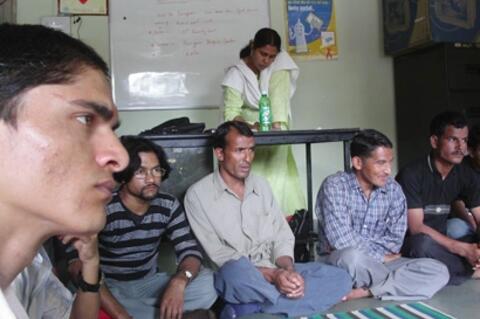
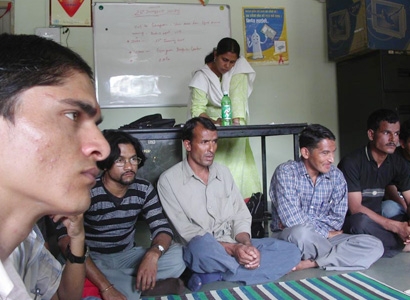
Reportedly, women often gather in groups within villages to listen to the programme together and then discuss the issues raised.
HIV/AIDS.
While there are about 14,000 people in Nepal with confirmed cases of AIDS or HIV after blood tests, the National Centre for AIDS and STD [sexually transmitted disease] Control estimates the number of infected people to be over 70,000. Nearly 50% of people living with HIV in Nepal are migrant labourers.
With an existing labour force of nearly 10 million, Nepal is experiencing an annual increase of 350,000 workers, according to Yubaraj Khatiwada, vice-chairman of the National Planning Commission (NPC) of Nepal. "However, while about 150,000 new workers can be absorbed by the country, the rest has to look for jobs abroad," he says. So each year, thousands of unskilled Nepali labourers go to India in search of livelihood. (The border between India and Nepal is open, and a bilateral treaty does not require the citizen of either to hold a visa and employment permit to stay and work in each other's territory). Many then live in poor unhygienic environments that make them vulnerable to diseases. Also, many of the men, who are without their families, frequent the brothels, where they may end up being infected with sexually transmitted infections (STIs) and/or HIV/AIDS and then carry the infection back home to Nepal.
Tilak, age 25, comments: "I come from Accham district in Nepal. I am working as a Security Guard with a housing society in Mumbai....I feel I get lot of relevant information on safe living through At Home and Abroad. I used to be in very high-risk behavior of visiting sex workers without using condoms, but after listening to the radio program I started using condoms regularly....I also share most of the information I learn from Home and Abroad with other Nepali friends & peers and mobilize them to listen to the radio program communally."
Satish Raj Pandey, Deputy Director of Family Health International Nepal, says: "We have seen that a number of these radio listeners group have actually walked to a clinic to get tested for both HIV as well as sexually transmit infections and in some of the districts that I have visited what I have seen is that when their husbands come home for holiday or after they've finished working in India, they have also encouraged their spouses to get themselves tested and at times they have actually used means to even trick the husbands into it. They somehow avoid having Sex with the husband for the first week or so by which time they would have encouraged their husband to go and have an HIV test. I think this program is having an impact."
Funded by Family Health International Nepal.
"AIDS Has a New Name in Nepal: Mumbaiya", by Sudeshna Sarkar, December 1 2009 - forwarded to the "SAFE - Social Action Foundation for Equity" Google Group on December 1 2009; Equal Access website, accessed December 29 2009; and "Radio Saves Wives from HIV/AIDS Infection in Nepal", by Jaya Luintel, Asia Calling, November 29 2008.
- Log in to post comments