










































Design and Evaluation of a Branded Narrative Story-based Intervention to Promote HPV Vaccination in Rwanda
The George Washington University
"Supporting individual health seeking behavior can drive demand for a broad range of adolescent services."
Though evidence is limited, efforts to promote human papillomavirus (HPV) vaccination in low- and middle- income (LMIC) countries appear to be hampered by barriers such as myths that the vaccine leads to promiscuity or infertility. Health branding is a strategy for behaviour change that involves creating mental associations with beneficial behavioural outcomes. Conducted in Rwanda, the present research used an existing multi-platform brand for girls' empowerment, called Ni Nyampinga (NN), to test a novel approach to HPV vaccination promotion. It is outlined in a PowerPoint presentation (and video, below) delivered at the Merieux Foundation 7th Vaccine Acceptance Meeting: Evidence-Based Policy for Vaccines - Update on Current State of Behavioural & Social Determinants of Vaccination.
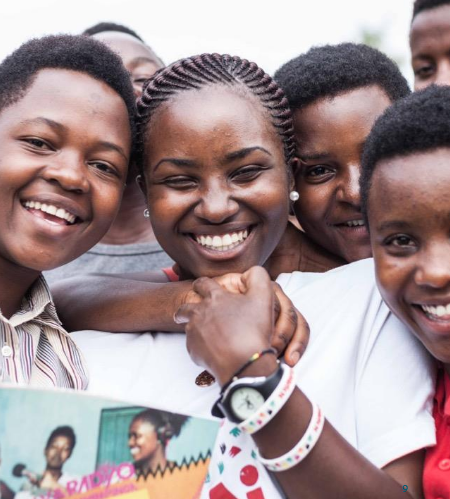
Meaning "beautiful girl inside and out who makes wise decisions" in Rwanda's language Kinyarwanda, the purpose of NN is to give adolescent girls in Rwanda the information and inspiration to fulfil their potential. Launched in 2011 by Girl Effect (see Related Summaries, below), the youth brand is made up of a magazine, radio drama and talk show, and a network of clubs and digital platforms that are created for girls by six 18- to 24-year-old Rwandan journalists. Grounded in principles of entertainment-education (EE), NN uses an indirect, storytelling approach to address specific issues around knowledge, attitudes, behaviours, and norms across the domains of health, education, economic empowerment, and safety, alongside broader themes around confidence and value. NN has become a nationwide movement, with 8 in 10 of all Rwandans aware of it and 55% of people over 10 years old reading or listening to the products every year (over 4.3 million people).
The efficacy study (2017-2018) of NN branding to promote HPV vaccination uptake involved:
- Formative research (focus groups with girls age 9-15) - lessons learned:
- In general, girls show positive relationships with health centres and positive knowledge and attitudes towards vaccines in general.
- Awareness of the HPV vaccine is variable, but the majority understand there are significant health benefits for girls/women.
- Sub-optimal information can create space for the spreading of rumours, such as that the vaccine will stop girls from being able to give birth in the future; these rumours can be compounded by anxiety about the pain of the needle for some.
- Fathers are likely to have accurate information, as they listen to radio; however, they are less likely to speak with their daughters about it.
- Prototype test to develop 3 radio messages to promote HPV vaccination among girls age 12-13 who had not yet been vaccinated:
- Unbranded direct (control): 78-second audio with direct messaging (public service announcement (PSA style) on how/why to seek out the vaccine
- Branded direct: 77-second audio clip, branded as NN with an older female authority (Baza Shangazi) talking directly to the audience, and a direct message on the importance and the need to vaccinate
- Branded indirect: 88-second audio clip with conversation between Baza Shangazi and a female journalist around the vaccine and the health implications and value for girls' own health.
Summary prototype results:
- Indirect style of content delivery was preferred over direct style.
- Familiar, older female presenter was trusted to provide health information and advice.
- The infertility myth can be countered.
- Messages can create positive attitudes toward HPV vaccine (and vaccines in general).
- Girls respond positively to messages that encourage looking after one's own health.
- It is possible to talk to girls about HPV virus when presenter is trusted and takes the time to explain.
- Men are not viewed as appropriate presenters of HPV vaccine information for girls.
- Efficacy trial - Randomised 726 girls to 3 groups with the one of the above messaging approaches. A pre-test survey, which exposed girls to their radio spot, found that knowledge about HPV was already quite high (most 90% or higher true responses) and that radio was the most common form of media use. Each girl was given an MP3 player with their condition's radio spots and asked to listen to them for 2 weeks; they were re-interviewed at post-test. Overall, it was found:
- Significant treatment effect of the branded indirect upon levels of knowledge (overall scale), compared to the control;
- Significant treatment effect of the branded indirect upon levels of knowledge (single item about effectiveness of HPV vaccine as preventive medicine for cervical cancer); and
- Dose response effect of brand indirect messages on attitudes toward HPV efficacy/safety.
Although this test was brief and exposure was limited, in a single channel, this study indicates that HPV vaccine knowledge/attitudes can be changed by exposure to branded messages. Factors to consider in future research:
- Intensity/duration of treatment
- Who says what message to whom...when and where?
- Channels relative to audience/location
Merieux Foundation 7th Vaccine Acceptance Meeting Booklet [PDF] and Girl Effect website, both accessed on November 22 2019.
- Log in to post comments