










































A Design Experiment: Imagining Alternative Humanitarian Action
"What would humanitarian action look like if it were re-imagined based on lived, human experiences? The primary aim for our design consultations was to explore just that."
This document shares the ideas and discussion that emerged from a six-month project to reimagine humanitarian action using design thinking, part of the wider two-year (2015-2017) 'Constructive Deconstruction' initiative led by the Humanitarian Policy Group (HPG) at the Overseas Development Institute (ODI). The document: describes how the approach taken is different, outlines the design challenge, profiles the various users of the system and some of their experiences, explores what a future state vision for humanitarian action could look like through a series of ideas and frameworks, takes a deeper dive into a few of those ideas and how they may be implemented in practice, and reflects on both the outcome of this process and its limitations. This design guide documents the ideas and discussions that emerged through design thinking in order to reimagine humanitarian action. In short, looking through a human-centred lens, it envisions a framework in which future responses are based on a clear understanding of the needs of crisis-affected people and proposes ideas for how humanitarian actors might do better to meet them.
As Christina Bennett, Head of the HPG, puts it in the report's Foreword, "Design Thinking is a collaborative tool that uses human experience to develop solutions to complex problems....Design Thinking is creative more so than theoretical, employs human connection, more so than statistics, and while based on principles of product and systems design, it's focused on user journeys and experiences." ODI felt that this type of approach is needed given that recent efforts to reform the humanitarian system have resulted in tweaks to current practices without challenging the assumptions, approaches, and architecture that have underpinned the system for decades. "Humanitarian action is inadequate, inappropriate, inefficient, untimely and inflexible and therefore, not fit-for-purpose." Given that the way humanitarian actors are working is simply not working, it is time for a system rethink. Once ODI settled on Design Thinking as their approach, they brought in ThinkPlace and convened a group of experienced humanitarian practitioners, refugees, and other recipients of aid alongside people from the private sector, finance, academia, and the media as co-designers.
The key design question: How might international humanitarian action become adaptable and accountable in ways that recognise people affected by crisis as the agents of change in their own lives? Research and design teams in North America, East Africa, and Europe extended out to conduct research and design activities in 23 locations around the world (including but not limited to Syria, Turkey, Kenya, and Greece). The specific aims were to:
- Surface situated stories and narratives about people's touchpoints with the formal humanitarian architecture, framing those experiences in their own words, and designing preferred future scenarios from a place of deep empathy with them.
- Identify "extreme cases" and cases of "positive deviance" where people interacting with the formal humanitarian architecture share the ways they work around the barriers they encounter.
- Provide a deliberate and safe space to co-design preferred future experiences WITH people who interact with the formal humanitarian architecture, rather than FOR or TO them.
Taking a co-design approach on this project started with building a shared understanding of the intent or vision (the change being sought), leading to a process of rapid exploration and divergence as project collaborators explored, innovated, and tested until they finally converged to formulate the future vision. Throughout the course of the design process, diverse audiences in the sector were brought together for intensive, hands-on learning and co-creation opportunities. The process directly engaged over 100 other actors (from various institutional and geopolitical contexts in the sector) through exploratory research, group testing sessions, ideation workshops, and more. "Taking a human centred approach means we look to understand the attitudes, expectations, past experiences, current knowledge, current behaviour, motivational intent and social norms - this depth of understanding can be then leveraged into nudges and larger scale interventions that speak to people's innermost drivers."
The core design team (former practitioners, former United Nations (UN) representatives, informed observers, and experts in humanitarian financing, conflict, resilience, and change) identified 10 key pathologies that pertained to what is understood as the humanitarian system. This was achieved through exploratory interviews with 75 "users", including recipients, practitioners, and experts across 16 locations and 73 organisations, as well as an extensive literature review. Within each of the 10 pathologies identified, the report outlines the key insights and opportunities and provides relevant and supportive quotes from the interviews. To cite only one example: forgetting the human in humanitarian: International humanitarian actors are neither trained nor incentivised to be humble, to really listen, and empathise in a way that is respectful of human connection, culture, and context. This has led to poor relationships and distrust on the ground. An opportunity would be investing more in human-to-human relationships and trust. Improving coverage and reach involves greater reliance on local connections with strong reputations. Quote from a local non-governmental organisation: "There's a qualitative difference between what people discuss under a tree sitting on rocks in the hot sand than those people sitting in an air-conditioned conference room at the capital level and in between...when you're in that position on the ground, you see things...you see a lot of things..."
Based on the insights on the pathologies gained from interviews with frontline responders, people affected by crisis, experts, and practitioners, key strategic shifts were identified in order to reform international humanitarian crisis responses. These shifts focused on three keys areas: enabling agency of people affected by crisis; improving the humanitarian system’s ability to adapt response to ground realities; and focusing accountability to people affected by crisis.
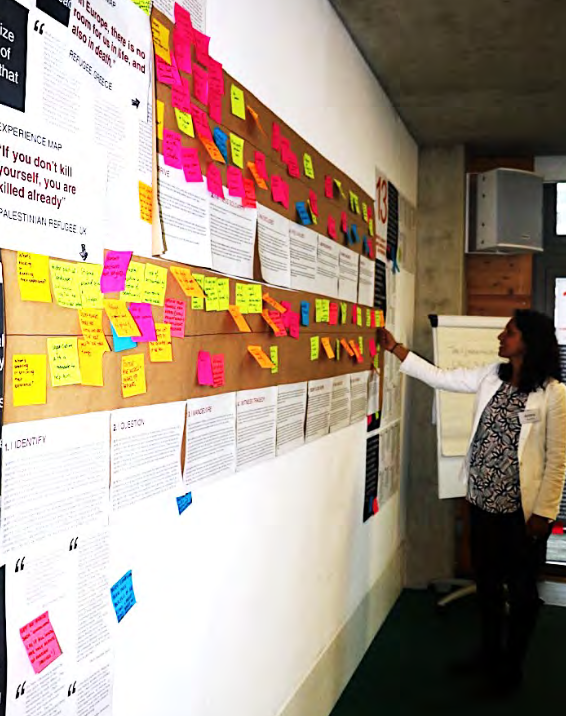
An important step to the beginning of any design process is situating the design challenge within the context of the key actors. In this case, understanding the broad actor groups, key entities, their roles, functions, and relationships through a non-representative "wheel" visualisation allowed the team to circumvent discussions around real/perceived hierarchies and, instead, it provoked conversations about where and how current humanitarian action fails to place "people affected by crisis" at the centre of its operations - despite all the well-intentioned rhetoric. The personas created during this project, which were based on composites of actual interviews, are situated across a two-by-two matrix, revealing the user groups' relative capacity to influence change in the humanitarian system as well as their relative degree of "affectedness" as it relates to crisis. The report showcases abbreviated versions of all 14 personas. It goes on to display snapshots of 11 "experience maps", or human stories that were documented from exploratory research with system actors. They are presented in "first-person" verbatim form, to give the reader the opportunity to empathise with and embed themselves in that user’s thinking and actions. These stories are annotated through "barriers" and "enablers", which were posted up by participants of the co-design workshops.
The framework for imagining alternative humanitarian action has four layers to it: the why, the who, the what, and the how. The "future experience pathway" laid out in the report outlines key user needs that international humanitarian actors could use as starting points to respond to needs such as resilience, protection, assistance, a sense of community, a future, and self-reliance. These needs can be met through many various touchpoints by many various channels. So, in this context and from a place of empathy and understanding, a diverse set of humanitarian actors were convened for a two-day "Insights and Ideation" workshop May 3-4 2017 to brainstorm potential ideas to address their needs and challenges. Together, they then shortlisted those ideas and then developed those ideas into concepts that could be built out into prototypes so that designers could work iteratively to test and refine those prototypes according to user feedback. The project organisers not only tested concepts through interactive workshops, but also through comparative analysis (one-on-one interviews with people who are engaged in real-world applications of concepts similar to the ones developed through this process). In total, the testing engaged 31 people across several protracted crisis contexts from 25 distinct organisations.
These prototypes ranged from proposals for discrete interventions to a call for large-scale cultural changes in the system. Specifically, four ideas were prototyped; they include, in brief:
- Community-led response fund: Communities manage and allocate their own rapid response fund. Example activity: Community groups use social media such as Facebook pages, discussion groups, and tweets to inform members in the community on how funds are used, who is involved, the progress of activities, and expected outcomes.
- Relief watch: An independent watchdog provides a rating of performance and aid effectiveness based on user and expert reviews. Example activity: Training journalists, activists, and civil society members to conduct community perception surveys, media monitoring, and rumour tracking of aid response - supporting them to report, advocate, and pressure national leadership.
- Humanitarian social economy: Humanitarian supply chains grow and support community-owned cooperatives. Example activity: Based on needs assessments and priorities in the community, the investment fund committee can support community-owned schools, health clinics, etc.
- United Beyond Nations: Affected people connect directly with local, national, and international responders and service providers via a networked humanitarian platform. Example activity: A person affected, frontline responder, or community organisation encounters a specific problem during a crisis and identifies what they need from the specific "problem areas" on the United Beyond Nations digital platform.
In conclusion: "People affected by crisis and conflict have rights. When states struggle - or fail - to protect and provide for their people's needs, the global community has an obligation to act. We, the Core Design Team on this project,...recognise that, at its worst, the sector can be impatient, competitive, bureaucratic, and demonstrate poor accountability to the people it claims to be helping. It is time to turn this behaviour on its head, unravel the current top-down model of humanitarian action and create a new paradigm. This new paradigm has three core elements: Agency, Adaptability and Accountability. Using this paradigm, we:
Agency
- acknowledge that people affected by crisis are humanitarian actors and active agents of change in their own lives;
- commit to recognising and supporting those best positioned to respond, irrespective of our own political agendas and financial interests; and
- commit to addressing the imbalance between the voices of donors and the voices of crisis affected communities, so as to place them at the centre of policy, planning and operational decision making.
Adaptability
- acknowledge that others have an important and legitimate role to play in assisting and protecting crisis affected communities; and
- commit to creating organisational incentives for collaboration, co-creation and failing-forward in a spirit of honesty, transparency and learning.
Accountability
- commit to independent reviews of our application of humanitarian principles and professional standards and publishing the results of such reviews.
- aim to ensure a level of coverage, assistance and protection in line with the principle of impartiality and in line with fundamental human rights.
With this in mind, we will do three things: work and advocate for states to better fulfil their obligations; mobilise a diverse coalition of actors to test new models of support, and source new funding streams to stimulate and embed innovation."
"Living this ethos means nurturing a new approach, a behavioural shift through a different way of thinking, speaking, and doing."
The team reflects: "Ultimately, what this process had to offer was a new approach to system change that charted out the desired experience of system users – from aid recipients to frontline responders to large aid agencies and the donors that fund them - and derived from this the ethos, characteristics and culture this ideal system should embrace in order to enable these ideal experiences: in short, a more interconnected and adaptive humanitarian system that is built upon the agency of people, and is held accountable for its failings and successes. Moreover, this human-centred design process has proven to be a rich launch pad for re-thinking the way change happens in this system."
ODI website, February 5 2018. Image credit: ThinkPlace
- Log in to post comments