










































Designing Inclusive HPV Cancer Vaccines and Increasing Uptake among Native Americans - A Cultural Perspective Review
Northern Arizona University (Bordeaux, Baca, Caporaso, Lee); University of Colorado Anschutz Medical Campus (Begay); University of Arizona (Gachupin); The University of Arizona College of Medicine-Phoenix (Herbst-Kralovetz); University of Arizona Cancer Center (Herbst-Kralovetz)
"It is only through demonstration of true participatory research that holds optimized direct benefit for tribes that future vaccine trials will be received favorably."
Despite a global and nationwide (United States - US) decrease, Native Americans continue to experience high rates of cancer morbidity and mortality. Vaccination is one approach to decrease cancer incidence, as in the case of cervical cancer. However, the availability of vaccines does not guarantee uptake. This review uses a critical Indigenous lens, as four of the authors self-identity from four unique Native American communities, to examine human papillomavirus (HPV) vaccination in Native American communities. After discussing reports of cervical cancer and HPV prevalence among Native Americans, the article explores historical trauma and medical distrust, considerations for broadening immunity in HPV vaccine design, and best practices for engaging Native American communities in future cancer vaccine trials and uptake.
Figure 2 in the paper highlights government actions and milestones relevant to Native American communities and health, including those for cancer and clinical trials. The authors also provide context for today's distrust among many Native Americans. For example, Native women have been restricted access to healthcare and the right to bear and raise children, as evident in the sterilsation of Native women without informed consent in the 1970s. These practices harmed the relationships between the US government and tribal families and communities. There has also been evidence of bioethical misconduct toward Native Americans in more recent years, when the Havasupai Tribe learned their biosamples, initially collected for genetic studies on type 2 diabetes, were used to study schizophrenia, inbreeding, and population migration, which did not benefit the tribe (as was the stated intent).
Examples of other negative experiences of tribes in trials have included not being recognised as sovereign Nations, naming tribes (resulting in decades-long stigmatisation), disseminating results without prior review or approval, or carrying out practices that cause direct harm. Research is often seen as a means to advance academic careers, garner funding for institutions, and publish harmful findings with little to no direct benefit to tribal entities.
Another type of harm comes when Native Americans and other racial/ethnic groups are underrepresented in, or excluded altogether from, scientific research. Native Americans have not been included in vaccine impact studies since the introduction of the Gardasil 9® HPV vaccine. The most prevalent high-risk HPV (hrHPV) types in cervical cancers among Native American women have not been well studied; however, two studies suggest that other hrHPV genotypes not represented in the currently approved vaccines are found frequently in these populations. Despite their exclusion from past and ongoing clinical trials, Native Americans continue to have high vaccination rates across the nation.
One concern is that "Misconceptions and misunderstanding surrounding vaccine formulation may cause hesitancy in vaccine uptake....For example, cultural concerns were raised by traditional healers and medicine men regarding the recent Coronavirus 2019 (COVID-19) vaccines....It is important that vaccine sponsors and government agencies are aware of such concerns and provide more transparency and work equitably with sovereign Tribal Nations, in order to stop the spread of false information and increase vaccine acceptance."
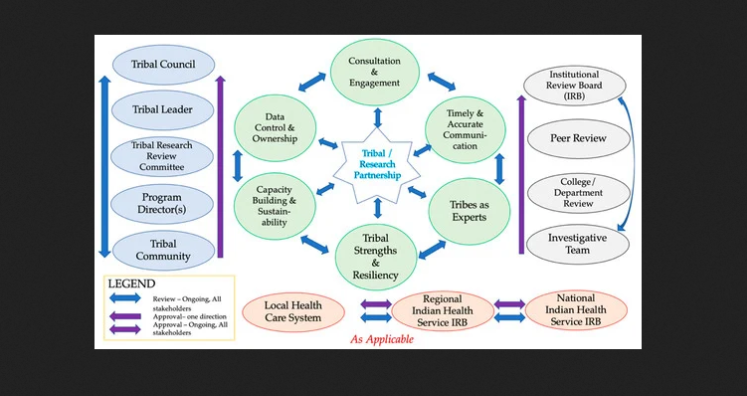
The authors go on to offer guidance when engaging with sovereign Tribal Nations in vaccine development and clinical trials in order to increase trust and encourage vaccine uptake. The "best practices" include:
- Consultation and engagement: The focus, question, goal, hypothesis, and objectives of a research study should be jointly determined. Engagement should begin early: For vaccine trials, the investigator or pharmaceutical company should initiate tribal partnerships long before presentation of the research protocol. Most tribes have established their own procedures and processes for reviewing proposed research, in addition to any university or commercial institutional review board (IRB). Tribal review and approval of a vaccine trial is critical, as their assessment of harms and benefits will be unique to their community and tribal members. Evidence of this approval is often a binding document known as a tribal resolution; oftentimes, a tribe will also require a memorandum of understanding or agreement (MOU/MOA) and data sharing agreement. If a researcher is working with more than one tribe, review and approval must be sought and obtained from each tribe. No public dissemination of results should occur with the general or scientific community without prior review and approval by the tribe.
- Tribal data control and ownership: "In true recognition of tribal sovereignty, data garnered as part of the research partnership belongs to the tribe. Furthermore, any sharing or use of data beyond original specific aims must be cleared and allowed by the tribe..."
- Timely and accurate communications: Communication with the tribe should always be in lay terms and avoid jargon or acronyms. Researchers should provide visual aids (e.g., illustrations of methods and procedures) for everything being proposed and, if possible, include a lab and clinic tour to demonstrate steps and introduce personnel. For vaccine trials, which are often multi-centre based, it is important to provide tribal leaders with clearly presented baseline data and then regular updates on ongoing data safety, adverse or reportable events, audit reports and findings, and status of the overall trial. "It is through timely and accurate data reporting that tribes will be fully engaged and supportive of vaccination, especially among youth, both male and female."
- Capacity building and sustainability: "An essential component of tribal sovereignty is self-governance. Vaccine trials have the potential to build tribal research capacity by which Indigenous scientists can lead research that is directly aligned with community needs and values which are essential for long-term culturally sustainable science...Deliberate actions should be undertaken to enhance the skills, knowledge and understanding of the research for tribes...For example, if a tribe were asked to participate in SARS-CoV-2 vaccine trial, and the tribe does not have local experts in protocol specifics, the researcher can secure a consultant to help the tribe with its determination."
- Acknowledgement of tribes as experts: Creating a framework to engage Indigenous peoples and communities in clinical trials should be part of an effort to build trust, increase inclusion of diverse groups in research, and enhance ethical research practices that promote tribal research regulations (e.g., tribal oversight and consultation) and benefits to participants and their communities. Collaborations with tribes and community members that recognise their expertise can build trust and can enhance research participation throughout the study's duration and beyond.
- Contribution to tribal strengths and resiliency: "The tribal experience is expansive, and the tribe is the most informed on what works best for them. In any kind of research, especially one that deals with sensitive topics or biospecimens, it is very important to engage respectfully. The more the research foci address these research priorities and recognize the past historical and current harms, the more a tribe may consider participation." Researchers are encouraged to share results of research efforts with the community at large so there is community-level ownership and responsibility for disease prevention and health promotion. These community open forums would need tribal clearance and approval of presentation materials beforehand.
In conclusion: "As in any positive human experience, building strong relationships is essential when communicating with tribes about the importance of cancer prevention. Rapport and trust are essential, especially when the conversation focuses on the safety and efficacy of HPV or other vaccines in preventing cancer....It is only through consistent and comprehensive messaging which tribal leaders fully understand that community-based endorsement and implementation will occur."
Current Oncology. 2021, 28, 3705-16. https://doi.org/10.3390/curroncol28050316.