










































Down But Not Out: Vasectomy Is Faring Poorly Almost Everywhere - We Can Do Better To Make It A True Method Option
"Program managers should coordinate demand-side and supply-side interventions, promote constructive male engagement, identify and support vasectomy champions, and use a range of communication modalities to increase accurate knowledge of vasectomy."
Vasectomy is 1 of only 2 contraceptive methods for men; and 1 of 2 permanent methods of contraception. Despite vasectomy's early programmatic introduction (in the 1970s) and many positive method features, there has been low demand for vasectomy services. Vasectomy's adoption has been impeded by deep-seated myths and misconceptions, with provider bias against it widespread. In addition, programmatic attention and donor funding have been limited and sporadic. This article seeks to deepen the international family planning (FP) community's focus on vasectomy and suggests how to improve programming for vasectomy so that it becomes a regularly available and accessible, rights-based method option for people in low- and middle-income countries (LMICs).
Global vasectomy use has declined markedly over the past 20 years, even as overall contraceptive use and demand for longer-acting methods has expanded substantially almost everywhere. Vasectomy's use has yet to advance above negligible levels in almost all LMICs. Countries with the lowest gender inequality are among those with the highest vasectomy prevalence, and vice versa. The article explores the reasons for vasectomy's low and declining use and reviews the few countries that have bucked this trend, drawing lessons that can inform future programming. For example:
- South Korea, formerly an LMIC, has the world's highest vasectomy prevalence, 17% (among 176 countries), and vasectomy accounts for 25% of all method use (among those married or in union - MWRA).
- In Bhutan, a couple's choice of vasectomy after attaining desired family size is a longstanding societal norm, with 1 in 6 MWRAs relying on it.
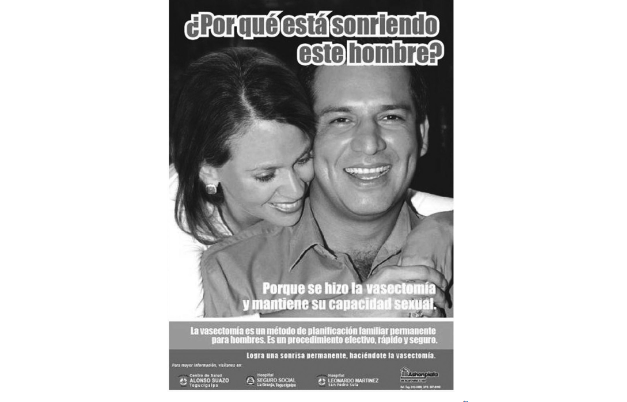
- A demand-side mass media effort mounted in the late 1980s in São Paulo, Brazil, contributed to a tripling of vasectomy prevalence between 1986 and 1996, from 0.8% to 2.6%, and doubling again by 2007 to 5.1%. Lessons learned include: Mass media can affect vasectomy-use behaviour, not only knowledge; mass media promotion needs to be maintained to avoid fall-off; and promotion of male responsibility and service provision by vasectomy-provider champions is effective.
- Costa Rica has a vasectomy prevalence of 5% - the highest in Latin America and the Caribbean (LAC) since 2010 across 4 consecutive surveys - and has the highest adjusted ranking on gender equality (low gender inequality index) of any LAC country.
- Between 2016 and 2021, Marie Stopes International (MSI) supported vasectomy services in 26 countries, 22 of them LMICs. During that 5-year period, more than 225,000 men received a vasectomy via static clinic networks, mobile outreach operations, or capacity-building of public sector providers.
- Over the past decade, World Vasectomy Day (WVD), a non-governmental organisation (NGO) network of vasectomy champions, has supported vasectomy awareness and service provision in the United States (US), Canada, and a number of LMICs. WVD master trainers have trained interested service providers who in turn have trained others, leading to more than 70,000 vasectomy procedures in Bolivia, Colombia, Ecuador, Mexico, Indonesia, Rwanda, and elsewhere.
- The experience of MSI/Bolivia, with support from WVD, holds promise as an emerging success story in expanding access to vasectomy services. It also provides suggestive evidence that relatively few trained vasectomy providers and vasectomy procedures may be needed for a country to attain a modest 1% level of vasectomy prevalence.
- Through cascade training beginning in November 2021, MSI/Bolivia and WVD had 10 trained providers working through 4 mobile and 6 fixed facility sites, complemented by an active vasectomy awareness campaign.
- In the 12-month period beginning in December 2021, 906 vasectomies were performed by these providers (representing 6.7 person-years of service).
- Doubling this number of providers (with continued awareness promotion) would result in 2,938 vasectomy clients served annually.
- Given the population of Bolivia (~12 million) and using double-decrement life table calculations, maintaining this level of effort over 15 years would result in a national vasectomy prevalence of 0.5% after 5 years; 0.9% after 10 years, and 1.2% after 15 years.
Based on the above and related experience, the article offers 14 programmatic recommendations:
- Programming efforts need to be holistic, coordinated between demand-side, supply-side, and advocacy interventions, as the situation warrants.
- Advocacy for vasectomy at all levels of the FP ecosystem is important, especially to attain funding that is additive to existing FP programme budgets, not substitutive.
- Demand-side work needs to be a substantial part of vasectomy-related programming, including focusing on women as well as men and addressing gender constraints.
- Mass and social media channels and approaches should be harnessed to increase accurate knowledge of vasectomy as a method and link prospective clients to vasectomy service providers. This can be particularly effective and cost-effective per person reached.
- Training efforts, when indicated, should entail a whole-site training approach and use cascade training - coordinated with demand-side work.
- Vasectomy champions are needed at all levels - policy, programme, client, community, and donor - encompassing service providers and satisfied male users willing to discuss their vasectomy with others in their community.
- Among providers, a linked "network of vasectomy champions" could be helpful, leveraging the global health and FP/RH (reproductive health) communities' growing interest in safe surgery.
- Vasectomy services should be affordable and be provided via diverse programming modalities, depending on the country context.
- Follow-up support to vasectomy clients should utilise various media applications to reinforce clients' correct knowledge of vasectomy and reassure or assist them if any minor side effects from the procedure arise.
- One service delivery approach might be "postpartum vasectomy" provided during the 3-month initial post-procedure period where backup contraception is needed.
- "Success" should be reframed, with achievement of immediate increases in vasectomy uptake secondary to laying a foundation for a longer glide path leading to normalisation and sustainability of vasectomy within a country's method mix (i.e., "Change takes time.")
- Two small but important survey-related recommendations are to: (1) ensure all surveys of contraceptive use report values for vasectomy, even when prevalence is negligible and (2) replace the term "female sterilisation" with "tubectomy" to avoid stigma and to parallel the term "vasectomy".
- A vasectomy-focused initiative is needed, perhaps as part of a broader male RH project, to help vasectomy become better known and understood, more wanted, and more accessible to clients in LMICs.
- Programming efforts for vasectomy will likely be "pilots", so programme accordingly: Engage respected organization, medical, and community leaders, and plan for scale-up from the start.
Policy recommendations:
- Policymakers and donors should:
- allot more time, attention, and priority to vasectomy;
- provide additive and sustained funding; and
- adopt metrics of success that focus on programme inputs and progress toward longer-term goals, not immediate vasectomy uptake.
- Programme managers should:
- coordinate demand-side and supply-side interventions;
- promote constructive male engagement;
- identify and support vasectomy champions; and
- use a range of communication modalities to increase accurate knowledge of vasectomy as a method and service.
In conclusion: "let's walk our talk on broadening method mix, enhancing constructive male engagement in FP, and working toward gender equality by championing vasectomy and giving it greater attention, priority, and funding in LMICs. Doing so can help to reverse a decades-long, global downward trend and make this method a true, rights-based contraceptive option for more people."
- Log in to post comments