










































Dr. Ben Cislaghi - Director of Monitoring, Evaluation, Research and Learning, Tostan - DFID Girl Summit 2014
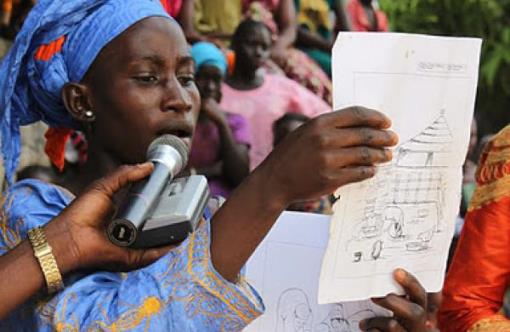
"One of the things we knew about the programme is that it had resulted in social change - one of these results was the abandonment of traditional harmful practices, but very little was known about the process..." Ben Cislaghi (from research by Cislaghi, Gillespie, and Mackie)
Panel Discussion: Spotlight on Progress - "Reaching Millions, Not Hundreds: Experiences in Scaling Up Community Social Change"
Context: This presentation is from one of the 14 "Spotlights on Progress" video-recorded sessions from the Girl Summit 2014, London, United Kingdom (UK). The sessions were organised to share best practice between practitioners, grassroots activists, and government ministers across the issues of female genital mutilation (FGM) (also FGM/C - female genital mutilation/cutting) and child, early, and forced marriage (CEFM). Girl Summit is a project of the Department for International Development (DFID), UK.
Profile of speaker: A featured panelist of this Spotlight session was Ben Cislaghi, Director of Monitoring, Evaluation, Research and Learning, Tostan, whose presentation was entitled "Values Deliberation and Collective Action in Rural Senegal". (See related summaries below for more on Tostan.) "Dr. Ben Cislaghi earned a Ph.D. in Politics and International Studies from Leeds University (UK) in 2013. His research explored how a model of participatory indirect development resulted in beneficial individual and community changes, such as the abandonment of harmful practices and women’s participation in public decision making. Dr. Cislaghi focuses on the effect of values-based education on the understanding and realization of human rights, and how human rights can influence social change. With co-authors Gerry Mackie and Diane Gillespie, Dr. Cislaghi is completing a forthcoming study, to be published by UNICEF [The United Nations Children's Fund], titled “Values Deliberation and Collective Action in Rural Senegal.” After completing his PhD, Cislaghi became Director of Monitoring, Evaluation, Research and Learning operations for Tostan, a non-governmental organization dedicated to bringing about sustainable development and social transformation based on respect for human rights."
Strategy overview: Cislaghi presents the work that he, Diane Gillespie, and Gerry Mackie did on examining Tostan's Community Empowerment Program (CEP) to find out what motivated community members towards collective action. After 5 years and hundreds of interviews, he brought five findings to the conference audience:
- First, deliberation and discussion about individual and collective values motivate the revision of harmful community social practices because they offer an opening for community-wide consideration in a non-threatening manner. The deliberation was framed in an international human rights framework which blended with local values and aspirations through local experiences. "A striking feature of these sessions was how each human right arrived as meaningless abstraction, was filled in with concrete local experiences and; responses, which turned it into a meaningful and actionable abstraction. The blend prompted reconsideration of past experiences, from unproblematic to problematic, from given to socially malleable. Finally, the human rights sessions culminated in a lofty but quite articulated aspiration to the realization of human rights for all."
- Second, the researchers found that the creation of revised social norms required a public sphere open to all in the community - without exclusion of those impacted negatively by social norms. In order to include the voices of the excluded, there was training for women in how to play a public role, with rehearsal with one another in classes of presenting key points in a public forum. "Women were newly able to present themselves in public, and more men were able to do so."
- The third finding was the importance of working with social networks, not just individuals, and with entire webs of knowledge. If a change is attempted in one part of the knowledge web, it will fail because the rest of the web functions to keep the knowledge web unchanged. “The new knowledge that respondents had been spreading to family and friends was being put into action by respondents to their benefit. Respondents now said they would engage more directly with others in the community who were indifferent or hostile to the program."
- A fourth finding was that changes in beliefs about self can contribute to a change in one's self; that can motivate a whole village. "They said they were better able to work together to bring about valuable changes for the community."
- And, fifth, by using the human rights framework to challenge inherited models of child protection, parents began to see options for their children beyond replicating the parents' opportunities. "Equality and freedom from discrimination, they said, were among the most important human rights and implied equal voice for women and younger; men. It also implied equal education for girls, and girls’ school enrollment had increased, according to respondents. They also said that equal education implies an end to forced and early marriage."
A year after the Girl Summit: "In 2014 and 2015, Tostan has continued to support the Government of Senegal’s established goal of total abandonment of FGC by 2017. Tostan’s Community Empowerment Program (CEP) is currently in place in 180 communities across the country. In 2014, 121 communities participated in a large public declaration for the abandonment of FGC in northern Senegal. Tostan's efforts have also led to the growth of the movement for the abandonment of FGC and child marriage in The Gambia, Guinea, Guinea-Bissau, Mali, and Mauritania, with a total of 180 new communities - representing 12,682 direct participants - engaged in Tostan’s CEP as of March 2015. Tostan reinforced the global effort to end FGC and child marriage by sharing information on content, methodology and strategy for changing social norms at the Tostan Training Centre (TTC). In 2015, a pilot training included 21 development practitioners and students from across East and West Africa, Europe and North America. The TTC will officially launch in 2016."
Overview of this Summit Session: From the Girl Summit summary document: "We know community-led social change is an effective, long-term strategy to promote abandonment of FGM and child, early and forced marriage. Reaching millions of people will be a key element of success in the global movement to end the practices and change the futures of as many girls. Yet the intensity, cost and technique of community-led social change present important challenges. Experiences in taking what worked with hundreds in one setting and scaling it up to entire districts and nations will be presented in this interactive spotlight...."
The speakers, in order of appearance, are:
Sonali Khan, Vice President, Breakthrough.
Adama Ndiaye, Secretary-General of the Ministry of the Family, Women and Children, Government of Senegal.
Dr. Ben Cislaghi, Director of Monitoring, Evaluation, Research and Learning, Tostan.
Ato Haileleul Seyoum, Director of Women and Youth Mobilization and Participation Enhancement, Ministry of Women, Children and Youth Affairs, Government of Ethiopia, and Dr Annabel Erulkar, Director, Population Council Ethiopia.
Hekate Papadaki, Grants and Development Manager, Rosa Fund.
The session is moderated by Rajesh Mirchandani World Affairs Correspondent/Anchor at BBC News."
Strategy points from the session outline include:
- "Scale Matters - given how widespread these practices are and the numbers involved.
- Girls should be at the heart of any approach. Girls can’t and don’t register complaints after the act. Action must come first to enable girls to have a view - to be able to able to say no and for example resist early marriage for example. Girls clubs and other mechanisms can support this process.
- How girls are valued matter (especially for child marriage) - dowry issues and how girls are seen matters. Push is to get families to invest in education of girls.
- Discourse matters - Issue is to shift the discourse on these issues and how they are talked about. Communities’ deliberations and discussions are crucial. These deliberations change communities’ views.
- Approaches can transform- Rights based approaches on these issues can challenge the vision that communities have of gender issues and rights more widely.
- How communities function matters - However, when community spaces and debate is restricted and excluded it needs to be opened up before change takes place. Women must join the public space to become actors.
- National leadership and political will matters - governments changing laws and clear messaging has an impact without it things are harder.
- Service providers play a role - health providers (esp. Reproductive health) child workers, education systems etc. all have a role and should be included in any approach. These actors need a shared vision and ambition.
- Religious leaders are important. - In the past child marriage was given support by the church. This must change.
- Linkages matter - Strong link between domestic violence, wider gender relations and CEFM.
- Communications are important - A clear communications strategy using media and other channels are important for scale. National schemes under which communities make public pledges have a role. They can tie in large groups of people.
- Many interventions are driven by limited evidence. - Research and randomized trials are on-going and will give us more information on what works and how. However, these sort of programmes that involve community engagement need to be flexible and learn from the process of implementation using trial and error."
Footage of this (available below) and other "Spotlights" are available on DFID’s YouTube channel.
The Girl Summit is a project of DFID. Click here and scroll down to see the full list of individuals and organisations committed to working on girls' issues, as well as a list of Girl Summit Charter signatories.
DFID Girls Summit Outcomes website and the "Values Deliberation and Collective Action in Rural Senegal", both accessed on August 12 2015. Image credit: Tostan
- Log in to post comments