










































Dr. Francesca Moneti - Senior Child Protection Specialist, UNICEF - DFID Girl Summit 2014
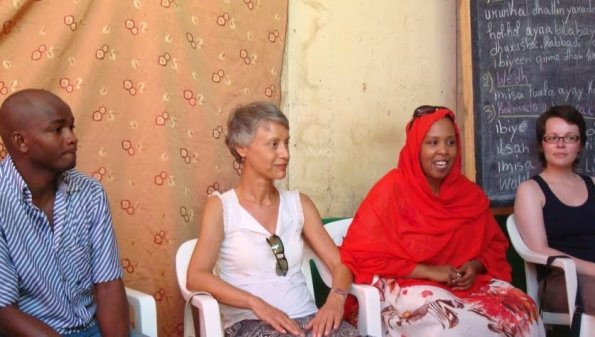
"When we began working on harmful practices, it became very clear to us very quickly that 'social norms' was fundamental." Francesca Moneti
Panel Discussion: Spotlight on Progress - "Prevention and Safeguarding: Protecting Those at Risk"
Context: This presentation is from one of the 14 "Spotlights on Progress" video-recorded sessions from the Girl Summit 2014, London, United Kingdom (UK). The sessions were organised to share best practice between practitioners, grassroots activists, and government ministers across the issues of female genital mutilation (FGM) (also FGM/C - female genital mutilation/cutting) and child, early, and forced marriage (CEFM). Girl Summit is a project of the Department for International Development (DFID), UK.
Profile of speaker: A featured panelist of this Spotlight session was Dr. Francesca Moneti, Senior Child Protection Specialist, The United Nations Children's Fund (UNICEF), whose presentation was entitled: Measuring social norm change. Francesca Moneti is responsible for policy and programme development on social norms and gender equality, particularly as it relates to preventing and addressing violence against children. Her focus has been on programming and advocacy to end FGM/C and child marriage.
Strategy overview: In this presentation, Moneti discussed the importance of social norms in perpetuating - and ending - FGM and CEFM. She described finding an operational definition of social norms agreed upon by academics, practioners, and communities for the purpose of measuring. She described it as a behaviour that people see around them and that conditions them to that behaviour: "if you feel that people around you want you to engage in that behaviour...[it becomes] a social obligation."
In discussing the measures needed to monitor change, she stated that there are data on prevalence and attitudes, but more data are needed on whether people believe that the behaviour - in this case, FGM or CEFM - is happening around them and whether that belief is driving them to engage in the practice, i.e., do they feel a social obligation to participate? She outlined areas of both individual and collective change that can be monitored. A change in people's feelings about the social obligation can be tracked and will be apparent before they change their behaviour. Thus, the work should be cast as promoting a positive new norm.
Moneti concluded by stating that we can support local volunteers and reporters to monitor these changes in social norms by tracking very simple markers/questions. Not only does this give very good information on shifts in the social norms but it also helps ground the work of local-level volunteers in evidence of what change is occurring. There is a process of discussion and dialogue that creates individual and collective empowerment that can be measured - who talks about it (the women, the girls, the boys); do they talk with each other; how do they talk about the issues. "We can support local measuring that becomes an empowering mechanism..." For example, in many programmes, there are volunteers in communities engaging in discussion; reporters for community radio stimulate discussion. Simple markers that community volunteers can track include: 1) is the discussion happening?; 2) is everybody discussing or is it limited groups?; 3) are people starting to question?; 4) are people starting to expect people to act differently?; and 5) are people's social obligations changing over time? By creating tracking, the volunteers doing the tracking become more aware of the process of change, and it becomes more deliberate."
Her presentation drew on analysis and evidence from the UNICEF 2013 report, "Female Genital Mutilation/Cutting: A Statistical Overview and exploration of the dynamics of change" (see source section below for a link to this resource).
Overview of this Summit Session: From the Girl Summit summary document: "This spotlight will share experience and discuss ways forward on measuring progress in addressing FGM and child, early and forced marriage - including measurement of changes in behaviour and the social norms which uphold these practises. Discussion will include the areas that need to be investigated; how they can be measured innovatively and ethically; and how this evidence can be effectively linked to national and international policy processes."
The session was opened by a "Commitment Announcement: Alexander Woolcombe from the Bill and Melinda Gates Foundation announced their commitment to join the global effort to strengthen the evidence base on FGM and CEFM. This includes: (i) working with Tostan to support their monitoring, evaluation and learning programme to understand how and why they are having impact; (ii) co-funding with CIFF to support ICRW and the Work Bank on research on the economic consequences of CEFM; and (iii) work in Ethiopia to improve nutrition and reproductive health by tackling structural determinants.
The speakers, in order of appearance, are:
Dr. Anju Malhotra, Principal Advisor on Gender and Rights, UNICEF - Assessing and measuring progress in child marriage reduction.
Dr. Francesca Moneti, Senior Child Protection Specialist, UNICEF - Measuring social norm change.
Dr. Caroline Harper, Head of Programme, Social Development, Overseas Development Institute (ODI) - Measuring empowerment and social transformation in the post-2015 agenda (OECD and ODI).
Kecia Bertermann, Monitoring & Learning Director, Girl Hub - Collecting data on empowerment and change in attitudes: innovations and ethics.
Professor Hazel Barrett, Coventry University/ Researching Female Genital Mutilation Intervention Programmes Linked to African Communities in the EU (REPLACE) - Approach to measuring community based behaviour change; Italy, Netherlands, Portugal, Spain and UK.
The session is moderated by Nick Dyer, Director General for Policy and Global Programmes at the Department for International Development."
Footage of this (available below) and other "Spotlights" are available on DFID’s YouTube channel.
The Girl Summit is a project of DFID. Click here and scroll down to see the full list of individuals and organisations committed to working on girls' issues, as well as a list of Girl Summit Charter signatories.
DFID Girls Summit Outcomes website, Blog: Ending child marriage: the time to act is NOW , and the "Female Genital Mutilation/Cutting: A statistical overview and exploration of the dynamics of change", accessed on August 7 2015. Image credit: Tostan website.