










































Ebola Response Anthropology Platform
Image
SummaryText
This online web platform has been created to give an anthropological perspective to assist in disease control efforts in Ebola effected countries, providing information about local cultures, belief systems, and practicies in the context of the Ebola response. "The aim is to enhance current efforts to contain the epidemic by providing clear, practical, real-time advice about how to engage with crucial socio-cultural and political dimensions of the outbreak and build locally-appropriate interventions."
The objectives are outlined as follows:
To submit information for inclusion on the portal, email ebola@ids.ac.uk
The objectives are outlined as follows:
- "to create an online resource portal enabling key stakeholders, practitioners, and researchers to access information, findings, and background resources about the socio-cultural, historical, economic, and political dimensions of Ebola;
- to identify, connect up, and support in-country anthropological and other social science capacity working in African countries affected by Ebola and to provide a platform for interaction with clinical, scientific, and outbreak control teams;
- to support relief teams and in-country clinical and social scientific capacity through training and guidelines oriented towards strengthening community-based activities; to provide rapid responses by e-mail, conference calls and web-based dialogues to operational questions raised by those working for NGOs, government and international agencies about how to contain the epidemic effectively;
- to develop appropriate anthropological resources and networks positioned to mobilise a rapid, substantive, socially-informed response to future Ebola outbreaks in vulnerable places, including: Mali, Cote d’Ivoire, Senegal, Uganda and South Sudan; and
- to inform global health policy by drawing lessons from the Ebola response and advancing a comparative perspective on Ebola and other emerging infections."
To submit information for inclusion on the portal, email ebola@ids.ac.uk
Source
Communication Initiative online forum submission from Naomi Marks, IDS on October 24 2014 and IDS website on November 3 2014.
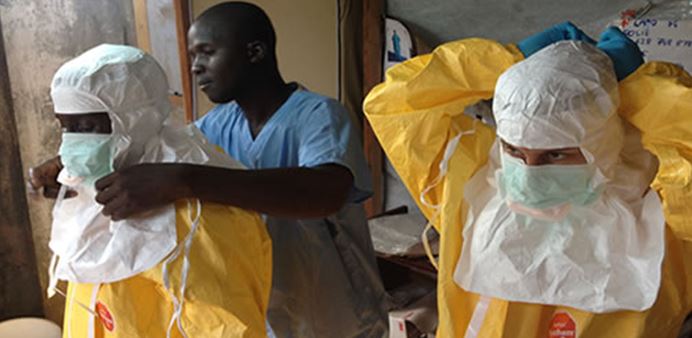
Image credit: European Commission DG ECHO (cc on flickr)