










































Essentials of Public Health Communication
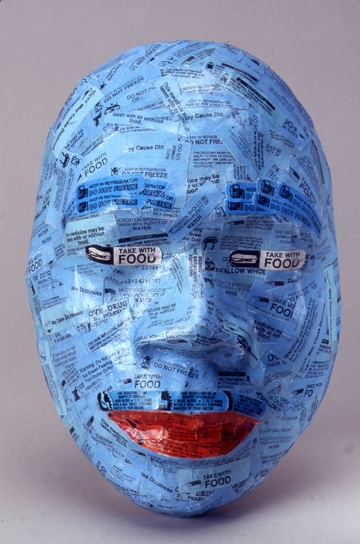
Essentials of Public Health Communication is devoted to the competencies in health communication and informatics recommended by the United States (US)-based Association of Schools of Public Health.
On the cover of the book is a mask, pictured above, entitled "Blue in the Face III: A Collaged Mask", by artist Frederick Weston. In her foreword, Dr. Claudia Parvanta explains the significance of this work of art and the many aspects of health communication it symbolises: "Telling someone to do something until you are 'blue in the face' is a folksy expression for what 'not to do' in health communication. And, Weston has particularly emphasized the advice to take his medication, (presumably for HIV), with food - advice he most likely found difficult, to impossible, to follow. (One of the complications of HIV is often a lack of appetite, or feeling nauseated.) He has covered the mask, or perhaps even built it up, of the tiny labels affixed to pill bottles dispensed by pharmacies. Prescription drug labels are notoriously confusing, and many of us are working to improve how we share information with patients about their illnesses, and their medications. Moving deeper in the mask, we can ask if Weston modeled it over his own face, or that of a friend? Whether in the making, or in the wearing, there is always a real face behind a mask. And, as health communicators, we must strive to know the real person, and not stop at the level of a 'persona'."
With chapter contributions from experts in public health informatics and epidemiology, health communication, and evaluation, Essentials of Public Health Communications introduces concepts and examples that are designed to prepare students to enter a local health department, community organisation, or government agency and then to contribute to health communication research, patient counselling, materials design, programme management, and media relations. Presented in what is described as clear, jargon-free language, with terms defined throughout, this book presumes no prior knowledge of the health communication or the informatics fields.
This text emphasises frameworks and methods, breaking down complex tasks into steps for mastery. It aims to simplify key concepts in public health informatics, clarifying how data are transformed into useful information and effective presentations. It examines how health communication is actively being used by the public health agencies and organisations, suggesting health communication projects that can be implemented at an academic institution or small-scale community level to enable hands-on learning. A companion website provides a complete package of instructor resources including sample syllabi and curriculum guides for two semesters of instruction, as well as small scale-research projects. (See the contact information below to inquire about accessing the companion website and other resources.)
Table of Contents
- Overview
- Chapter 1: Introduction to Public Health Communication & Informatics
- Chapter 2: A Public Health Communication Planning Framework
- Chapter 3: Informatics and Public Health
- Informing & Educating People about Health Issues
- Chapter 4: Understanding and Reporting the Science
- Chapter 5: "What" to Communicate? Understanding Population Health
- Chapter 6: Communicating for Policy and Advocacy
- Chapter 7: Speaking to the Public: Health Literacy & Numeracy
- Being Persuasive: Influencing People to Adopt Healthy Behavior
- Chapter 8: Persuasive Health Communications: The Role of Theory
- Chapter 9: Formative Research for Strategy Development
- Chapter 10: The Strategic Health Communication Plan
- Chapter 11: It's a Multi-media World
- Chapter 12: Developing and Testing a Media Strategy
- Chapter 13: Developing the Implementation Plan
- Chapter 14: Evaluating a Health Communication Program
- Special Contexts
- Chapter 15: Patient Provider Communication
- Chapter 16: Risk and Emergency Risk Communication: A Primer
416
"'Blue in the Face' Exemplifies Health Communication Through Visual Art", accessed on August 13 2012.
- Log in to post comments