










































Evaluation of the Responsible, Engaged, and Loving (REAL) Fathers Initiative on Physical Child Punishment and Intimate Partner Violence in Northern Uganda
Institute for Reproductive Health, Georgetown University (Ashburn, Lundgren); Save the Children United States (Kerner); Save the Children International (Ojamuge)
"Several studies have shown that working with men can have positive effects..."
Violence against women and violence against children in Uganda are recognised as significant public health concerns. In response, a community-based initiative called Responsible, Engaged and Loving (REAL) Fathers was designed to address gender norms that promote use of violence in child discipline and with intimate partners in post-conflict Northern Uganda. This paper describes evaluation results of the REAL Fathers Initiative's work to promote positive parenting and partnership skills building among young fathers (aged 16-25) with young children (aged 1-3) who were living with a wife or partner.
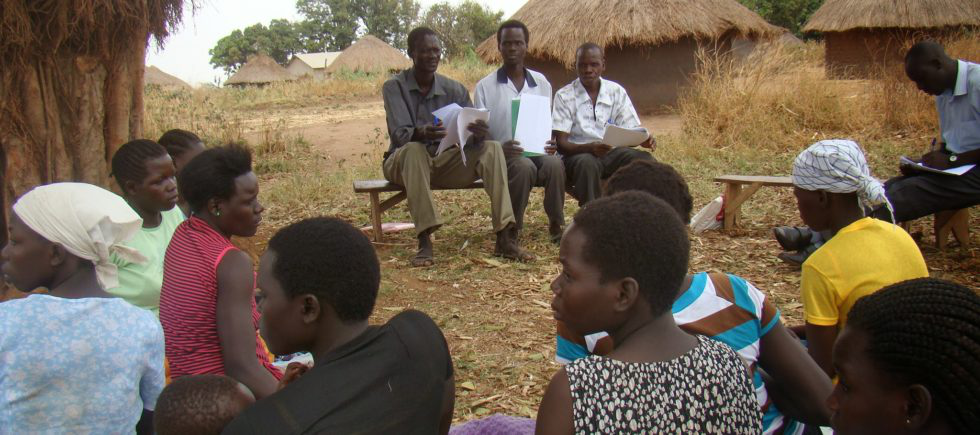
The REAL Fathers Initiative (see Related Summaries, below) was grounded in social cognitive theory. It used modeling of alternative strategies for nonviolent discipline and conflict resolution in an effort to improve fathers' parenting and communication skills and confidence in adapting nonviolent strategies. It entailed a community-grounded mentoring programme, wherein volunteers from the community were selected by the young fathers and then trained to serve as mentors, as well as the display of a series of six posters at locations in the community frequented by the young fathers. Corresponding with the themes and messages presented during the mentoring sessions, the posters included a photograph of a local father performing one of the desired behaviours, such as reading to his child, and a statement indicating that others approve of that action. After the final mentoring session, an open community meeting took place in each study community to support norm change. These community celebrations supported norm change by providing fathers a public forum to commit to continue practicing new skills and for the family members and others in attendance to commit their support for the men's adoption of positive change.
The study was conducted in two cohorts in villages across all eight parishes of Attiak sub-county, which was heavily affected by a 20-year war. A total of 340 men were recruited into cohort 1 in July 2013; 160 men were recruited in November 2013. Effectiveness of the REAL Fathers Initiative was evaluated by comparing men who participated in at least one individual and one group mentoring session (exposed) versus men who did not (unexposed), in two independent samples at endline and at long-term follow-up. Specifically, men were surveyed at baseline prior to implementation of the intervention and again after a 10-month intervention period, including a 6-month period of mentoring, posters, and community celebrations and a 4-month post-implementation period. All 500 men were surveyed at long-term follow-up in July 2015, 12 and 8 months for cohorts 1 and 2, respectively, after the end of the intervention period.
At endline, 256 (51%) men had been exposed to at least one individual and one group mentoring session. Of the entire sample, 66 (13%) men did not see posters with messages about fatherhood in their community.
Physical violence declined over time among the entire sample from 38% at baseline to 12% at long-term follow-up.
Table 3 in the paper presents levels of key parenting and partner relationship outcomes across baseline, endline, and long-term follow-up. Overall, there were decreases in perpetration of physical punishment and all forms of intimate partner violence (IPV), attitudes rejecting both forms of violence, and increases in positive parenting and confidence in using nonviolent discipline over time.
Some specific findings include: Men who participated in mentoring sessions as compared to men who did not were more likely to disagree with statements about the use of physical child punishment such as, "Parents should teach a child who misbehaves by spanking or hitting him/her" at endline and at longer term follow-up. Exposed men had significantly greater odds of feeling confident to manage their child's behaviour without resorting to use of physical violence or threats of violence in the short term and over the longer term.
Results of multiple logistic regression analyses testing the association between participation in the intervention and key partner relationship outcomes are presented in Table 5 in the paper. For example, exposed men as compared to unexposed men had significantly lower odds of justifying IPV for any reason at endline and at long-term follow-up, which the researchers suggest "is particularly notable given the relatively light nature of the intervention, implemented by volunteers with fewer than 10 days of training over a 6-month period."
The researchers point to the limited effects of the REAL Fathers Initiative on men's agreement with traditional gender roles at endline. This finding is reflective of "the challenge in addressing the underlying norms for men and women in the family context....Additional engagement with wives or other influential individuals in the lives of new parents could contribute to more significant change in attitudes and norms related to gender roles. While engaging men in reflecting on roles and expectations of women and men as parents is an important aspect of the REAL Fathers intervention, sustained change in gender roles likely requires more long-term support and broader community involvement."
In conclusion, the REAL Fathers Initiative was found to have led to "significant, positive effects...on increasing positive parenting practices, confidence in using nonviolent discipline, and lowering the odds of use of physical punishment, and use of psychological and verbal IPV."
Prevention Science (2017) 18:854-64. DOI 10.1007/s11121-016-0713-9. Image credit: © REAL Fathers