










































Expanding Reach Into Sanitation Market Through Behavior Change Communication: Lessons from Rural Cambodia
World Bank Group
Water and Sanitation Program
Cambodia has one of the lowest sanitation coverage rates in Southeast Asia and the Pacific region. Only one in three people have access to modernized sanitation facilities. In order to improve access to rural sanitation, the Water and Sanitation Program of the World Bank’s Water Global Practice has collaborated with Cambodia’s Ministry of Rural Development to test new sanitation initiatives. An early project in 2009 that focused on a low-cost latrine with no installation or shelter costs resulted in over 10,000 units being sold over a two year period.
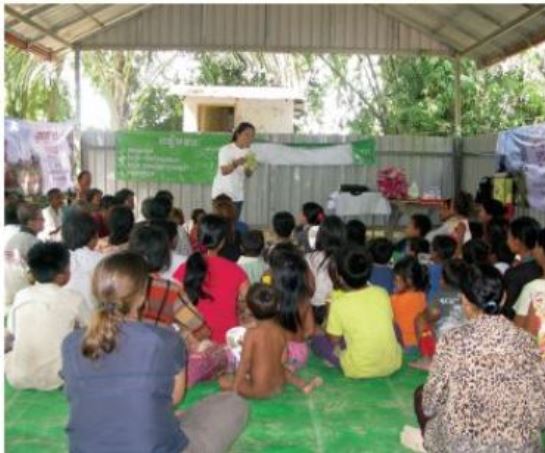
In 2011, The Water and Sanitation Program launched a new project, this time partnering with iDE, 17 Triggers (an agency that focuses on behavioral change communication), and the Commune Committee for Women and Children, an outreach collective that works to mobilise communities around health, education, and children’s development. Together, the three organisations undertook a two-year behaviour change communication programme that was geared toward researching and understanding the factors behind household decisions to purchase new latrines.
Behavior change campaigns can employ a variety of communication strategies. The Water and Sanitation Program project elected to use interpersonal communication for greater effectiveness in delivering complex messages to households, and because mass media outreach was too expensive for the government to maintain over a sustain period.
Key lessons learned from implementing the programme included:
Motivational factors - Key drivers for latrine adoption among rural Cambodians are status and personal convenience. Outreach materials used these triggers rather than more practical benefits such as improved health and sanitation.
Immediate solutions - Outreach materials also included supplier contacts, products, and prices, making it easier for households to make an informed choice at the close of a one-on-one meeting with project staff.
Affordability - Although one of the main messages stressed the low cost of new latrines and the achievability of new latrines for most households, affordability continued to be an issue. Many rural Cambodians often cannot pay the up-front cost of a new system and require assistance in the form of small loans or payment plans.
Mentoring and supervision - All the Commune Committee for Women and Children volunteers were provided with a three-day communications training to help them carry out their grassroots activities. Continuing supervision and mentoring helped workers to maintain a high standard of service.
Male participation - Data from the project indicates that most of the participants in the direct outreach sessions were women; however, a national survey showed that, in nearly half the reporting households, men and women jointly decide on a latrine. It would be worthwhile to understand, therefore, whether including men in outreach would increase overall household sales.
The overall results of the 2011 project were, as stated in the study: More than 20,000 people (70% women) were reached in 174 villages, and an average of 25 people attended each community session. Subsequent findings suggested improved sanitation coverage and an increase in latrine purchases after community outreach. In 2014, five more provinces agreed to participate in further outreach activities. The Water and Sanitation Program provides training and materials, with local communes bearing the cost from their own funds.
World Bank’s Water Global Practice website, March 3 2016.
- Log in to post comments