










































Forming and Updating Vaccination Beliefs: Does the Continued Effect of Misinformation Depend on What We Think We Know?
University of Edinburgh (Pluviano, Watt, Della Sala); Suor Orsola Benincasa University (Pluviano); Universidade Federal de São Paulo (Pompéia); Universidade Estadual Do Norte Do Paraná (Ekuni)
"Comparing these two cases of vaccine misinformation could be of particular relevance for health communicators to prevent the spillover effect from misbeliefs about one vaccine on intention to use another."
Many events have the potential to erode public trust in vaccines. Sometimes, it is a new critical study that spreads misinformation about a vaccine. Another departure point for the possible emergence of misinformation is scientific uncertainties about a novel infectious disease. Misconceptions about the measles, mumps, and rubella (MMR) vaccine and the Zika virus have captivated global attention and are surrounded by misinformation and conspiracy theories. Among Western Europeans, an enduring tradition of the MMR controversy is the misbelief that the MMR vaccine is linked to autism. In contrast, the Zika virus represents a disease about which knowledge and ill-founded beliefs may be relatively limited for Western Europeans. The present study explores misconceptions about the MMR vaccine and a novel, fictitious Zika vaccine.
Two experiments are reported, examining misconceptions among students from the University of Florence, Italy, as motivated by a poor risk understanding (Experiment 1, N = 130) or the exposure to conspiracy theories (Experiment 2, N = 130). Participants were assigned to one of two conditions: (i) a Misinformation condition, wherein participants were presented with fictitious stories containing some misinformation (Experiment 1) and rumours focused on conspiracy theories (Experiment 2) that were later retracted by public health experts; and (ii) a No misinformation condition, in which both autism and epilepsy are presented as having occurred after vaccination, but there was no reference in either story to rumours about the correlation of vaccination with these clinical conditions.
In Experiment 1, participants were presented with two fictitious stories, presented in a fixed order. The first story was about a baby developing autism after receiving the MMR vaccine. The second story was about a baby developing epilepsy after receiving a fictitious vaccine against Zika virus. This study found that participants were more hesitant towards vaccines when exposed to the stories including vaccine misinformation. That is, participants having higher misconceptions about the MMR and Zika virus vaccine reported a lower intention to vaccinate their child and more negative attitudes towards vaccination in general. Contrary to expectation, misconceptions regarding a novel vaccine (Zika) vaccine were higher than misconceptions about a familiar vaccine (MMR).
The results suggest a positive impact of a trusted source communicating the scientific consensus about vaccines. The perceived expertise of the source providing the correction negatively correlated with MMR vaccine hesitancy so that the more the perceived expertise of the source, the higher the vaccination intent. In a similar vein, the perceived trustworthiness of the source providing the correction negatively correlated with Zika misconceptions so that the more the perceived trustworthiness of the source, the fewer misconceptions were held about Zika virus vaccine.
Experiment 2 examined the persistence of misconceptions about the MMR and Zika virus vaccine as motivated by the exposure to conspiracy theories. All participants were presented with two fictitious stories, both in either one of two conditions (Conspiracy or No conspiracy). The first story was about a baby developing measles because he was not immunized with the MMR vaccine. The second story was about a baby being diagnosed with Guillain-Barré syndrome (GBS) after a mosquito bite. Both stories then mention that there are vaccines that protect against these disorders; the misinformation consisted of mentioning rumours claiming the MMR and Zika virus vaccines were just part of a conspiracy to make money for pharmaceutical companies, which is later retracted by public health experts. (In the No conspiracy condition, there was no reference to these rumours or to their correction.)
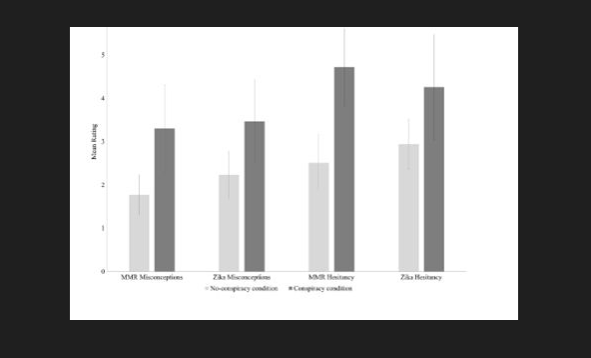
The findings from Experiment 2 replicated those from Experiment 1, as individuals presented with misinformation (conspiracy theories) that was later corrected showed more vaccine misconceptions and were more hesitant towards vaccines than those exposed to the No conspiracy condition. Once again, Zika misconceptions were higher than MMR misconceptions, although hesitancy to vaccinate against Zika decreased when credible sources provided corrections of misconceptions, which did not occur in the case of MMR.
Together, the experiments highlight that Zika virus represents a peculiar case showing how missing information can easily evolve into misconceptions. Zika is a relatively novel disease that is not present in the participants' country of origin and thus has received less coverage in European traditional media outlets than the MMR vaccine. While the evidence about the safety of the MMR vaccine is solid, scientists are still learning about Zika. This uncertainty may have intensified the negative impact of misinformation about Zika. That is to say, in Experiment 1, people might have been more resistant to the misinformation related to the MMR vaccine because they might have been already exposed to corrections detailing why the link between the MMR vaccine and autism was false. Conversely, in the case of Zika, they could have continued to rely on misinformation in order to account for otherwise unexplained events (if Zika does not explain epilepsy, what does?). Indeed, misinformation flourishes when there is missing information, as in the case of Zika, because people tend to think that there are "cover-ups".
In conclusion, this study "presented evidence of spillover effects of misconceptions about the MMR vaccine to Zika virus vaccine....[L]ittle knowledge about a disease can increase beliefs in conspiracy theories and that these effects can be reduced by presenting corrective information from credible sources, pending confirmation in samples with different demographic characteristics since vaccine hesitancy is a multifactorial issue...Future studies must strive to build psychometrically validated questionnaires about the possible reasons for subjective feelings about each type of vaccine, their hesitancy towards than and what aspects of vaccine experts lead people to mistrust their opinions."
Cognitive Processing https://doi.org/10.1007/s10339-022-01093-2.
- Log in to post comments