










































The Future of Malaria SBCC
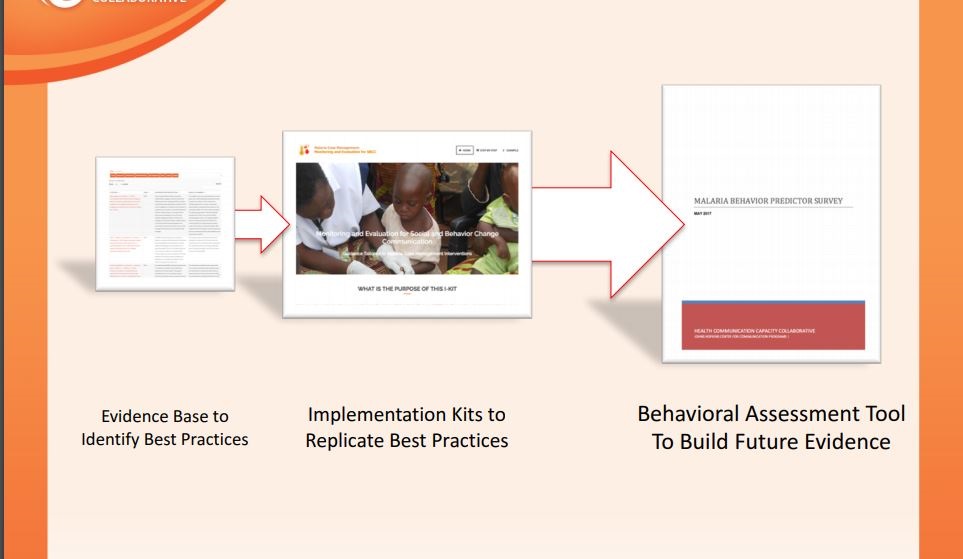
"This ...webinar held by the Health Communication Capacity Collaborative (HC3) highlighted three new tools for malaria social and behavior change communication (SBCC) research, monitoring and evaluation (RM&E)."
Organised by HC3, this webinar broadcast 3 presentations on malaria prevention programme tools by: Mike Toso, Malaria Program Officer, HC3; Cori Fordham, Malaria Program Officer, HC3; and Carol Underwood, PhD, Senior Research and Evaluation Officer, Johns Hopkins Center for Communication Programs.
The tools included:
- "Malaria SBCC Evidence Package: http://healthcommcapacity.org/malaria-evidence-database/: a searchable database, fact sheets and infographics featuring articles demonstrating the positive role of SBCC on malaria outcomes
- M&E I-Kit for Malaria Case Management SBCC (coming soon): a guidance document for monitoring and evaluating malaria case management SBCC interventions
- Malaria Behavioral Assessment Toolkit (coming soon): a research tool that is being developed to qualitatively and quantitatively capture malaria SBCC-related behaviors and influencing facts"
Mike Toso spoke about the "2014 Desk Review and Qualitative Assessment of Malaria Case Management SBCC in Four Countries", which was used to formulate guidance on monitoring and evaluation to help achieve:
- An increase in prompt care seeking for febrile children under the age of 5.
- Increased demand for rapid diagnostic testing.
- Increased adherence to national testing and treatment guidelines for malaria diagnosis and treatment.
This resulted in a 6-step guidance system including: 1) Identify root problems to be changed with SBCC, including prioritisation by cost; 2) Develop an M&E framework, a behaviour model, and indicators, using USAID templates; 3) Determine timing, resource, and strength of evidence; 4) Select data collection methods; 5) Use World Health Organization (WHO) templates for consent; and 6) Analyse data. Three projects used as examples are: Stop Malaria Project, using focus group discussions (FGDs), in-depth interviews (IDIs), and an omnibus survey; Champion Communities, using cross-sectional surveys in intervention and nonintervention areas; and Mobilize Against Malaria, using pre- and post-intervention cross-sectional health facility surveys.
Cori Fordham presented the Malaria SBCC Evidence Package (see related summary below), which includes the searchable database and also factsheets and infographics that "compile and highlight key SBCC successes on malaria outcomes". She illustrated the database organisation as: citation, year intervention, and results summary. She then reviewed the 3 key areas: Case Management; Insecticide-treated Nets; and Service Provider Behaviors, with the scoring system for assessing each study's evaluation method and results and the scoring of the SBCC strategy. Cori then reviewed the details needed for publishing study results, including: theory, audience segmentation, channels, strategic approaches, formative research, and programme adaption based upon monitoring results, as well as campaign exposure data.
Carol Underwood discussed the Malaria Behavioral Assessment Toolkit, which was created to help practitioners understand the potential of qualitative and quantitative research. She covered: use of the toolkit; its 3 components - how to choose methodology, how to do a quantitative survey, and how to use qualitative approaches. She detailed the methodologies with examples and tools to obtain results.
Health Communication Capacity Collaborative (HC3) website, January 24 2019.
- Log in to post comments