










































Gapminder World
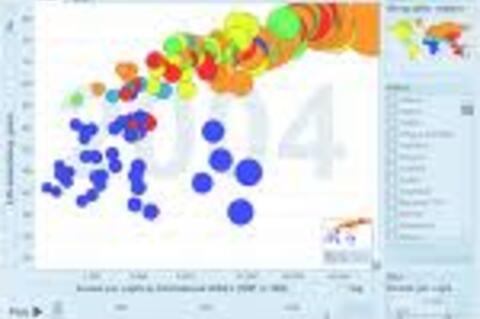
This information and communication technology (ICT) initiative revolves around the creation of tools that are designed to help people - from politicians and decisionmakers to citizens - understand changes in the world. The idea is that all people should get free access to already existing statistics about global development because, thus empowered with information, they might prove pivotal in taking action to promote sustainable global development and to contribute in various ways to achievement of the United Nations Millennium Development Goals.
Specifically, in the words of its developers "[t]his software unveils the beauty of statistical time series by converting boring numbers into enjoyable, animated and interactive graphics." By visiting Gapminder World, one may view time series of development statistics for all countries. Provided by the World Bank, these World Development Indicators include: carbon dioxide emissions, child mortality, economic growth, internet users per 1,000 people, military budget, phone users per 1,000 people, and urban population. One sees a scatterplot where each bubble represents a country, with the position of each bubble determined by the indicators on the axes. The size of the bubble represents the population of the country. For instance, by clicking on Angola and then 1960 and then "play", one may track its growth over time.
Gapminder also has features that are driven by an online community of users who blog together and who request more interactive features to be developed. For instance, in response to many requests for the opportunity to make one's own Gapminder graphs, organisers tweaked the software so that users may now convert their own time series into moving bubbles. This free Google Gadget is called Motion Chart, and it enables everyone to make a Gapminder-like bubble graph that they can publish on their web-page or blog.
The Gapminder website also features a series of free 3- to 10-minute videos ("GapCasts") that show the conversion of statistical time series into moving graphics in ways that are designed to allow evidence-based trends to be communicated as simple story lines. The time series used are then fed back into Gapminder World so that end users may further explore the underlying statistics by manipulating the Trendalyzer graphics in ways that help them understand global development trends in the way(s) that suit their particular analytical needs.
Technology.
Gapminder website; and emails from Karin Brunn Lundgren to The Communication Initiative on October 28 2008 and October 30 2008.
Comments

- Log in to post comments