










































Harnessing the Power of Collaboration to Expand the Coverage and Equity of COVID-19 Vaccinations in India: A Community Collaboration Model
Affiliation
John Snow India Pvt. Ltd., or JSIPL (Soni, Seth, Arora, Kumari); World Health Organization, or WHO (Singh); John Snow Inc. (Kanagat, Fields)
Date
Summary
"Experiences gained from the project can be used to encourage the consideration of collaborative participation in routine immunization, new vaccine introductions, and other public health programs and decision-making processes."
The United States Agency for International Development (USAID) stressed the need to ensure that COVID-19 vaccination reaches the most vulnerable population groups - a quest that could be more successful through collaboration. Prioritising risk communication and community engagement by collaboration with civil society as an approach to deal with the impact of the COVID-19 pandemic has proven effective. In August 2021, the MOMENTUM Routine Immunization Transformation and Equity project, supported by USAID and led by John Snow India Pvt. Ltd. under the guidance of the Ministry of Health and Family Welfare (MoHFW) of the Government of India, pioneered multiple pathways for scaling solutions for reaching the most vulnerable with COVID-19 vaccination. This paper explores the MOMENTUM Routine Immunization Transformation and Equity project's model of collaborating with community-oriented non-governmental organisations (NGOs), community influencers, religious leaders, and associations of people.
Based on previous experiences from routine immunisation with respect to vaccine hesitancy and geographical inaccessibility, the Government of India and partnering organisations were convinced that growing resistance towards the COVID-19 vaccine, linked to misinformation, could not be overcome effectively with the current system in place, and the marginalised and vulnerable population groups could not be focused on properly in the current system. Thus, the project team assisted the MoHFW of India at the national, state, and district levels to develop a collaboration mechanism that utilised the strengths of NGOs specialising in working with vulnerable and marginalised populations in 18 states and union territories and 298 districts. The collaboration followed a 4-step consultative process between the government, donors, and project implementation team:
The project, with its proactive on-ground implementation, reached approximately 50 million beneficiaries (January-December 2022) through interpersonal communication (IPC), mid-media (locally generated communications), hard-copy printed materials (flyers, leaflets, etc.), and telephone reminders (on the due date of vaccination and publicising upcoming camps). The administration of more than 14 million vaccine doses was facilitated during that 12-month period through ground-based activities by local NGOs and project teams, including mobilising, facilitating hard-to-reach populations to ongoing camps, and organising special vaccination camps. The team suggests that the modalities (e.g., folklore, street plays, IPC, communication by faith leaders, community champions, etc.) were culturally acceptable to the communities, they had a significant contribution in bringing marginalised people to the public health mainstream. A significant proportion of doses were facilitated for vulnerable populations (6.1 million). The team contributed not only by means of communication, mobilisation, and facilitation, but also organised cascade training sessions and contributed to capacity building of vaccinators, NGOs, and outreach workers.
Per the project team: "Several considerations were critical to the success of this collaborative approach, including understanding the needs and limitations of the NGOs; working directly with communities to identify appropriate outreach and engagement strategies; prioritizing strategies that supported a multi-directional exchange of information; and adapting strategies based on grounded realities and internal lessons learned. Strategies evolved over time, and the level and quality of community participation increased during planning and implementation. Real-time data analysis facilitated quick and timely decisions; constant effort helped establish collaborations between corporates, funding organizations, and senior team members, which developed mutual confidence because of timely and planned knowledge-sharing sessions."
During the 18 months of project planning and execution, the team gained several learnings regarding the effectiveness of the activities and interventions. Some activities that were of particular importance were:
In conclusion: "Engaging community-level partners and ground-based institutions broadens the horizon of public health practice. The local NGOs have a deep understanding of underlying problems in their respective communities. They hold positions of high trustworthiness and receptivity among the communities....The geographical reach and experiential attributes of these NGOs are well-positioned to be leveraged for reaching the unreached in national primary healthcare programs, with a special focus on routine immunization, strengthening of data systems, appropriate messaging, and emergency response."
The United States Agency for International Development (USAID) stressed the need to ensure that COVID-19 vaccination reaches the most vulnerable population groups - a quest that could be more successful through collaboration. Prioritising risk communication and community engagement by collaboration with civil society as an approach to deal with the impact of the COVID-19 pandemic has proven effective. In August 2021, the MOMENTUM Routine Immunization Transformation and Equity project, supported by USAID and led by John Snow India Pvt. Ltd. under the guidance of the Ministry of Health and Family Welfare (MoHFW) of the Government of India, pioneered multiple pathways for scaling solutions for reaching the most vulnerable with COVID-19 vaccination. This paper explores the MOMENTUM Routine Immunization Transformation and Equity project's model of collaborating with community-oriented non-governmental organisations (NGOs), community influencers, religious leaders, and associations of people.
Based on previous experiences from routine immunisation with respect to vaccine hesitancy and geographical inaccessibility, the Government of India and partnering organisations were convinced that growing resistance towards the COVID-19 vaccine, linked to misinformation, could not be overcome effectively with the current system in place, and the marginalised and vulnerable population groups could not be focused on properly in the current system. Thus, the project team assisted the MoHFW of India at the national, state, and district levels to develop a collaboration mechanism that utilised the strengths of NGOs specialising in working with vulnerable and marginalised populations in 18 states and union territories and 298 districts. The collaboration followed a 4-step consultative process between the government, donors, and project implementation team:
- Needs assessment for identification of areas of collaborative support and geographies for intervention, including, for example, technical assistance (TA) for catalysing service delivery and use (e.g., community engagement, demand generation, and risk communication).
- Identification, onboarding, and capacity building of NGOs to address last-mile delivery gaps, including through social mobilisation and community engagement activities for equitable vaccine coverage.
- Devising of risk communication strategies for effective community-based collaboration with the flexibility to customise demand-generation activities. The on-the-ground communication strategy focused on managing vaccine eagerness, hesitancy, and crises with respect to fear of adverse events following immunisation. The team emphasised collaboration with the local governments, as well as in workplaces, community-based organisations (CBOs), and faith-based organisations (FBOs), to customise interventions to reach specific population groups (e.g., truckers, immigrants, older adults, pregnant and breastfeeding women, and differently-abled people, among others). Activities included mapping and reaching out to vulnerable populations, raising awareness, mobilising communities, and connecting beneficiaries to the health system. Aligning with the national and state government needs, the NGOs customised the delivery of messages during the 'Har Ghar Dastak' (knock on every door) campaign of the national government.
- Devising a monitoring, evaluation, and learning (MEL) framework for reporting collaborative efforts.
The project, with its proactive on-ground implementation, reached approximately 50 million beneficiaries (January-December 2022) through interpersonal communication (IPC), mid-media (locally generated communications), hard-copy printed materials (flyers, leaflets, etc.), and telephone reminders (on the due date of vaccination and publicising upcoming camps). The administration of more than 14 million vaccine doses was facilitated during that 12-month period through ground-based activities by local NGOs and project teams, including mobilising, facilitating hard-to-reach populations to ongoing camps, and organising special vaccination camps. The team suggests that the modalities (e.g., folklore, street plays, IPC, communication by faith leaders, community champions, etc.) were culturally acceptable to the communities, they had a significant contribution in bringing marginalised people to the public health mainstream. A significant proportion of doses were facilitated for vulnerable populations (6.1 million). The team contributed not only by means of communication, mobilisation, and facilitation, but also organised cascade training sessions and contributed to capacity building of vaccinators, NGOs, and outreach workers.
Per the project team: "Several considerations were critical to the success of this collaborative approach, including understanding the needs and limitations of the NGOs; working directly with communities to identify appropriate outreach and engagement strategies; prioritizing strategies that supported a multi-directional exchange of information; and adapting strategies based on grounded realities and internal lessons learned. Strategies evolved over time, and the level and quality of community participation increased during planning and implementation. Real-time data analysis facilitated quick and timely decisions; constant effort helped establish collaborations between corporates, funding organizations, and senior team members, which developed mutual confidence because of timely and planned knowledge-sharing sessions."
During the 18 months of project planning and execution, the team gained several learnings regarding the effectiveness of the activities and interventions. Some activities that were of particular importance were:
- Engagement of government stakeholders: Involving government staff at all levels (State, District, and Block officials) facilitates the timely implementation of interventions (including inter-departmental coordination and conducting vaccination camps) in hard-to-reach areas and catalyses feedback and action.
- Involvement of local NGOs: Engaging with local NGOs is an effective mechanism for accelerating social and community mobilisation. Local NGOs with a strong ground presence and footprint help to quickly map and reach out to priority audiences and seek the support of local stakeholders such as village heads, FBOs, self-help groups, elected representatives, etc.
- Contextualisation of information, education, and communication (IEC) materials: The development and adaptation of available IEC materials in local languages and local formats ensures quick vaccine acceptance and community action.
- Customised demand generation approaches: Tailored approaches - such as night camps and collaborations with community and religious leaders to suit local needs and raise awareness of COVID-19 vaccination - help in reaching specific subpopulations that might be more likely to miss vaccinations due to the fear of wage loss and other competing work and family commitments.
- A strategic orientation with a clearly determined group to be reached and implementation approach is important to keep the activities of collaborators aligned and to prevent confusion among the partners.
- Collaboration partners with strong ground presence must be chosen wisely through a rigorous vetting process.
- The current project deployed the monitoring and evaluation (M&E) indicators to keep policy partners informed and aligned with the ground realities on vaccine uptake. However, in the future, the M&E efforts must also be designed according to research priorities.
- Specific requests must be shared with collaborative partners and discussed during follow-up meetings.
- Managerial capacities of the collaborating partners (in this case, NGOs) must be upgraded periodically.
- The management of collaborations must aim towards convening rather than commanding and constraining partners. Mutual and respectful cooperation must be fostered by sharing management responsibilities with ground-level partners.
- Community participation - involving religious and community leaders, as well as CBOs and FBOs, and facilitating a sense of ownership among them - must be prioritised in initiatives designed for marginalised, vulnerable, and hard-to-reach people.
In conclusion: "Engaging community-level partners and ground-based institutions broadens the horizon of public health practice. The local NGOs have a deep understanding of underlying problems in their respective communities. They hold positions of high trustworthiness and receptivity among the communities....The geographical reach and experiential attributes of these NGOs are well-positioned to be leveraged for reaching the unreached in national primary healthcare programs, with a special focus on routine immunization, strengthening of data systems, appropriate messaging, and emergency response."
Source
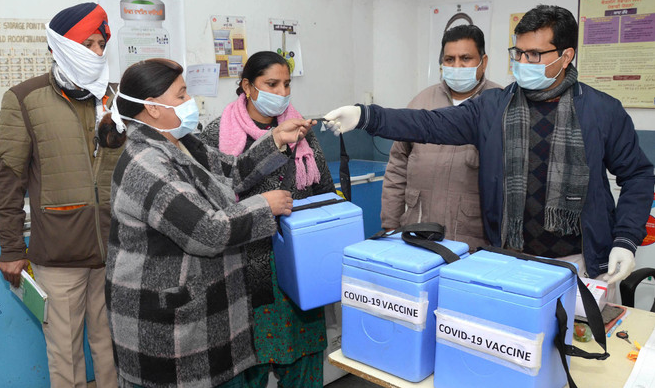
Vaccines 2023, 11(6), 1022; https://doi.org/10.3390/vaccines11061022. Image credit: Sarabjit Singh (Tribune India) via Wikimedia Commons ((CC BY-SA 4.0)
- Log in to post comments