










































Hathipaon Mukt Bharat (Filaria Free India)
Certified polio-free in 2014, India turned its attention to another public health challenge: the elimination of lymphatic filariasis (also called filaria or elephantiasis - "Hathipaon" in colloquial Hindi), which is a neglected tropical disease (NTD) that threatens nearly half of its population (500 million people). So, in advance of the first wave of mass drug administrations (provision to 400 million people of free medication that could protect them from lymphatic filariasis) that began in mid-December 2014 in 14 Indian states, the Indian Ministry of Health & Family Welfare (MOHFW) partnered with the Global Network for Neglected Tropical Diseases (Global Network), an initiative of the Sabin Vaccine Institute. These organisations worked to develop a brand identity and television, cinema, radio, print, mobile, and online content in an effort to resonate with India's lower income populations and provide this broad demographic with a simple call to action: "Help India eliminate lymphatic filariasis by taking your safe, free dose of pills when health workers visit your home." The task is to attract greater attention to the seriousness of the disease and the importance and simplicity of taking preventative medication.
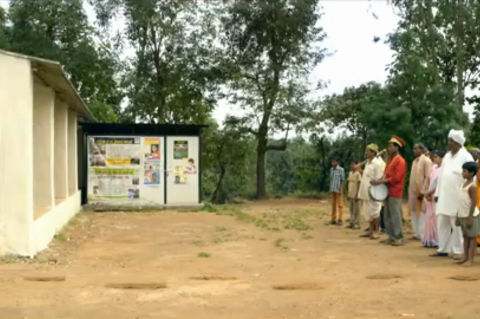
The public service announcement (PSA) leads villagers to a patient with a manifestation of lymphatic filariasis (as a manifestation of this disease, parts of a person's body swell to massive proportions). The PSA begins with children discovering giant footprints in the dirt and going on a journey on foot with fellow villagers to investigate. At the end of the path, they meet the man with the large feet who suffers with the disease. "Messaging highlights the irreversible nature of advanced filaria and, at the same time, the simplicity of its prevention - with what is described as an uplifting tone. The patient himself delivers the key message: 'this disease can happen to anyone.'" According to organisers, care has been taken to sensitively handle the subject and to create empathy with the patient. Portraying a pitiful picture of the patient is avoided; instead he is shown as a champion for treatment and action who encourages people to participate in the mass drug administration and consume the pills for a Hathipaon Mukt Bharat (Filaria Free India). Bauddhayan Mukherji, Founder and Director of Little Lamb Films, said: "Given the diversity of our target audience, we wanted to make sure there were a variety of cues throughout the videos that were distinctly Indian, but not necessarily representative of any one state or region." The PSA also emphasises that the pills are free and safe, and, if everyone consumes their dose of the pills daily, it will help in achieving the larger goal: to eliminate filaria from India.
Disseminated through regional television channels Doordashan TV and All India Radio, the 3 television videos that were produced in Hindi were dubbed in 9 different regional languages to ensure widespread comprehension; print-based advertisements were disseminated in vernacular, state-specific media. To increase acceptance of the videos across India, the team selected a neutral language, Sanskrit, for the musical score, with lyrics that translate as: "There are signs along the way that lead us to the ultimate truth," meant to pair with the visual treatment in the films.
Reliance Group lent its corporate support to the campaign by promoting it through the company's mobile, mass media, and web-based channels. Their involvement is set to take centre stage when the second phase of the campaign begins in February 2015, with mass drug administration rounds taking place in states not covered during the first phase, including Uttar Pradesh and Bihar.
Health
Lymphatic filariasis can cause disability and disfigurement among those infected. Though prevention is very easy, the MOHFW has faced significant difficulties in combating the disease. Many people are complacent when it comes to prevention - in part because of apathy toward the disease and the length of time it takes to manifest itself (8 to 10 years). As a result, many people fail to consume their medicine even with the government's door-to-door efforts to deliver free, preventive doses and educational messaging in endemic regions.
The Sabin Vaccine Institute (Sabin) is a non-profit organisation of scientists, researchers, and advocates dedicated to reducing needless human suffering from vaccine-preventable and neglected tropical diseases (NTDs). Since its founding in 1993 in honour of Dr. Albert B. Sabin, the developer of the oral polio vaccine, Sabin has developed new vaccines, advocated for increased use of existing vaccines, and promoted expanded access to affordable medical treatments in collaboration with governments, academic institutions, scientists, medical professionals, and other non-profit organisations. The Global Network for Neglected Tropical Diseases is an advocacy initiative of Sabin that works in partnership with international agencies, governments, academic institutions, corporations, non-governmental development organisations, and the general public to raise the awareness, political will, and funding necessary to control and eliminate the 7 most common NTDs by 2020.
MOHFW partnered with the Global Network for Neglected Tropical Diseases (Global Network), an initiative of the Sabin Vaccine Institute. Ogilvy & Mather Mumbai and Little Lamb Productions executed the development of the creative campaign.
Global Network for Neglected Tropical Diseases website and Express Pharma website - both accessed January 21 2015.
- Log in to post comments