










































How Social Networks Predict Epidemics
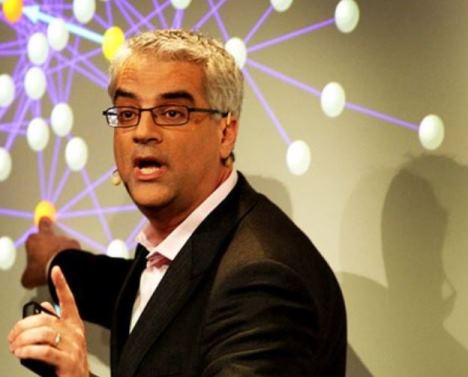
In this TED talk transcript of Nicholas Christakis's 2010 talk, he describes studying a research approach of forming networks by having a primary group of people select and connect friends with the network. He and a colleague are looking for "the mathematical, social, biological and psychological rules that govern how these networks are assembled and what are the similar rules that govern how they operate, how they affect our lives." He discusses using his findings to tackle predicting epidemics, both early detection and disseminating warnings.
Christakis includes a broad range of what can be spread by a form of "social contagion", from ideas to practices, like health practices, for example, to germs, like HIV, for example. He shows, through graphics, the curve of how an epidemic builds through a network: "the diffusion-of-innovation, or the adoption curve.... You could have friendship relationships, sibling relationships, spousal relationships, co-worker relationships, neighbor relationships and the like. And different sorts of things spread across different sorts of ties. For instance, sexually transmitted diseases will spread across sexual ties. Or, for instance, people's smoking behavior might be influenced by their friends. Or their altruistic or their charitable giving behavior might be influenced by their coworkers, or by their neighbors. But not all positions in the network are the same."
Christakis's graphics show that some people have many connections to a network, and he explains that they are more likely to contract the germ or adopt the idea than those with less exposure, thus making them central to the network. He suggests monitoring those central people for early warnings about epidemics. This "centrality" of certain people is due to the "friendship paradox", the fact that "friends of randomly chosen people have [a] higher degree [of network connectivity] and are more central than the random people themselves." In an experiment on monitoring the spread of H1N1 flu at a university, the germ appeared and took 16 days to reach a large proportion of students (network members), giving disease monitors 16 days to take public health actions.
Christakis explains that the technique of fostering networks can be used to spark health behaviour changes through using personal influencers in networks, rather than as a dissemination of information tool. He also looks at cost saving in immunisation - for example, when vaccine supplies will not cover an entire population, vaccinating those central to networks provides greater immunity to the network. In addition, he looks at how to use large collections of data in "massive-passive" data collection efforts - for example, data from the 8 million phone users in a country in Europe or from email interactions, online interactions, online social networks, etc. Such administrative data can help, for example, "monitor doctors prescribing behaviors, passively, and see how the diffusion of innovation with pharmaceuticals occurs within [networks of] doctors."
Both fully passive data monitoring and quasi-active monitoring could be useful, as in the example of a phone company asking people to participate in a texting project to send their daily body temperature in to a monitor and to ask friends to do the same. By finding the central friends in the network, only texts from them would need monitoring for signs of a potential flu epidemic or other contagious disease increase. Due to data collection and network potentials, the author sees potential for a "new era of what I and others would like to call 'computational social science.'"
The TED website, June 16 2014.
- Log in to post comments