










































HPV Vaccination Discourses and the Construction of "At-risk" Girls
Concordia University (Rail, Molino); University of Toronto (Fusco, Moola); University of British Columbia (Norman, Petherick, Bryson); University of Western Ontario (Polzer)
"We hope that our contribution legitimates areas and types of research that are crucial for 'real' dialogue in public health, that is, dialogue that involves multiple stakeholders and that is not dominated by vaccine manufacturers and their key opinion leaders."
This qualitative study considers how Canadian youth, parents, and health professionals (HPs) consider human papillomavirus (HPV) vaccination (HPVV) in relation to broadly circulating public health and industry-sponsored discourses about HPV and HPVV. The study is informed by a poststructuralist theoretical framework, which enables understanding of how discourses have shaped and created meaning systems and are implicated in societal relations of power. It is driven by the assumption that HPVV discourses have both enabling and constraining effects on young girls' bodies and subjectivities.
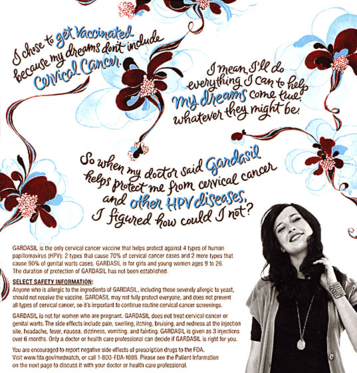
The researchers report that, since 2007, various campaigns have been launched to promote the HPV vaccine in Canada and have appeared in print media (advertisements, opinion pieces), pamphlets and consent forms for parents, training sessions for HPs, posters and materials in health and postsecondary institutions, and advertisements in traditional (television, movie theatres) and social media. The researchers provide evidence challenging some of the assumptions on which these HPVV campaigns are structured. While the purpose of HPVV is to block a few of the over 200 HPV types, the vaccine manufacturers have marketed their product as an "anti-cancer" vaccine. Yet, for example, "given that cancer takes 15-40 years to develop, there is no proof yet of HPVV's efficacy to reduce cancer." Likewise, critical analyses of national newspapers in Canada, the United States (US), and the United Kingdom (UK) have noted that the media have relied on discourses associating HPV infection with cancer-related illness and death. But "HPVV discourses serve to erase the complex aetiology of the relationship between HPVs and cancer and, in so doing, construct a crisis situation wherein HPVs are seen as commonplace and potentially deadly, but constituting a preventable risk.
Other studies analysed by the authors explore "medicalization and the ways in which HPVV discourses conjure up moral sentiments regarding girls' proper sexual activity and personal health as well as mothers' responsibility for the protection of their daughters." Studies have described a complex decisional matrix in which discourses concerning risk, morality, and personal responsibility for sexual health influence HPVV decisions.
As the researchers explain, many studies of HPVV that focus on stakeholders are intended for social marketing purposes and address reasons for vaccine hesitancy or uptake among youth in various countries, including Canada. Observing that limited qualitative research exists on the views of those directly involved in HPVV, the researchers carried out interviews between May 2014 and July 2016 with participants (n=146) from 4 Canadian provinces and diverse socio-cultural locations. Girls and boys mostly ranged in age from 12 to 16 years, although 8 older participants (17- to 21-year-olds) were recruited based on their self-identification as bisexual, questioning, gay, trans*, pansexual, or polysexual. With the exception of a few who refused the vaccine, youth participants were vaccinated with Gardasil in a school context. For parent participants, most were female, and only a few refused consent for their daughter's vaccination. HPs (nurses and physicians) were recruited both from public health agencies and in clinics providing services related to women's health. About half of the nurses also worked as school nurses and were directly involved in school vaccination programmes.
Selected findings:
- Girls often interpreted and accepted HPVV as they did other childhood vaccinations, and they showed very limited knowledge or understanding of the purpose or implications of HPVV. However, most girls shared that having received the vaccine conveyed to them a sense of protection. Generally, most did not experience their bodies as "at-risk" or "vulnerable".
- "For most parents, the decision to vaccinate their daughter was motivated by a sense of trust in the school and the health system. Despite this, many felt that the information they received was framed to make them adhere to HPVV, and that information about potential benefits/harms was not available. Despite some parents' ambivalence, all but a few consented to HPVV, moved by what they considered to be their mandate: protecting their daughter."
- "HPs reported trust in medical research and health institutions. Most received information from a public health agency or directly from the pharmaceutical company and considered HPVV in the same way as other vaccines (i.e., its benefits were considered greater than its 'minimal' risks).... [O]verall, HPs equated questioning or refusing the vaccine with lack of information, thus justifying increased efforts for vaccine promotion."
Results of the poststructuralist discourse analysis provide evidence of how participants discussed HPVV. Four discourses were circulated by a majority of participants:
- The discourse of risk and protection from risks (e.g., the importance of being conscious of risks, of acting on the fear of risk)
- The vaccination discourse (e.g. vaccination alleviates the fear of cervical cancer, of cancer epidemics)
- The discourse of gender and health (e.g., the female body is a primary vector of sexually transmitted infections (STIs), a site for future diseases like cervical cancer)
- The biomedical discourse (e.g., trust in doctors and the medical system, faith in modern medicine).
Also, 2 discourses circulating during the interviews were unique to a subgroup of participants: Girls appropriated the discourse of "proper childhood" (e.g., children should trust their parents' decisions), and parents appropriated the discourse of responsible parenthood (e.g., the responsible choice is to "protect" one's daughter and "arm" her in the war against cancer).
As the researchers explain, given the widespread appropriation of the above dominant discourses, there were mere traces of resistance to HPVV. Individuals most resistant to the HPV vaccine and its related discourses were mostly nurses, Euro-Canadian parents whose daughters experienced death (n= 1) or grave health problems after HPVV, as well as girls who experienced adverse events immediately following their HPVV. "These 'resistant' participants raised questions about the need to vaccinate, the fact that the 'new' vaccine was being 'tested on girls', and the idea that HPVV was a public health priority. They also had concerns regarding informed consent."
In the researchers' estimation: "The results speak to HPVV campaigns as morally laden, gendered, heteronormative and factually misleading." They conclude the article with a discussion of 4 main concerns stemming from the study:
- HPs were found to generally appropriate dominant HPVV discourses and use fear of HPV infection as a strategy to "manufacture consent" for HPVV among girls and parents. "Rather than allowing for informed consent to take place, documents are designed to intensify parental fears about the risks of HPVs at the same time as they work to assuage anxieties about the vaccine's efficacy and safety. The presentation of 'facts' is a carefully constructed story designed to compel parents to consent to have their child vaccinated." HPs tend to see themselves as acting as responsible agents of the state by helping to redistribute risk management from the state to the individual.
- The results show that girls lack information but are nevertheless impacted by the gendered discourse on HPV vaccination; they generally feel responsible for preventing and not spreading STIs. "In contrast, parents' narratives reflect the cancer effect as well as the powerlessness, uncertainty, anxiety, stress, and fear that emerge alongside the vaccine and the perceived imperative to act upon their daughter's cancer risk. In doing so, they take to heart their social responsibility as parents."
- The analysis of narratives highlights that "opportunities for broader dialogue about girls' sexual health are foreclosed, as are important discussions about health inequalities, overmedication, and medicalization of girls' bodies." Furthermore, the researchers find that "independent research and information about the HPV vaccine, its potential harms and benefits, and its available alternatives are lacking, and therefore, that informed assent (for girls) and consent (for parents) are absent."
- The researchers "question whether public health is advanced when dominant HPVV discourses and practices transform healthy bodies into 'at-risk' bodies, and when cancer prevention is instrumentalized in the pharmaceuticalization of public health."
"Breaking the code of silence surrounding HPVV as well as independent research and key actions are needed to remedy the situation."
Canadian Journal of Public Health https://doi.org/10.17269/s41997-018-0108-8. Image credit: Sandalia Genus
- Log in to post comments