










































Human-Centered Design for Global Health Equity
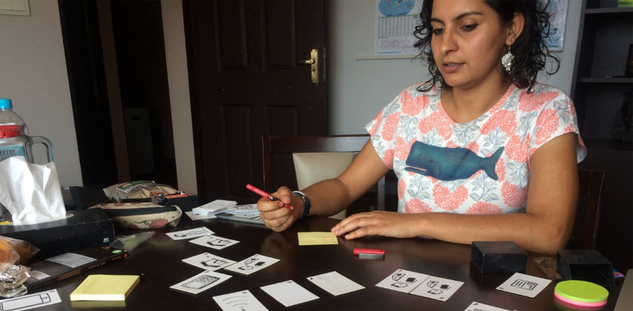
The University of Washington (Holeman); Medic Mobile (Holeman; Kane)
"Grounding technology design in evidence of people's everyday experiences means that the process is more tailored to the concrete details of particular local situations than is the case in efforts to design interventions based on universal behavior change theories...or evidence from health outcomes trials in other settings."
A growing number of information and communication technology for development (ICT4D) researchers are attending to health equity in their design and research efforts, some of which are grounded in the human-centred design approach. Amid concern that human-centred design is just another trendy development buzzword, this paper seeks to clarify how the approach may be of value to the scientific and practical agenda of global health equity. It is part of an ongoing action research effort focused on supporting a growing community of designers, developers, and implementers of an open source project spearheaded by the non-profit organisation Medic Mobile. This project, called the Community Health Toolkit, grew out of an intervention for coordinating community health workers (CHWs) through conversational text (SMS) messaging.
The paper begins with a summary of Medic Mobile's research context and methods (section 2), and then draws on a combination of literature review and reflection on action research efforts to develop the grounding for the analysis to follow. To understand why health equity matters for design and for global development, authors Isaac Holeman and Dianna Kane explain that there is a clear gradient around the world: the higher a person's social status and economic means, the lower their mortality rate. In that context, Medic Mobile was formed in 2010 with the goal of improving health care in hard-to-reach communities through open source technology. They quickly realised the difficulties of replicating evidence-based technological interventions in an inflexible, "cookie-cutter" manner, which led to their first design principles: "start with people not with tech, design for the familiar, address practical challenges from day one, and make room for big ideas that may take years of iteration to mature."
In section 3, Holeman and Kane contextualise how the design discipline differs from conventional approaches to research and innovation in global health. They discuss its emphasis on craft skills, such as the ability to sketch out or model an image of a work product, hands-on engagement with the materials, and iterative methods that can yield insights about the practicality, perceived value, and potential adoption of an intervention before initiating a costly pilot study. For example, designers elicit people's views with sketches, photographs, interactive role-plays, mockups, and prototypes "that allow people to lay their hands on the future". Figure 2 in the paper depicts a sketch of an SMS-enabled antenatal care (ANC) intervention. "Partners often find such workflow sketches more participatory and accessible to input (especially across language, culture, and power barriers) than technical product specifications or detailed written/verbal descriptions alone."
Section 4 examines how design researchers distinguish human-centred approaches from other kinds of design practice. Emphasising the diversity of perspectives within this multidisciplinary field, Holeman and Kane consider related yet distinct terms such as user-centred design and design thinking. What makes human-centred design not only distinctive but also highly relevant to health equity, they argue, is the commitment to fostering stakeholder participation. "This is not to say that human-centered design is inevitably democratic; participation can be neglected or depoliticized in a manner that grants no real power to non-experts." The term 'human-centred' may also evoke commitments to supporting or augmenting people's skills, rather than using technology primarily for purposes of efficiency or managerial control, and to reframing purely technical issues in relation to people's values and the broader human context of implementation.
Next, section 5 reflects in a practical way on Medic Mobile's experiences creating over 70 digital health initiatives over a period of 10 years. In short, the organisation designs for and with community members, CHW supervisors, nurses, and managers, in many languages, for a range of phones, tablets, and computers, in hard-to-reach settings with or without connectivity. Medic Mobile employs 14 designers globally, 12 of whom are women; the team includes 7 Kenyans, 4 Americans, and one each from Nepal, Uganda, and Senegal. They have supported ANC, postnatal care and family planning, child health including immunisation and nutrition services, early child development, outbreak surveillance, cervical cancer screening, and HIV and tuberculosis (TB) services.
Reflecting on their own experieces at Medic Mobile, Holeman and Kane go on to flesh out more of the issues they reviewed earlier: iteration (e.g., using personans), hands-on participation (e.g., using participatory design cards), human skills (e.g., supporting health workers in the task of coordinating care and mobilising communities), and human values (e.g., looking beyond the design of discrete technologies to reimagine services, the organisation of health systems, and broader social arrangements that pattern who receives equitable care and who does not). They also reflect on the difficulties of growing a design team, and on the prospect of practicing human-centred design as a pragmatic way of accompanying health workers in their struggle for health equity. ("As designers with niche expertise in digital technology, accompanying a community in their struggle for health equity affords us an active role in an ongoing process of social change.")
Having layed out their conception of human-centered design as a flexible yet disciplined approach to innovation that prioritises people's needs and concrete experiences in the design of complex systems, Holeman and Kane explore implications for research and practice. For instance, beyond merely producing rigorous publications, networks of action can support human-centred design practitioners in learning from one another through ongoing cooperation.
In conclusion: "human-centered design is not restricted to building technologies or solving purely technical problems, so much as it is a way of accompanying health workers and making sense of the complex challenge of health systems strengthening in a digital age....Design matters for global health equity, and what is more, equity in global health matters for human-centered design."
Information Technology for Development, DOI: 10.1080/02681102.2019.1667289.