










































Information Technologies Vital to Tackling Climate Change
United Nations (UN)
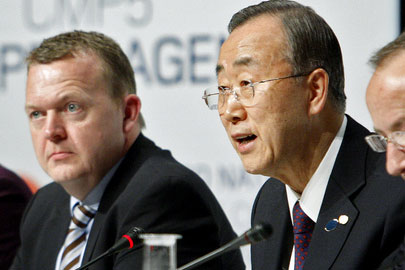
Secretary-General of the United Nations (UN) Ban Ki-moon stated that information and communication technologies (ICTs) are vital to tackling climate change and urged participants in this October 2009 United Nations International Telecommunication Union (ITU) global forum "Telecom World" to think of creative ways to use the latest technology to usher in a "green" economy.
Mr. Ban stated that "Indeed, ICTs are part of the solution. Already, these technologies are being used to cut emissions and help countries adapt to the effects of climate change.” As an example, he cited a joint UN/partners' and mobile phone companies' project of installing 5,000 new weather stations across Africa. The weather stations will monitor the impact of climate change, and, when there is news, text messages will be sent immediately to farmers’ mobile phones. In an effort to raise awareness of climate change, the UN mobilised young people to use internet tools such as Facebook and Twitter in support of its campaign to "seal a deal on climate change" in December 2009 at the global conference in Copenhagen, Denmark, aimed at developing a new treaty to curb greenhouse gas emissions. The UN Environment Programme (UNEP) created a ‘Twitter for Trees’ project, in which one tree was planted for each of the more than 10,000 people who signed up on this free social networking and microblogging service. Further, ICTs are being used to try to reach Millennium Development Goals (MDGs) by 2015.
ITU pointed out that "while ICTs provide unprecedented opportunities to accelerate social and economic development, communities that currently lack access and know-how are being further marginalised. It is, therefore, encouraging its member States to adopt school-based community broadband plans to bring ICT access to disadvantaged and vulnerable groups. The agency’s Connect a School, Connect a Community initiative aims to facilitate public-private partnerships that will help countries establish school-based ICT centres." Mr. Ban advocated for teamwork - political will among world leaders to support connecting all schools by 2015.
The head of the Joint UN Programme on HIV/AIDS (UNAIDS) spoke of the explosion of mobile technology as a great opportunity to scale up the AIDS response in economically poor countries. As stated here, millions of people in developing countries who had been left behind by the digital divide are now able to access health information and healthcare services through mobile technology, including HIV testing, data collection, epidemic tracking, training of health workers, HIV prevention, and treatment support.
News on ICT in Education, October 15 2009. Image credit: UN News Centre
- Log in to post comments