










































Integrating Reasoned Action Approach and Message Sidedness in the Era of Misinformation: The Case of HPV Vaccination Promotion
Qingdao University (Xiao); Washington State University (Su)
"HPV vaccination is a timely case for examining the integration of communication theories and theories of behavioral prediction and change..."
Public acceptance and completion rate of the human papillomavirus (HPV) vaccine remain stagnant. In the current media landscape, the issue of HPV vaccination has been plagued by misinformation, which impacts attitudes about the vaccine and can induce vaccine hesitancy and refusal. Those seeking to promote HIV vaccination by providing factual information often wonder how to be convincing in the arguments they make. Although communication theories such as the reasoned action approach have been studied in HPV vaccination promotion, "message sidedness" has to date not been been examined in the context of HPV vaccination and might be relevant in the era of misinformation. Thus, this study investigates the persuasive effects of one-sided and two-sided social media messages on attitudes about HPV vaccination in the context of misinformation.
The study is grounded in concepts including:
- The reasoned action approach, which assumes that intention to perform a behaviour is the immediate antecedent of that behaviour and that the intention, in turn, is formed based on a few central components including attitude, perceived norms, and perceived behavioural control.
- Attitude, which contains two distinct dimensions: (i) affective attitude, which is evoked by emotions and is often measured on a continuum of positive and negative feelings; and (ii) cognitive attitude, which is elicited by rational evaluations of the matter of interest and is often measured on a continuum of instrumental benefits or losses. For example, in the case of HPV vaccination, a person may perceive getting the vaccine as useful for protecting against life-threatening diseases but also feel repulsed by vaccination due to fear of needles.
- Message sidedness, which is a theoretical framework rooted in persuasion. This concept at the centre of a debate about whether it is more persuasive to present an argument in favour of a given position or to provide both supporting and opposing arguments. Definitions relevant in the context of this study are: a one-sided message only contains truthful facts about the HPV vaccine; a non-refutational two-sided message features truthful facts and misinformation about the vaccine; and a refutational two-sided message includes both truthful facts and misinformation, along with a refutational statement debunking the misinformation.
- Prior misperceptions as the moderator of influences of message sidedness on attitude. That is, factual beliefs that are false or contradict the best-available evidence can be particularly tenacious in distorting beliefs about health issues and deter individuals from acknowledging and believing the correct facts, since they are motivated to consume and interpret information that is in line with their predispositions.
Data were collected with an online survey conducted among 251 participants aged 18 and above and who have not received the HPV vaccine. A four-condition (one-sided vs. non-refutational two-sided vs. refutational two-sided vs. control) between-subject experiment was conducted. Prior to the experiment, a survey measuring demographic details and prior misperceptions about HPV vaccination was administered. Participants were then exposed to four Facebook posts, all of which were associated with the United States (US) Centers for Disease Control and Prevention (CDC). In the one-sided message condition, the posts present an argument in favour of the HPV vaccination, highlighting the true side effects, safety, effectiveness, and global implementation of the vaccine. In the non-refutational two-sided message condition, the posts include that truthful information along with misinformation-based arguments opposing HPV vaccination. In the refutational two-sided message condition, the posts present both supporting and opposing arguments, along with additional statements refuting the opposing arguments. In the control condition, four Facebook posts present health issues unrelated to HPV vaccination.
A post-experiment survey indicated that, compared to the control, one-sided messages addressing misinformation increased positive attitude about the vaccine as prior misperceptions increased. However, a "backfire effect", which occurs when misconceptions are entrenched further after being exposed to evidence-based corrections, may be a risk for individuals with lower prior misperceptions. Within the sidedness conditions, refutational two-sided messages were more effective in increasing cognitive attitude for individuals with lower misperceptions, whereas one-sided messages had a persuasive advantage for individuals with higher misperceptions.
In discussing the findings, the researchers note that, although consistent with prior research that refutational two-sided messages elicited the highest affective and cognitive attitude about HPV vaccination, the main effect was not significant. One implication of this finding is that "mere exposure to promotional or corrective messaging may not be enough to enhance positive attitude toward the vaccine. As suggested, a multi-method strategy (e.g., provider level feedback, educational intervention) accompanied by communication technologies (e.g., social media messages, mobile alerts, and reminders) may be the most effective in promoting HPV vaccination acceptance..."
Having outlined other theoretical and practical implications of the study, as well as its limitations, the researchers conclude that the study has revealed "nuanced influences of sidedness-based messages on vaccination attitude and shed light on future vaccination-related promotional interventions. Future research may seek to determine the impact of message sidedness on intention and behavior via attitude."
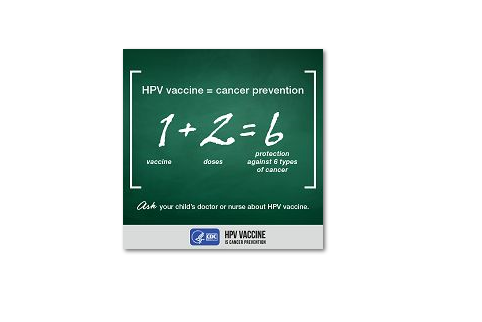
Journal of Health Communication, 00: 1-10, 2021. DOI: https://doi.org/10.1080/10810730.2021.1950873. Image credit: CDC via Facebook
- Log in to post comments