










































The Interplay between Framing and Regulatory Focus in Processing Narratives about HPV Vaccination in Singapore
Nanyang Technological University
"...findings demonstrate that the valence or framing of narrative content can change the extent to which audience members engage in the narrative and thus provide practical insights for the development of narrative messages designed to promote health."
A 2016 study found that only 9.8% of female Singaporeans had been vaccinated against human papillomavirus (HPV), in part because Singapore is a conservative country, and Singaporeans have strong reservations about HPV vaccination as it relates to the possibility of being sexually active. Gain- and loss-framing has been one of the message strategies to encourage HPV vaccination. Gain-framed messages focus on describing the positive outcomes of adopting a recommended behaviour (e.g., avoiding HPV infection), whereas loss-framed messages focus on presenting the negative outcomes of non-compliance (e.g., getting HPV infection). One moderating factor is "regulatory focus", which is concerned with how people pursue a goal in a way that maintains their personal values and beliefs. This study examined whether regulatory focus changes the effects of gain- and loss-framed narratives on promoting HPV vaccination among young females in Singapore.
According to regulatory focus theory, the ideal self is a representation of attributes that individuals would like to possess. In contrast, the ought self encompasses attributes that individuals believe they should possess. The ideal and ought self guide the formation of two motivational systems: (a) promotion focus, which facilitates the fulfillment of one's ideals or wishes, and (b) prevention focus, which allows the fulfillment of one's duties and responsibilities. For example, if someone decides to receive the HPV vaccine to protect oneself from getting HPV or cancers caused by HPV, the decision is regulated by promotion focus. However, if someone receives the vaccine due to responsibility, such as protecting the partner or limiting the spread of HPV infection, it is regulated by prevention focus.
Other concepts informing the study come from research on narrative:
- Transportation: When audience members are transported into a story, they accept the narrative world, experience strong emotions, and pay attention to the narrative events. Hypothesis 1 (H1) is that: (a) A loss-framed narrative will produce greater transportation than a gain-framed narrative. (b) This effect will be more prominent among those high in prevention focus than those low in prevention focus.
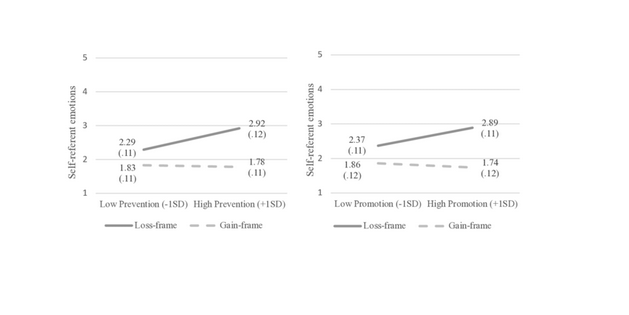
- Emotional responses to narratives: Self-referent emotions (e.g., alarmed, disturbed) are generated as a result of imagining how the audience member self would feel in the story situation. On the other hand, audience members may affectively respond to a story character without taking the perspective of the character (e.g., sympathetic, compassionate). This emotional category is referred to as character-referent emotions. H2 is that (a) A loss-framed narrative will produce stronger self- and character-referent emotional responses than a gain-framed narrative. (b) This effect will be more prominent among those high in prevention focus than those low in prevention focus.
H3 is that: Transportation and self-referent emotions will mediate (a) the effect of message framing and (b) its interaction with regulatory focus on individuals' intention to receive HPV vaccination.
The researchers conducted a 2 (framing: gain vs loss) x 2 (perspective: first- vs. third-person) factorial design experiment and measured regulatory focus, as a quasi-experimental factor. Participants, 226 female undergraduate students attending a large university in Singapore who had not been vaccinated against HPV, reported their regulatory focus and then read either a gain- or loss-framed narrative about HPV vaccination. The two messages differ in emphasising either possible avoidance of the HPV infection from vaccination (gain-frame, n = 114, "Having gotten the vaccine, your risk of contracting some of high-risk HPVs significantly drops") or possible attainment of HPV infection from non-vaccination (loss-frame, n = 112, "not getting the HPV vaccine could increase my chance of contracting high-risk HPVs"). In the gain-framed narrative condition, the main character complied with vaccination recommendations two years previously and thus received the "negative" test results for HPV, protecting herself against possible HPV infection. Conversely, the main character in the loss-framed narrative did not comply with vaccination recommendations and was later diagnosed with HPV infection.
The results showed an overall advantage of a loss frame over a gain frame in producing transportation and self-referent emotions, which in turn led to increased vaccination intentions. This pattern was more pronounced among those high in prevention or promotion focus, with self-referent emotions being the primary mediator transferring the interactive effects onto vaccination intentions. (Referencing the above, H1a and H2a were supported, H1b was not supported, H2b was partially supported only on self-referent emotions, and H3a was partially supported.)
Put another way, the study implies that, because people tend to pay more attention to negative stimuli than positive ones, a narrative describing negative consequences of not being vaccinated against HPV may be more transporting and conducive of emotional responses than the one describing positive outcomes. Although character-referent emotion has been found to promote altruistic motivations to help the victim, self-referent emotion appears to be an important component in producing egoistic motivations to engage in risk reducing behaviours.
In conclusion: "This study advances prior research in framing by addressing boundary conditions and specific mechanisms for the framing effect in narrative messages." Among the suggestions for future investigation: Researchers could replicate the findings with multiple message conditions with varying framing approaches across different cultural contexts.
Health Communication, December 2018. DOI: 10.1080/10410236.2018.1553022.
- Log in to post comments