










































Investigating an Issue-Attention-Action Cycle: A Case Study on the Chronology of Media Attention, Public Attention, and Actual Vaccination Behavior during the 2019 Measles Outbreak in Austria
University of Vienna (Arendt); KU Leuven (Scherr)
"Surveilling the development of media and public attention in the immediate aftermath of a measles outbreak may be a cost-effective strategy to predict future patient load..."
The news media can be a factor in vaccination acceptance or hesitancy, including as a result of news coverage during a measles outbreak. News reports can influence health beliefs about the safety of vaccines by, for example, erroneously suggesting that there is an alleged link between the measles, mumps, and rubella (MMR) vaccination and autism. In addition to perpetuating negative beliefs and myths about vaccines, the news media can raise the visibility of issues and as such, place them on the public agenda. News media outlets can then serve as an orientation point for other news and social media outlets, which results in so-called issue-attention cycles. This study investigates how these cycles may foster actual measles vaccinations after a considerable amount of news media coverage, thereby creating issue-attention-action cycles. The context for the study is a 2019 measles outbreak in Austria, which has one of the lowest MMR vaccination coverage rates among European countries.
After an introduction, the paper reviews previous research on the health-relevant consequences of issue-attention cycles. In short, while it seems intuitive that highly visible vaccine-preventable disease (VPD) outbreaks should facilitate vaccination, there is a lack of empirical evidence.
In January 2019, an infected 15-year-old boy was identified at the regional hospital in Graz, Styria, and presumably infected a number of children in the hospital. There was a high degree of uncertainty due to the fact that nobody could know whether more cases would appear in the first days after the index case had been observed. Health professionals and authorities reacted to this event, and the news media started to report on it some days later.
The researchers assessed media attention on the measles outbreak using a news archive of Austrian newspapers, television, radio, and online media (observation period: January 1, 2019 - February 20, 2019). They used online information-seeking as an indicator for public interest, investigating how often individuals used the term "masern" (measles) in the search engine Google. The "Wissenschaftliche Akademie für Vorsorgemedizin", an institution cooperating with the Styrian government, provided data for vaccinations in Styria for 35 days of the (51-day) observation period.
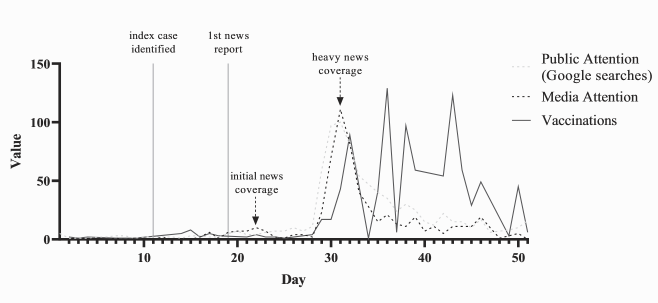
There was a strong correlation between media attention and public interest. The first news report on the index case appeared on January 19, 10 days after the index case had been identified. This initial news coverage almost exclusively occurred in 2 local newspapers with high circulation rates in Styria. Longer articles on the measles outbreak appeared in these local newspapers on January 29, including the headline "Alarm um Masern" (Alarm over Measles). On the same day, the measles outbreak was also covered in the public broadcaster's evening news programme. On January 30, the measles outbreak was heavily covered in many national newspapers and in the background-oriented night version of the public broadcaster's news programme. Google searches increased sharply on January 29, presumably in response to the televised evening news programme and local news coverage, followed by a sharp increase in nationwide heavy media attention 1 day later. Both public interest and media attention ultimately peaked on January 31. Public interest seemed to be stimulated by initial news coverage and preceded the follow-up heavy news coverage.
When comparing the observation period of 2018 and 2019, there was a substantial increase in the number of vaccinations: N = 160 vaccinations against measles were documented between January 1 and February 20 in the preceding year of 2018 when there was no measles outbreak. This value increased substantially for the same time period in 2019 (N = 913). What is notable is that the number of vaccinations substantially increased after the heavy news coverage and after a peak in public attention. One day after the peaks in media attention and public attention, there was an initial peak in the number of vaccinations on February 1; this increase in the number of vaccinations did not appear immediately after the identification of the index case (January 11), but only after news coverage had stimulated public interest.
The researchers note that the content of news coverage may be an important (limiting) factor for behavioural consequences. The overall tone of the news coverage appeared to be very positive from the perspective of public health, it provided background information in a responsible way, and it was clearly pro-vaccine (including several direct appeals to get vaccinated). The coverage possibly influenced the public's perceived severity of measles and perceived susceptibility to it. The coverage also reported on an effective solution (i.e., via vaccines; response efficacy) and provided references to contact information (e.g., where to get vaccinated for free; self-efficacy).
With regard to practical implications:
- The study found that a spike in news coverage and public interest preceded an increase in vaccinations within 1 (media attention) or 2 (public attention) days. If there is a measles outbreak, health professionals can monitor the amount of news coverage and search engine volume (publicly available data); if a substantial peak appears, the number of people who want to get vaccinated may increase.
- The sharp increase in public interest occurred 1 day before the sharp increase in media attention. Thus, Google Trends data may be especially helpful in supporting resource allocation, because it provides a more rapid real-time assessment and allows for some time to adjust (e.g., increasing the number of physicians, ordering more vaccines).
In conclusion: "The present study provides evidence for issue-attention-action cycles in the health domain. Although more research is still needed..., the present case study provides preliminary evidence that news coverage can increase public attention by 'spotlighting' a key event that 'echoes' via an increase in actual vaccinations. Given that the vaccination coverage for measles is too low in many countries (including Austria), increases in vaccinations represent a beneficial news media effect on public health."
Journal of Health Communication, DOI: 10.1080/10810730.2019.1652709.
- Log in to post comments