










































kiwanja.net
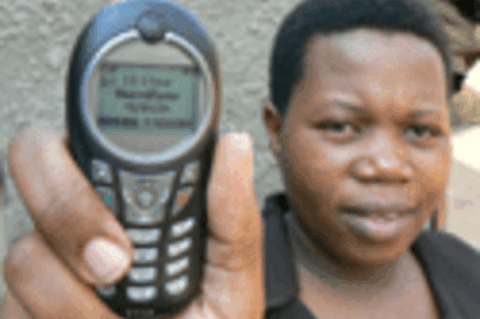
This initiative is based on the belief that all non-profits, whatever their size and wherever they operate, should be given the opportunity to implement the latest mobile technologies in their work, and actively seeks to provide the tools and the environment to enable them to do so. With a key focus on developing countries, and a particular emphasis on low-cost, grassroots, sustainable solutions, kiwanja.net's work is centred around 3 complementary areas:
- Inform: providing mobile-related information to those who need it most
- Advise: helping them understand that information
- Act: providing the tools to help them act on it
kiwanja pursues these elements in part through its interactive website, which features details about all its own projects as well as a searchable "mobile database" that contains details of projects and reports from around the world which make social and environmental use of mobile technology in fields such as human health, economic empowerment, conservation, education, human rights, and poverty alleviation. Details are provided about the off-the-shelf solutions and services kiwanja.net is developing for the non-governmental organisation (NGO) sector as part of its "low cost, high impact" ethic. These solutions include FrontlineSMS, which provides access to the communication tool of short messaging service (SMS). The mobile gallery contains a range of high resolution mobile-phone-related images. Intended audiences are NGOs, non-profits, students, and mobile- or ICT-related news organisations looking for royalty-free photographs for use in brochures, general literature, websites, essays, project reports and proposals, and news articles. The site also features a blog, which supplements kiwanja's social networks (on Facebook: the FrontlineSMS Supporters Group, The Social Mobile Group, and the Silverbackers Group). Kiwanja.net also has a presence on Twitter. Furthermore, people are encouraged to add links to their own websites, contribute a photo, help with research, and/or share thoughts on how technology can provide social benefit.
kiwanja.net uses the strategy of awards and recognition to stimulate creative thinking and action. nGOmobile is a competition designed to encourage grassroots, non-profit organisations in the developing world to think about how text messaging could benefit them and their work with conservation and other development issues. Launched in the autumn of 2007, nGOmobile awards prizes of laptop computers, mobile phones, global system for mobile (GSM) modems, software, and cash to 4 NGOs who come up with the most innovative application ideas.
kiwanja.net's Silverback is a mobile phone game, free to download, with multiple levels that teaches people about gorilla conservation. Taking the player from a juvenile gorilla to a fully-mature silverback, the game highlights threats to gorillas in the wild, and contains numerous help screens and gorilla facts. Silverback was launched in the spring of 2008 in response to the escalating conflict in the Democratic Republic of Congo (DRC), home to the last remaining mountain gorilla populations.
kiwanja.net is working with mobile practitioners, researchers, developers, bloggers, academics, development experts, and the general public to create a community of people interested in the use of mobile technology for positive social and environmental change in the developing world. For details, click here.
kiwanja.net's mobility project is a collaborative project which brings together academics, technicians, educators, and practitioners in the information technology (IT) and mobile fields with the common goal of developing an empowering range of tools and resources to unlock the power of mobile applications development for users in the developing world. The focus is on two key areas: the development of mobile-based programming tools, and the development of an online mobile phone programming curriculum.
Click here for further details on kiwanja.net's current projects; click here for information on past initiatives.
kiwanja also regularly gives talks at international workshops, conferences, and events on a wide range of mobile-related topics, including grassroots mobile innovation, the use of mobile phones in international conservation and development efforts, FrontlineSMS, and the role of anthropology in the social mobile space.
Technology.
As of this writing, kiwanja.net has 2,000 members, who are researchers, practitioners, bloggers, ICT professionals, developers, authors, and members of the general public interested in the social mobile space.
kiwanja.net believes in appropriate technologies which are primarily needs- or people-driven rather than technology-driven. "We must not forget where conservation and development work takes place - usually in the field and often under difficult and challenging conditions - and ensure that the needs of our foot soldiers are not forgotten in the clamour to develop high-end, bandwidth-intensive, hardware-hungry devices and services. And we must stop re-inventing wheels, communicate more, realise that our work is not a race to get 'there' first, go back to basics, face up to our failures and ensure that our projects are sustainable - financially, yes - but also through the sharing of skills, knowledge and experiences with the people in the countries where we work..."
Editor's note: In order to contact kiwanja.net via email, please send a note to ken[dot]banks[at]kiwanja.net
kiwanja.net website; and email from Ken Banks to The Communication Initiative on March 26 2009.
- Log in to post comments