










































Knowledge and Attitudes about the Flu Vaccine among Pregnant Women in the Valencian Community (Spain)
Hospital Universitario del Vinalopó (Rodríguez-Blanco); Universidad CEU Cardenal Herrera (Rodríguez-Blanco); Cátedra Balmis de Vacunología. University of Alicante (Tuells)
"It is important to understand the reasons for the behavior of rejection of this vaccine, as an opportunity for modifying said behaviors..."
At present, vaccine coverage and the acceptance of vaccines during pregnancy is sub-optimal due, in general, to the fear of adverse effects and the lack of information or advice from health professionals. The objective of this research was to estimate the degree of acceptance of the flu vaccine and to analyse the reasons behind hesitancy around, or rejection of, the vaccine during the pregnancy of a sample of expectant women in two health departments, Torrevieja (TV) and Elche-Crevillente (EC) from the Valencian Community (VC, Spain).
A prospective observational study was conducted during the 2015-2016 flu season campaign (October 15 2015 to January 31 2016) in two health departments (TV and EC), which were comprised of 10 primary care health centres. The midwives from these centres were trained on flu vaccine advice. They then offered flu vaccine advice during monitoring visits to 1,017 expectant women and afterwards conducted a telephone poll of 683 of the women in order to find out their reasons for accepting or rejecting the vaccine.
Opinions on vaccines in general were favourable or very favourable for 88.0% (n = 601, 95% confidence interval (CI): 85.4-90.6) of the expectant women, and 98.5% (n = 673, 95% CI: 97.6-99.4) manifested having received all vaccines according to the vaccination calendar, throughout their lives. Of the women who received flu advice about the vaccine from the midwife, 77.4% (95% CI: 74.8-79.9%) declared their intention to vaccinate. After the recommendation, the vaccine coverage among the women polled was 61.6%, with a percentage of accordance of 98.8% (95% CI: 98.0-99.6%) between the coverage declared and the Nominal Vaccination Registry (NVR) of the VC.
Most were aware of the recommendation and identified the health centre and the midwife as the main sources of information, followed by friends and family. The internet was also a consistent source in favour of vaccination 80.8% (n = 42). This latter finding "underlines the importance of the proactivity of the health professionals in the medical offices and the need to bring positive messages to the public sphere through social networks and the internet, two key elements for obtaining an optimal vaccination coverage."
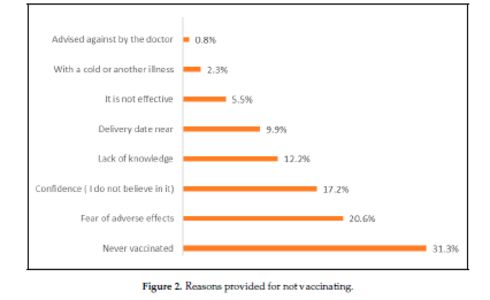
The reasons for non-vaccination were: "not having previously received the flu vaccine", 31.3% (n = 82); "fear of the adverse effects of the vaccine", 20.6% (n = 54); and "the low confidence on the vaccine", 17.2% (n = 45). Only 12.2% (n = 32) affirmed not vaccinating due to not receiving advice from the health professional. Other reasons cited were: "giving birth before the vaccination appointment", 9.9% (n = 26) and the "belief that the flu vaccine is not effective", 5.5% (n = 15).
In light of the results obtained in this work, and after a literature review, the researchers group the factors related to flu vaccination in pregnant women into 4 categories: (i) the setting (e.g., the "calendar effect", where the professional's recommendation decreases as the campaign moves forward, affects final vaccination coverage); (ii) the pregnancy (e.g., women perceived the vaccination as something that was not necessary for the pregnancy); (iii) the health professionals (e.g., the midwife, in her monitoring and counseling role during the process of monitoring of the pregnancy, significantly increased vaccine coverage in this study); and (iv) the fetus/newborn (e.g., health professionals must explain the benefits of the flu vaccine for the fetus to prevent the mistaken belief that the mother is the sole beneficiary).
In conclusion: "Ensuring that the flu vaccine is perceived as more effective and acceptable through the messages directed towards the expectant mothers, directly through the midwives or through the communication media and social networks, will result in an increase of vaccine coverage." The hope is that this study can serve as the basis for the development of more effective strategies when providing health recommendations to women of childbearing age.
Medicina 2019, 55(8), 467; https://doi.org/10.3390/medicina55080467
- Log in to post comments