










































'As Long as It Comes off as a Cigarette Ad, Not a Civil Rights Message': Gender, Inequality and the Commercial Determinants of Health
University of Edinburgh (Hill); Australian National University (Friel); SPECTRUM (Shaping Public Health Policies to Reduce Inequalities and Harm) Consortium (Hill, Friel)
"The commercial determinants of health present a major challenge for governments in seeking to protect and promote the health of women, men and all citizens. They deserve our scrutiny."
To date, the field of scholarship exploring commercial determinants of health (CDoH) has primarily focused on the multiple ways in which corporate policies, practices, and products influence people's health. This paper brings to bear on the analysis the ways in which CDoH intersects with gender - a social determinant of health that, through prevailing expectations of behaviour (norms), can engage with and impact on inequalities and health. Specifically, it examines the ways in which corporations encourage women's consumption of unhealthy commodities - alcohol and tobacco - through the creation and reinforcement of gendered norms and stereotypes. The analysis also highlights the ways in which corporations shape institutional and policy settings, which in turn can undermine the health of women and girls and exacerbate global health inequities.
Drawing on research from diverse fields - including, for example, industry documents and market research - the review includes 3 sections. The first part describes the practices by which CDoH seek to influence potential consumers, highlighting how these practices interact with and reinforce gender inequalities in social expectations, roles, and aspirations. Specifically, the researchers examine how gendered messaging has featured strongly, for many decades, in both tobacco and alcohol marketing - and the ways in which female-targeted marketing has evolved in line with changing social norms. For instance, women have increasingly been encouraged in these types of ads to express their freedom and individuality through their consumption of the products, while continuing to be represented as a fashionable, slim, and sexually attractive ideal. In other words, "unhealthy commodity industries are willing to associate their brands with discourses of empowerment so long as these align with prevailing social norms and do not actually challenge dominant systems of privilege and subordination."
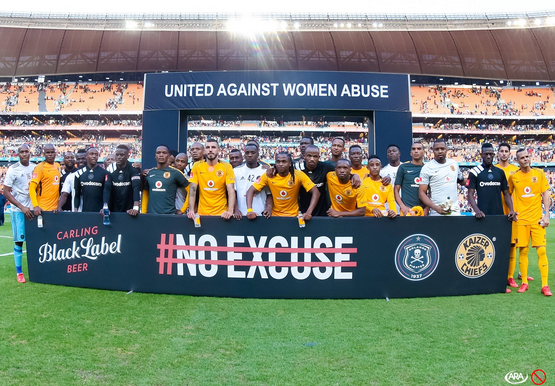
As pressure has built over time for governments to restrict the advertising of unhealthy commodities, many companies have sought to support their image as social partners and reduce the likelihood of regulatory controls on their activities through corporate social responsibility (CSR) activities and donations. Both the alcohol and tobacco industries have increasingly focused their CSR activities on the promotion of women's causes and female "empowerment" in low- and middle-income countries (LMICs), where women represent a growing market. Meanwhile, these practices link women's emancipation to consumption of potentially addictive substances, while reinforcing gendered expectations and stereotypes - and making a profit. For example, the global beer company AB InBev took a high-profile role in South Africa's #NoExcuse campaign against gender-based violence (GBV; see image above). Per the researchers: "Initiatives such as these serve to create a 'responsible' public profile for alcohol companies while simultaneously promoting their reputation and brands...and distracting from the role of alcohol in violence against women..."
The second section examines CDoH's more subtle, yet still insidious, strategies to maintain their structural power. The researchers argue that these practices "create the conditions that exacerbate gender inequities, undermining various social determinants of health for girls and women." Reviewing the feminist critique of capitalism and economic globalisation, they explain that "the strategic actions of powerful corporate entities (including multinational tobacco and alcohol companies) reinforce a prevailing philosophy that privileges economic objectives and market freedom over other social goals, thus buttressing structural inequalities between women and men." One example is the dominance of men in corporate positions of power, which reinforces a more aggressive and confrontational culture in many workplaces. This type of culture can lead to the marginalisation of women's concerns and causes, "perpetuating a structurally-embedded gender bias that contributes to gender inequalities in the social determinants of health."
Specifically, the researchers illustrate how corporate actors pursue strategic growth in emerging markets, create new markets among female consumers, actively resist market regulation, and use tactics in LMICs that are restricted in high-income countries. As an example of the latter tactic: In the Philippines, billboards advertising brandy used the tagline, "Have you tasted a 15 year-old?" When the campaign was challenged following complaints from local women's groups, the manufacturer defended the campaign by claiming no sexual innuendo was intended. The researchers argue that these types of industry strategies have had damaging effects on women's health. For instance, evidence indicates the expansion of multinational cigarette and alcohol companies into emerging markets, where women have traditionally had very low levels of tobacco and alcohol use, has been particularly detrimental. While it is difficult to find direct evidence of how specific industries impact gender inequalities, the researchers point to broader evidence concerning the impacts of economic globalisation on gender inequalities in income, status, and influence.
The effectiveness of these sometimes-invisible strategies is reinforced by "a predominantly neoliberal understanding of social dynamics, which interprets freedoms and responsibilities primarily in terms of individual actions". An illustration of this concept is industry-funded campaigns that emphasise individual responsibility in avoiding alcohol-related harm. However, "there is indirect evidence that campaigns focused on 'binge' or unsafe drinking may reinforce gendered stereotypes by disproportionately presenting young women as 'guilty' of such behaviours..."
The final section outlines the need for more research is needed to unpack the pathways between CDoH and gender inequalities in health, and to inform efforts to address these inequalities. For example, research could be conducted to understand how the dominance of large corporate actors shapes structural gender dynamics in ways that undermine the capabilities of men as well as women. Advocacy organisations such as Promundo have highlighted the impacts of harmful masculine norms, more generally, and the need for gender-transformative approaches.
In conclusion: "The addictive nature of nicotine means the tobacco industry is relatively resilient to economic recession, with business analysts predicting it will do better than most in the wake of COVID-19....Whatever other challenges we can anticipate in future decades, the commercial determinants of health will continue to exert a powerful influence on the health of women and men."
International Journal of Environmental Research and Public Health 2020, 17, 7902; doi:10.3390/ijerph17217902. Image credit: Posted on the Carling Black Label South Africa Facebook page, March 3 2018 - accessed on November 2 2020.