










































Media Framing of Human Papillomavirus (HPV) Health Issues and HPV Vaccine-Related Sentiment in English Language News Media in India (2015-2018)
School of Communication Studies, Panjab University
The news media play a crucial role in shaping public perception of risks and health beliefs. Health behaviour associated with the causes of human papillomavirus (HPV) infection and HPV vaccine uptake in a population are influenced by the public perception of the risks of HPV infections and beliefs related to the efficacy of HPV vaccine. While research on HPV and HPV-vaccine-related messages in Indian media is lacking, negative information regarding vaccines and immunisation have been found on Indian online and web-based media. Research shows that negative news coverage can generate a negative information loop, beginning with a negative media report about a vaccine and leading to a spike in adverse events reporting post-vaccination. Consequently, there is a drop in vaccine uptake, inviting more negative media coverage. With its theoretical base in the concept of media influence and the ecological model of health behaviour, this study analyses the media coverage of HPV-related issues and HPV vaccine-related sentiment in English language news media in India from 2015 to 2018.
In 2017, India's National Technical Advisory Group on Immunization (NTAGI) recommended that the HPV vaccine be added to the Universal Immunization Program (UIP). (The Indian states of Delhi and Punjab have introduced the vaccine for adolescent girls in their immunisation programme as an optional vaccine.) However, the Government of India has refrained from including the vaccine in the UIP due to:
- In 2009, a feasibility study of the HPV vaccine conducted by an American non-profit organisation, Program for Appropriate Technology in Health (PATH), in partnership with the provincial governments of the Indian states of Andhra Pradesh and Gujarat, hit a roadblock following the deaths of 8 pre-adolescent girls, who were among the 24,000 girls who had been administered the vaccine during the study. The Parliamentary Standing Committee of the Ministry of Health and Family Welfare (MHFW), India, highlighted ethical violations committed during the trial conducted jointly by PATH and Indian Council of Medical Research (ICMR). The study was abruptly stopped, even though it was found that the deaths of the adolescent girls were not related to immunisation with the HPV vaccine.
- In 2012, a writ petition filed in the Supreme Court of India called for revoking licenses of the 2 HPV vaccine manufacturers (Merck and GlaxoSmithKline), citing that the then Drug Controller General of India (DCGI) had allegedly approved the vaccine without conducting proper clinical trials and without any evidence of the vaccine's efficacy and safety. The decision is still pending with the apex court of India.
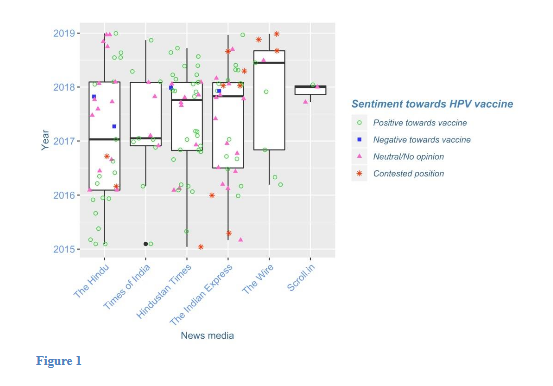
The sampled news media for the study, covering the period 2015-2018, include 4 national daily newspapers, The Hindu, The Times of India, The Indian Express, and Hindustan Times, as well as 2 Indian news websites, The Wire and Scroll.in. The sentiment analysis reveals:
- A prevalence of prevention and awareness messages related to HPV-related issues and the HPV prophylactic vaccine in the HPV-related coverage.
- A predominantly positive sentiment towards the HPV vaccine with a marginal presence of thematically framed negative and contested opinion against the vaccine. (For example, among the 61 news items that focused on the HPV vaccine, 41 news items (67.2%) carried a positive sentiment towards the vaccine (e.g., mentioned the efficacy and importance of HPV vaccine as a potent prophylactic against HPV-related disease). All the stories with negative sentiment included references to the 2009 HPV vaccine trial controversy in India, and associated vaccine inefficacy with the alleged ethical violations in the trials.)
- A prevalence of authoritative frames, with medical professionals amongst the most attributed sources within news items (26%), and an absence of the public, the patient, or the individual opinion and voice.
- Routine coverage in a national or global context, while regional and local perspectives were sparse.
- Framing within an economic determinants of health (DOH) category, which suggests that the media's perception of economic factors, such as the cost of the vaccine and affordability of health services and interventions, are front of mind in a low-income country like India.
- Extensive use of the category of behavioural DOH (e.g., sexual behaviour (specifically, having multiple sex partners and unprotected sex), as a high-risk factor in HPV-related diseases) to establish responsibility in HPV-related health status. ("The prevalence of an authoritative framing of the HPV-related issues using behavioral determinants of health by media, as seen in the studied sample, necessitates a critical examination of attribution of responsibility and its affect on public policy, public perception and health behavior.")
In conclusion: "Since the results of this study are based on a selected sample of the English language news media in India, it is recommended that the results be used as probes for studying HPV-related coverage in the vernacular press, online media and social media as well."
International Journal of Scientific and Research Publications, Volume 10, Issue 1, January 2020. ISSN 2250-3153. http://dx.doi.org/10.29322/IJSRP.10.01.2020.p9778.
- Log in to post comments