










































Media Matters
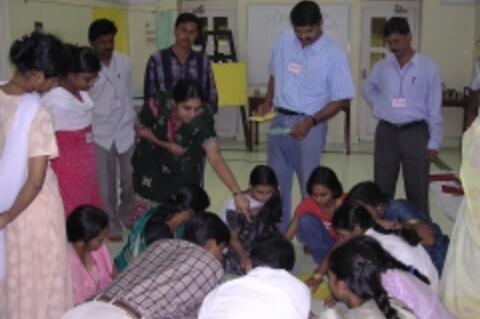
The core of Media Matters' work is participatory theatre. In 1996, an informal process with a youth group resulted in "Chhi!", a one-act play in Hindi on the issue of solid waste management. The story revolved around the struggle of a theatre group to create a socially relevant play. A 2-year long process and over 50 performances later, Media Matters formally came into being. Examples of related efforts include: "Geeta, ek glass pani...", a campaign play on the issue of child domestic work in Thane city; "Jeeeti Raho!", a narrative about the relationship and struggle among 3 generations of women that explores the issue of sex selection; "Mulichayya Jatila He Shobat Nahi!", a play about the dreams, aspirations, and struggle of adolescent girls; an anti-liquor play with women in Pune district of Maharashtra; a process to prepare college-going youth to perform for a HIV/AIDS campaign in Mumbai; a process wherein village women struggled to "perform" for the first time in their lives in Uttar Pradesh; orientation of theatre groups to perform on key behaviour change issues in Jharkhand; and "kataar!", a 35-minute play in Hindi that provokes a rethink on issues related to right to information.
To elaborate on the process, using the latter example, "kataar!" was created through a workshop process with a group of 9 women and men in the 17-26 age group from the Mumbai-Thane region. Over a 3-month period, they designed and scripted the play, all the while learning about issues related to the right to information and enhancing their skills in facilitating post-performance discussions. These discussions with the audience create the space and opportunity to share experiences and to dialogue on the right to information act. (Editor's note: Media Matters offers to perform this play for other groups and communities, for a fee. Various suggestions are offered to spark interest in the performance at a community level, such as involving local volunteers and groups in planning and publicity of the show through blackboards/notice boards, invitations, dawandi, megaphones, etc. A template of a poster and flyer in PDF format of the play is available. Please see the contact details below to inquire).
Media Matters believes in a learning-centred approach to capacity building. The effort is towards creating space and opportunities for participants to share, dialogue, and discover for themselves. "We strive for an environment that is enabling, content that is relevant, methodology that encourages participation, and facilitation that respects the learner.
We have designed, organised and facilitated a wide range of need-based capacity building programmes child rights, child participation, school in development, adolescent life skills, youth in development, gender, women & community empowerment, reproductive rights, communication skills, counseling skills, facilitation skills, communication strategy and planning, and advocacy." For example, Media Matters has developed a 6-month full-time para-professional course on development, and also offers annual 6-day residential workshops in Participatory Communication & Action and Theatre for Development. Other offerings have included "Children Can!", a workshop on facilitating child participation, as well as a workshop on designing a community-led advocacy strategy.
Media Matters also develops various communication resources in an effort to facilitate dialogue. In doing so, the organisation seeks to move away from monologue, away from the use of communication resources for delivery of "key messages". Specifically, "[w]e believe groups and communities have the capacity to bring about and manage change. Communication resources therefore should support such a process through reflection, exchange of knowledge, beliefs and experiences, initiating a dialogue that could lead to action. We strive to design and develop media and communication resources that create space for voices that are unheard, in local language, sharing of concerns and aspirations, critical thinking and negotiation. We seek to explore and experiment so that groups and communities can not only review and adapt the existing resources to their own context but also gain the skills to create their own area-specific and need-based communication resources." These communication and facilitation resources are designed to support group and community processes, events, and campaigns on children and rights, gender and participation, reproductive health as a right, HIV/AIDS and youth, adolescents and life skills, solid waste management in urban areas, and male participation in reproductive health.
At Media Matters, research and process documentation (R&PD) is an ongoing process, integrated into all projects and processes. Most of this R&PD work is participatory, and is designed to explore various tools and methods to engage groups in reflection, review, and analysis. Studies have focused on working with groups and communities to understand their views and opinions on issues and bring about a dialogue for change. "This ongoing process enables ownership by the stakeholders and throws new questions and challenges for the project team, thereby building a better understanding of issues and concerns addressed by the projects and processes. These learnings feed in to the existing and future projects, programmes, and social development interventions." Examples of research work include: a study of media, methods, and audiences in 3 districts of Maharashtra; a study to understand the status of children in domestic work in Thane city; a study carried out to assess the listenership of All India Radio in 3 districts of Maharashtra; participatory learning and action (PLA) with women self-help groups (SHGs) to understand reproductive health, rights, access to different contraceptive methods, and their contraceptive preferences. "Daring to Dream" is a documentation of best practices adopted by 13 rural hospitals in 3 districts of Maharashtra; "In Other Words..." is a documentation of the real-life struggles, achievements, and dreams of 12 working children in 3 states; "Whose Dream Counts?" documents PLA processes facilitated with children's groups at the community level; "Suno Sunate Hein!" is a photo-documentary of a city-level campaign to promote rights of the child; and "Yuvashakti" is an audio documentation of a radio programme on the role of youth village volunteers in village planning, in 3 districts of Maharashtra.
Media Matters has also made documentaries and docu-fiction on a range of issues to capture learnings of community processes and to bring issues to the fore. Media Matters documentaries have focused on capturing voices from the community, thereby providing an opportunity for viewers to reflect, think, and draw their own conclusions on controversial issues through post-screening discussions and dialogue. The issue-based documentaries and participatory video projects have taken the form of issues related to children and child rights; water and sanitation, cleanliness, and solid waste management; adolescent girls; and HIV, AIDS, and counselling.
Rights, Environment, Children, Youth, Reproductive Health, HIV/AIDS.
Email from Media Matters to The Communication Initiative on November 13 2008; and Media Matters website.
Comments

script in hindi to motivate the adolscent girls.
i want to prepare a drama to motivate the girls in our society and which will teach their parent and even the society and also what is the importance their education in their own development and also their contribution in nation development.it must be small drama with a big message.
- Log in to post comments