










































Mining Google Trends Data for Health Information: The Case of the Irish "CervicalCheck" Screening Programme Revelations
University College Cork
"The CervicalCheck controversy was a public event which was high on emotion and low on reliable information. This, in turn, led to a media storm which propagated anxiety amongst the population, as is indicated by the results of this study."
"CervicalCheck" is an Irish national screening programme that allows women aged 25-60 years old to avail of a free cervical smear test. In April 2018, it was revealed that roughly 220 women with cervical cancer were never informed that their negative smear test results were inaccurate, which, in concert with a lack of publicly available information, led to a media frenzy. Contributing to public anxiety around the issue was the trajectory of Ireland's school-based human papillomavirus (HPV) vaccination programme. Launched in 2010 for girls aged 12-13 years, the programme initially enjoyed compliance of 80%, with a peak of 86.9% in 2014-2015. This success was in a climate in which mothers were found to have minimal knowledge of HPV or the vaccine, which left space for anti-vaccination lobby groups to spread misinformation and to lobby for parental choice; in 2016, the compliance rate dropped to around 50%. The present study used Irish Google search trends in the wake of the CervicalCheck revelations and the drop in HPV vaccination rates as a proxy for public interest.
Irish relative search volume data for several terms relating to cervical testing/cancer and HPV were extracted from the Google Trends website for a 5-year period from February 2014 to January 2019 and analysed for the presence of anomalous spikes and shifts in the mean baseline.
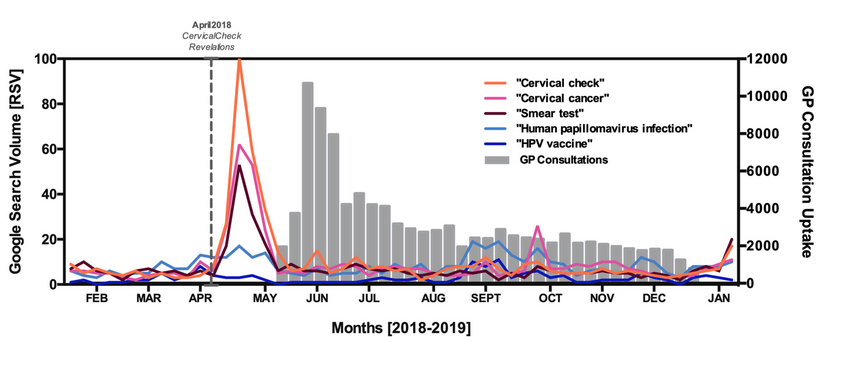
The simplified timeline of the CervicalCheck revelations is presented in Figure 1 of the paper, demonstrating: the initial reporting in April 2018; subsequent commencement of general practitioner (GP) consultations the following month; publication in September 2018 of a report examining the events surrounding the CervicalCheck failures; the death of a high-profile victim in October 2018; and re-ignition of public discontent in January 2019 due to lack of progress.
The results found an unprecedented, short-lived (4- to 5-week) positive spike in searches relating to cervical testing/cancer immediately after the CervicalCheck revelations, which remained anomalous for the month to follow (p < 0.05). This public interest preceded a mirroring increase in uptake of complimentary consultations offered by the Department of Health to the women concerned: Almost 350,000 smear tests were ordered in Ireland in 2018, representing a ~40% increase in the annual testing rate.
Despite this service engagement and interest in cervical health, the relative search volumes for terms "human papillomavirus infection" and "HPV vaccine" were just 78% and 51% of their maximum search volume for the 5-year period. Due to the considerable media attention afforded to the anti-vaccination lobby groups in previous years, the researchers observed a number of anomalous search weeks for these two phrases from August 2015 onwards, but searches for both terms peaked in September 2017 and failed to reach similar levels thereafter.
Taken together, these findings suggest that the Irish public did not seek information on HPV and cervical testing/cancer concurrently, indicating that many may not connect the two issues. That is, "the Irish public did not demonstrate a heightened awareness of the primary prevention scheme for the main etiological contributor of the disease. The HPV vaccination programme has encountered challenging times in the past two years and, as a result, the HPV Vaccine Alliance was established in 2017 to present the facts about HPV vaccination in the factsheet and infographic-style outreach projects. Although efforts in educating the public appear to have stemmed the tide, the hangover from the anti-vaccination lobby groups is clear as uptake rates remain wholly inadequate."
The researchers suggest that more public education and promotion of the HPV vaccine is warranted, particularly in the context of vastly reduced uptake in recent years. Specifically, "vaccine advocacy groups should address the apparent understanding deficit and utilise high-profile publicity to reiterate the connection of HPV and cervical cancer to the public, in order to promote the national primary prevention scheme. This type of advocacy should be clear, factual and presented in a manner which does not detract from the suffering of those who were failed by the CervicalCheck programme."
In conclusion: "Google Trends data represents a free an open source means by which to assess information-seeking behaviour of the public in relation to health and disease."
Cureus 11(8): e5513. doi:10.7759/cureus.5513.
- Log in to post comments