










































"The Needle Is Already Ready to Go": Communities' and Health Care Professionals' Perceptions of Routine Vaccination in Nunavik, Canada
Institut national de santé publique du Québec (Dubé); Université Laval (Dubé, Lyonnais); Université du Québec en Abitibi-Témiscamingue (Renaud, Fletcher); Centre de recherche du CHU de Québec-Université Laval (Pelletier, Fletcher)
"Improving vaccination coverage in Nunavik requires a more global reflection on how to improve and culturally adapt the health care and services offered to the Inuit population."
Indigenous Peoples in Canada, including First Nations, Métis, and Inuit, experience health inequalities that are the consequence of a multitude of historical, cultural, and structural factors. Reports have shown that Indigenous communities have had traumatic experiences with the healthcare system, a system actively involved in colonial efforts, notably by enforcing medical experiments such as vaccine trials. In light of findings that these communities have a higher level of vaccine hesitancy and lower vaccine uptake rates, this study explores the perceptions and determinants of routine vaccination among Inuit in the northern region of Nunavik by describing factors influencing vaccination decisions from the perspective of community members and health professionals.
The study is grounded in the socio-ecological model (SEM), which postulates that health is determined by a multitude of interrelated factors acting at different levels. According to the SEM, the adoption of health behaviour such as vaccination is influenced by intrapersonal (individuals' characteristics, such as biological determinants, perceptions, and knowledge); interpersonal (relationships and social networks); organisational (characteristics of institutions and services); community (sociocultural factors); and public policy (laws and policies at local, state, and national levels) factors. In this article, to simplify the presentation of findings, the intrapersonal and interpersonal levels are merged, as are the community and public policy levels.
Semi-structured interviews were conducted virtually between October 2020 and January 2021 with 18 Inuit and 11 non-Inuit health professionals.
A lack of trust in the healthcare system emerged from the interviews. Participants associated this lack of trust with history (and ongoing) issues of colonialism, discrimination, and systemic racism. Although childhood immunisation is well regarded and accepted, several Inuit participants said they felt pressured to accept vaccination. Outright refusal is not uncommon, and professionals noted that it was often difficult or impossible to identify the reasons behind the refusal.
Barriers and enabling conditions of vaccination in Nunavik are outlined, using the SEM. Factors acting at the community and public policy (e.g., rumours and misinformation about vaccination, language barriers), organisational (e.g., complexity of the vaccination process, staff turnover, lack of specialised vaccination workers and interpreters), and intrapersonal and interpersonal (e.g., past experiences with vaccination, vaccine attitudes, social norms) levels were identified as having an impact on vaccination decisions.
Many opportunities to enhance vaccine acceptance and uptake were identified:
At the policy and community levels:
- Health professionals mentioned that Inuit have a different conception of health than in biomedicine and that many adhere to a more traditional way of life. Many participants thus suggested reviewing how vaccination is introduced to Nunavimmiut. Several ideas were mentioned. For example, adapting practices to the cultural context by offering vaccination in workshops or informal gatherings rather than in an appointment, learning a few words in Inuktitut, and drawing parallels to concepts that Inuit understand and that can increase their interest in vaccination.
- Health professionals also mentioned the need to involve and mobilise Nunavimmiut, since they are the experts on their health. Some participants suggested offering a specific health training programme for the Inuit; to be able to offer health care by local people who are aware of the reality experienced by the community could be beneficial.
- Increased collaboration with community leaders is also needed, according to participants. For example, having the support of an elder who has witnessed vaccine-preventable diseases and can share his or her stories about them can be a powerful vaccine promotion tool due to the high status of elders in Inuit communities.
- One Nunavimmiut suggested raising awareness about online misinformation and improving digital literacy among the communities.
At the organisational level:
- Some health professionals mentioned the importance of the role of community wellness workers and interpreters. Because they are people from the communities, patients identify more with them and are more receptive to the information they provide.
- Several Inuit participants expressed a desire for more information about the content and side effects of vaccines. Although pamphlets are usually offered at appointments, some health professionals pointed out that they are not widely read because Inuit prefer to communicate orally. It was suggested by many to use different communication channels, such as the radio, which is listened to by almost everyone. Offering more information through social media was also an idea brought by some participants.
At the intrapersonal and interpersonal levels:
- Positive attitudes towards vaccination can play a key role in decision-making. Among the Inuit participants, some mentioned the desire to protect their health, the health of their children, and the health of the community. In that sense, strategies should be put in place to increase Inuit awareness of the benefits of vaccination, not only on individual health but also on community immunity.
- Trust is important. Recommendations from a health professional who has been working in a community for a long time and are well known are usually very well respected. According to health professionals, fostering staff retention would allow professionals to establish and maintain trust with their patients, as well as earn the respect of the community in which they practice, which would, ultimately, enhance vaccine acceptance and uptake.
The key finding of this study is the importance of sociocultural factors underlying vaccination decisions, a cross-cutting theme in the findings. As shown in different studies conducted during outbreaks, vaccine refusals can be understood as legitimate and rational decisions, given how Inuit people were treated by the colonial health services and given the issues they are still facing today in access to health care. The Canadian health care system is structured around a health biomedical approach that does not consider the Inuit's holistic vision of health, which connects several dimensions (e.g., cultural, social, environmental, and spiritual). Most of the suggested strategies cited by participants aim to address this non-culturally safe care and refer to the broader concept of decolonising health care.
"In conclusion, this study...showed a multitude of interrelated factors acting at different levels. Although some barriers to accessing vaccination services were identified, many of the factors and perceptions reported appear to be rooted in colonialism, which continues to have consequences on Inuit health. Interventions to improve access to vaccination services are needed. But if real progress is to be made, what is more urgently needed are efforts to improve health services by making them culturally appropriate and free from discrimination and racism."
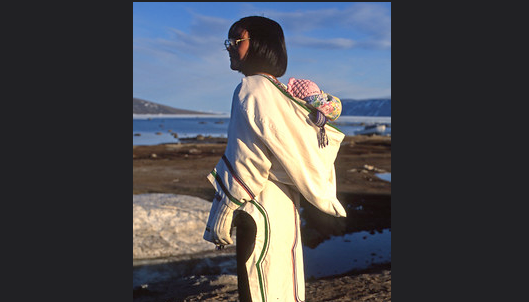
International Journal of Circumpolar Health 2024, Vol. 83, 2295042. https://doi.org/10.1080/22423982.2023.2295042. Image caption/credit: Inuit woman carrying her child, Clyde River, Nunavut, Canada. Peter Prokosch via GRID-Arendal on Flickr (CC BY-NC-SA 2.0 Deed)
- Log in to post comments