










































Online Media Use and HPV Vaccination Intentions in Mainland China: Integrating Marketing and Communication Perspectives to Improve Public Health
Pennsylvania State University
"The results...give credence to incorporating an interdisciplinary perspective to understand why individuals in a country with a scarce supply of the HPV vaccine seek it out."
Since the human papillomavirus (HPV) vaccine is relatively new for residents of mainland China, residents of the country are likely turning to the internet and social media to seek information about the HPV vaccine. Overall, examinations of online information have suggested that the HPV vaccine is welcome but expensive and scarce in mainland China. As such, the present study examines the role of media in shaping HPV intentions in mainland China by applying both communication and marketing-focused theoretical frameworks in order to better understand ways to increase vaccine uptake among young Chinese men and women.
The paper begins with an overview of the conceptual frameworks and considerations that guide the study, including:
- Commodity theory: This suggests that the more limited and resource-intensive the commodity (the vaccine) is perceived to be, the more valuable it is in the eyes of consumers.
- Cultivation theory: The core argument is that people rely on information from the media to understand and think about the world around them. The perception of social reality stored in one's memory can affect decision making and behaviour.
- Influence of presumed influence (IPI) model: Derived from third-person effects (TPEs) research, IPI suggests that the more time people spend consuming specific media messages, the more likely they are to believe that other people are also frequently exposed to similar content. This belief leads to speculation that others are strongly influenced by that media exposure, which subsequently impacts the individual's own attitudes and behaviours.
- Gender differences: Little media coverage in China suggests that men should also be vaccinated against HPV.
- Age, education, and income: These factors could also influence perceptions that result in vaccination intentions. For example, the HPV vaccine is not free in mainland China and can be quite expensive.
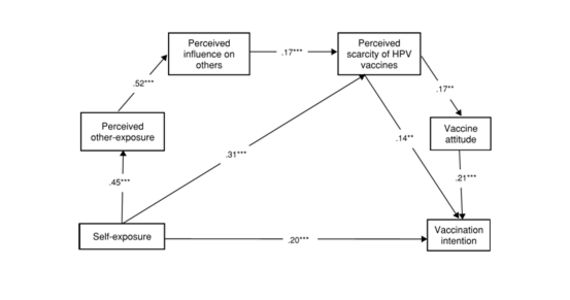
Although the HPV vaccine in China is accessible to people aged 9-45, the online survey included respondents aged 18-33 (n = 359), because adolescents' perceptions of health issues can be significantly influenced by their parents. Figure 2, above, shows the path analysis, which reveals, in short:
- Respondents' self-exposure to online content regarding the HPV vaccine is directly related to their intentions to be vaccinated: People who are frequently exposed to online content regarding the HPV vaccine are more willing to take the vaccine in comparison with light viewers. (One potential explanation is that Chinese news outlets generally frame the vaccine in a favourable tone.)
- With regard to cultivation effects, higher levels of self-exposure to online content regarding the HPV vaccine is a positive predator of perceived scarcity of the vaccine in mainland China: The researchers note there is a significant proportion of online news and consumer-generated content commenting on the HPV vaccine shortage on the mainland. People who are heavily exposed to these messages are likely to regard the vaccine as a valuable commodity, as not everyone is capable of getting it.
- The scarcity perception, in turn, is positively related to respondents' attitudes toward the vaccine: People who perceived the HPV vaccine as scarce and rare in mainland China tend to have positive vaccine attitudes, which in turn enhances intentions to be vaccinated. The indirect effect is significant in the model.
- Regarding the IPI, higher levels of respondents' self-exposure to online content regarding the HPV vaccine is positively related to perceived other-exposure to these messages.
- The perception of other-exposure significantly increases respondents' perceived media influence on others, which in turn increases their perceived scarcity of the vaccine: Given the fact that China has a large population that places a burden on resources, everyone's basic needs cannot always be met, including vaccination. Perceived scarcity may generate a sense of insecurity and anxiety, causing people to desire the vaccine even more.
- The path of vaccine attitude to vaccination intention is significantly different for women than men: Compared with women, men's intent to be vaccinated is not high, even if they realised the vaccine shortage. Future research could use additional variables, perhaps including social norm perceptions related to other men's acceptance of vaccination, to better predict men's reactions to online vaccine information.
From a marketing perspective, this study suggests that using scarcity appeals may be an effective communication strategy for promoting the HPV vaccine in mainland China. Notably, unlike mainland Chinese individuals, who are worried about the vaccine's unavailability, people in developed countries appear to have more safety concerns about the vaccine. These cross-cultural differences point to the importance of conducting additional research in this area that directly compares media effects across countries. In conclusion: "Future work can build of the findings presented here to help develop campaigns and health interventions aimed at educating and facilitating HPV vaccination in mainland China and in other countries where the vaccine is scarce."
Health Education Research, cyaa002, https://doi.org/10.1093/her/cyaa002.