










































'Our Courage Has Grown': A Grounded Theory Study of Enablers and Barriers to Community Action to Address Violence against Women in Urban India
University College London (Gram, Osrin); Society for Nutrition, Education and Health Action - SNEHA (Paradkar, Daruwalla); London School of Hygiene & Tropical Medicine (Cislaghi)
"Community members play a key role in addressing violence against women, but often need encouragement, support and protection to do so."
Transforming communities into safe and supportive environments for women facing risk of violence has long been a goal for feminist activists and researchers. Violence against women (VAW) is a collective issue for communities and is driven by individual and structural factors requiring action by multiple stakeholders. Thus, mobilising communities to act in the face of VAW requires an understanding of community action. This paper proposes a conceptual model of enablers and barriers to such action based on a study of informal settlements in Mumbai, India.
Interventions that mobilise communities to tackle social and structural drivers of VAW involve communities collaborating with implementing organisations in identifying, prioritising, and tackling causes of the problem based on principles of bottom-up leadership and empowerment. Implementers who have worked with communities to change social norms and promote community action theorise that collective power to create social change arises after a period of awareness raising.
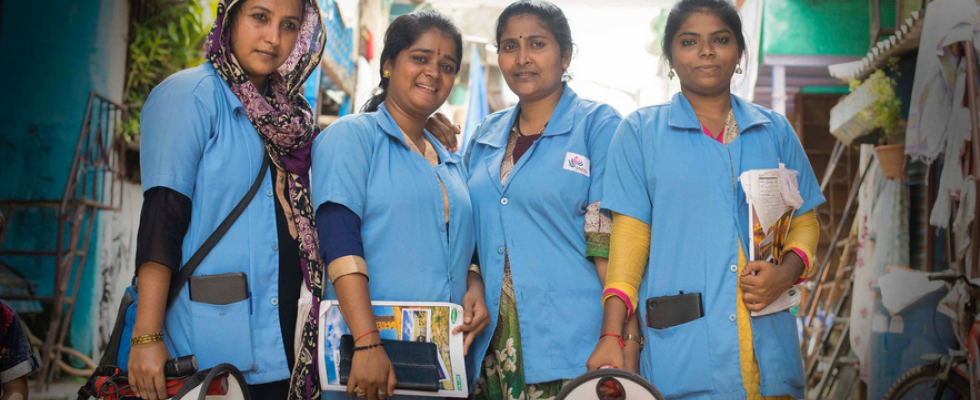
The non-governmental organisation (NGO) Society for Nutrition, Education and Health Action (SNEHA) is implementing a community-based violence prevention programme in Dharavi and Govandi, two large informal settlements in Mumbai. In these settings, transgression of social and gender norms can lead to domestic violence, while the stigma of divorce provides a strong disincentive for survivors to leave abusive marriages. SNEHA's programme involves crisis counselling and community mobilisation, which entails meetings of groups of women, men, and adolescents who discuss community and gender issues with a facilitator and take action to address VAW.
Data collection took place in 2021-2022 in Dharavi and Govandi. The grounded theory study sampled respondents based on exposure to SNEHA's community mobilisation programme using 3 categories: (i) general community members who had little to no exposure, (ii) current members of NGO-run groups, and (iii) community volunteers who have received additional training and support. In all, researchers conducted 27 focus group discussions and 31 semistructured interviews with 113 community members and 9 NGO staff, along with over 170 hours of field observation.
The study found that residents responded to violence in diverse ways, ranging from couple mediation to police and NGO referral. One female volunteer had convened a joint meeting of 10-15 people from a woman's marital and natal homes after a survivor of VAW had tried to poison herself. Through dialogue and diplomacy, she got the husband to agree to stop the abuse.
Enabling and constraining factors to community action fit into a social ecological model containing intrapersonal, immediate social network, and wider societal levels.
The researchers identified 4 themes that interlink the factors:
- Legitimacy of action, or the extent to which action to address VAW was socially constructed as legitimate - Community members questioned not only whether VAW was "wrong", but who was "wrong" in specific disputes. At the wider society level, gendered expectations of male authority and women's fulfilment of domestic roles impacted these assessments.
- Collective power, or the capacity to draw on relationships of trust and solidarity to act through neighbourhood solidarity - For instance, at the intrapersonal level, some respondents described acting out of an urge to help when faced with the scale of other women's suffering.
- Protection against risk, or the degree to which community members were protected from physical, social, and legal protection against reprisal for action - One finding: At the immediate social networks level, showing up in a physical group was more intimidating than a lone intervener and could discourage perpetrators from retaliating.
- Informal leadership, or the extent to which initiators of action became informal leaders - Repeat interveners could develop influential prosocial reputations that incentivised and facilitated action. Broad access to social networks was necessary for the development of informal leadership.
This model integrates multiple perspectives on community action into one analytical framework, which can be used by implementers to ensure that community members receive encouragement, support, and protection to act.
In exploring implications for research and practice, the researchers note, for example, that intervention designers could ground their work in one or more of the 4 core themes described above. They could develop consciousness-raising efforts that involved community members in critiquing specific incidents of violence, not only the general wrongness of violence. They could strengthen police and crime prevention units in order to facilitate neighbourhood solidarity and protection from backlash for interveners. They could support informal leaders with a reputation for tackling VAW to address challenges in encouraging disclosure of VAW. Finally, they could raise awareness on the part of community mobilisers of risks of vigilante violence, in addition to installing safeguards.
BMJ Global Health 2023;8:e011304. doi:10.1136/bmjgh-2022-011304. Image credit: SNEHA
- Log in to post comments