










































The Power of Social Media for HPV Vaccination - Not Fake News!
University of Minnesota
The controversial human papillomavirus (HPV) vaccine is especially well positioned for social media discussion because its introduction to the public coincided with the rise of social media. Social media can be used to communicate healthcare information, including recommendations for HPV vaccination. In this article, Dr. Deanna Teoh suggests that healthcare providers and healthcare organisations need to maximise pro-HPV vaccine messaging and appeal to both logic and emotion to overcome the anti-HPV vaccine messaging that exists on social media.
As Dr. Teoh outlines, the Fogg theory of mass interpersonal communication posits that social media have the ability to combine the credibility of interpersonal persuasion with mass media, resulting in a desired attitude or behaviour change among a large group of people. They accomplish this effect through automated structures (tasks such as "liking" or forwarding are easy), rapid cycles, large social graphs, and measured impact (users are able to visualise a message's impact immediately via the number of "likes", comments, and shares generated). This effect can, unfortunately, be leveraged to disseminate false information ("fake news") and encourage unhealthy practices. This phenomenon is prominent in regard to vaccination, which is associated with a high suspicion about side effects and, when herd immunity is achieved, low risk of disease.
Dr. Teoh explains that the predominant sentiment about the HPV vaccine varies by social media site. For instance, content analyses of text-based Twitter have revealed a higher prevalence of provaccine messages, whereas a content analysis of video-based YouTube showed that a majority (57%) were antivaccine. The messaging strategies used also vary depending on message focus. Fact-based provaccine messages tend to use numbers, whereas antivaccine messages use personal stories detailing how an individual was harmed by the vaccine.
What is the impact of social media on HPV vaccine uptake? An ecologic study of 274 million exposures to more than 258,000 tweets showed a correlation between state-level (in the United States) HPV vaccine coverage and the predominant tone (positive, negative, or mixed) of social media messages about the vaccine to which that state's residents were exposed. Another study found that respondents were more likely to recall information about HPV vaccine harms rather than disease prevention from social media (30% vs. 11%, p < .01) and traditional media (29% vs. 19%, p < .01). In contrast, respondents were more likely to recall vaccine benefits from personal conversations (33% vs. 24% for harms, p < .01). This study also showed an association between HPV vaccine message exposure and parental intention for adolescent vaccination. Although social media messaging promoting the HPV vaccine has been shown to increase knowledge about the vaccine, it has not been shown to increase vaccination rates.
That said, it has been suggested that peer endorsement, a proxy for social support, may reduce social anxiety about receiving the controversial HPV vaccine. Social media comments may also help people overcome logistical barriers by suggesting locations where HPV vaccination is offered at a reduced cost or sliding-scale fee for those without insurance.
Dr. Teoh concludes that the data shared in this article "have important implications for future social media message framing and strategies to encourage HPV vaccination."
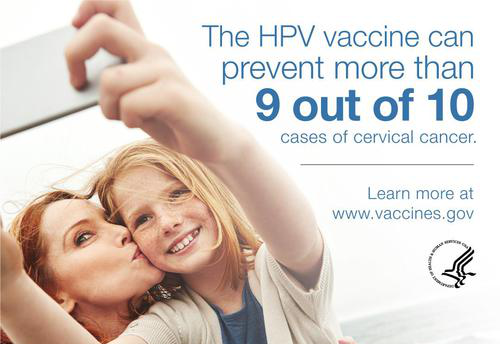
2019 ASCO Educational Book. https://doi.org/10.1200/EDBK_239363. Image credit: Vaccines.gov